Showing posts with label Second Amendment. Show all posts

Sunday, November 15, 2020

Supreme Shift (Part 2): Barrett's Record

(Since the previous post, Amy Coney Barrett was confirmed by the Republican controlled Senate, without a single Democratic, and Republican President Trump who nominated her was defeated in the election by Democratic candidate Joe Biden.  Back to now-Justice Barrett.)

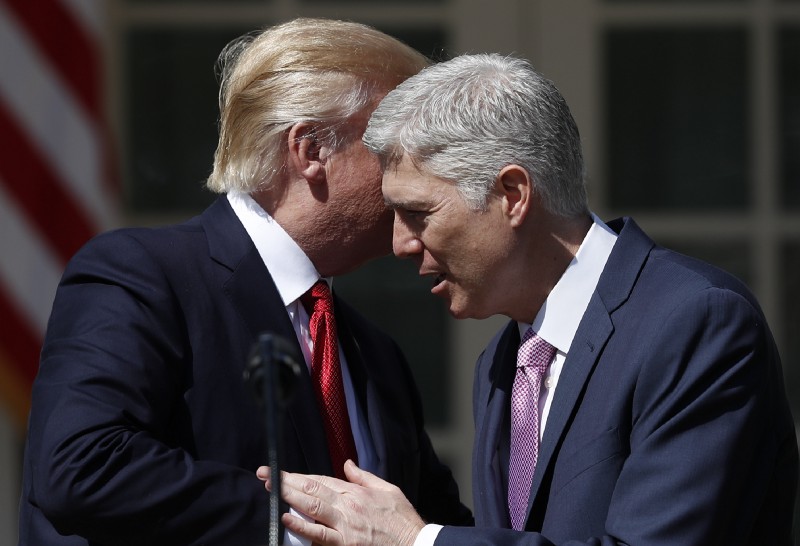
Yuri Gripas/Abaca Press/TNS
In her three years as a federal appellate judge, Amy Coney Barrett established a distinct record. That is--need it be said again--distinctly politically conservative.

And need I repeat, not judicially conservative, as in judicial restraint, strict interpretation, adherence to stare decisis, deference to the laws and policies of the elected branches and the states, textualism, originalism, etc. But politically conservative, as in voting like a conservative Republican politician would vote on the those "hot-button" issues like guns, abortion, immigration, criminal law, etc. Whether that's good or bad, right or wrong, wise or foolish is not the point. It's just what her record is.

From the time she was nominated by President Trump and confirmed by the Senate to the 7th Circuit Court of Appeals in 2017, Barrett disagreed publicly with the majority of her colleagues on that court several times. That is, she dissented either in a separate opinion of her own or, at times, she voted to join a dissent written by others. When she did dissent, it was uniformly for the politically conservative legal result. And as judicial scholars understand, dissents are extremely revealing.

Dissents tell us what it is that a judge thought--oftentimes, felt--was very important. So important that it justified going public with a disagreement. Consider that the dissenting judge is announcing to the world, "I lost." The judge is announcing that, despite having lost the majority vote, "I feel compelled to register a public disagreement."

A public disagreement, that is, instead of going along with the majority. Instead of going along to get along. It entails expending collegial capital. Irritating and, yes, sometimes antagonizing the majority by telling the world that my colleagues on the court are so seriously wrong, about something that is so seriously consequential, that the public must know just how wrong they are and how their decision is so harmful to the law, society, or both.

Beyond that, if the judge who disagrees with the majority is actually authoring a dissenting opinion--i.e., not just voting to join someone else's dissenting opinion--that judge is personally choosing to expend time and effort and the resources of her chambers to engage in a public act of protest. She is not required to do so. There's no institutional requirement or obligatory directive that she must do so. This is purely a matter of personal choice. So too is casting a vote to join another dissenting colleague, even if not as exacting as writing one's own dissenting opinion.

That's a long way of restating that dissents are very revealing. Voting in dissent and, even more so, writing a dissenting opinion.

So let's start looking at then-Judge (now-Justice) Barrett's dissents. Let's consider the common threads. You know: connect the dots. 

Immigration
In several cases, Barrett joined the majority of her colleagues or actually wrote the majority opinion, ruling against immigrants and immigration rights--e.g., approving deportation, despite issues of due process or equal protection or the likelihood of torture upon return to the home country.

But she dissented in one case, Cook County v. Wolf (2020). The majority had ruled for the immigrant.

(click to enlarge)
In that case, the majority of Barrett's court rejected the Trump administration's expansion of the "public charge" rule. That Trump expansion would deny entry to any immigrant who might need any public assistance at any time. That expansive restriction on immigration was held by the majority to be well beyond the authorized bounds of governing immigration law.

Barrett authored a dissenting opinion. She approved the Department of Homeland Security's restrictive rule. She argued that the immigration law should be read to bestow very broad regulatory discretion to the Department, enabling it to decide who should be considered a "public charge" and, therefore, inadmissible.

Gun Rights
Barrett dissented in several cases involving various issues of criminal justice. In her dissenting opinions, she always argued against the accused, or the criminal defendant, or the inmate, or the convict--except once. That one case involved the gun rights of convicted felons.

(click to enlarge)
In that one case, Kanter v. Barr (2019), the convicted felon, following his release from prison, challenged the constitutionality of laws that prohibit his possession of firearms. The court upheld the federal and state laws in question. The majority held such laws to be reasonable regulations consistent with a non-absolute 2nd Amendment right to bear arms. According to the majority, both Congress and the Wisconsin legislature found that persons who have committed felonies, whether their crimes were violent or not, were more likely to abuse firearms.

Barrett disagreed. In her dissenting opinion--again, the only dissenting opinion or vote in which she sided with a criminally accused, a defendant, an inmate, or a convict--she sided with the convicted felon. According to her, the federal and state laws were unreasonable restrictions on gun rights. Declining to defer to Congress or the state legislature, she argued that such restrictions should only apply to persons proven to be dangerous, not merely convicted of felony that was non-violent.

We'll continue with  other cases involving criminal justice in the next post. But it already bears repeating after discussing only two cases: the point is not whether then-Judge Barrett's positions were right or wrong, wise or foolish, etc., etc. The point is the common thread--i.e., politically conservative. Not judicially conservative or restrained.

In the immigration case, Barrett declined to give a strict reading to a federal statute and, instead, approved an extremely broad reading by an administrative agency. In the gun rights case, she declined to defer to the other branches of the federal government or to the state--both of which had adopted what they believed to be reasonable restrictions.

This is not strict construction or deference to the politically accountable branches and the states. Not judicial restraint. It's today's political conservativism.

Sunday, October 1, 2017

A Supremely Blockbuster New Term?

For much of the last two terms, the United States Supreme Court was short one Justice. The vacancy created by the death of Justice Antonin Scalia in early 2016 remained unfilled until the appointment of Neil Gorsuch late last term. During that interim period, the eight sitting Justices came to a 4-4 draw in several cases; in other cases, the competing ideological sides obviously compromised in order to render some decision; and in still other cases, the Justices either declined to grant review or they did grant review in cases that would be heard when there would be a full complement of nine Justices.

For the 2017-18 term of Court that is to begin Monday, October 2--the iconic First Monday in October--the cases that are already on the Court's docket strongly suggest that this will be a year of blockbuster decisions. It is always possible, of course, that the Justices will bob and weave and avoid confronting some of the hot-button constitutional questions at the heart of these cases. But with four Justices who lean very politically conservative, and four very politically liberal--oftentimes leaving Justice Anthony Kennedy to cast the deciding vote-- the Court can be expected to resolve some very ideologically-contentious issues with some very ideologically-charged rulings.

Here are several of the most significant issues the Court will tackle this term:

Partisan Gerrymandering
As in extreme gerrymandering. As in extreme mathematical efficiency to virtually guarantee that the political party in power remains in power. As in making it extremely difficult for that party to lose elections.
So, for example, in the case to be heard by the Court this week, Gill v. Whitford, the Republican party in power in Wisconsin has carved up voting districts in the state in ways that severely dilute the effect of Democratic votes. This gerrymandering has, in fact, produced a near certainty that the Republicans retain control of the legislature. Indeed, even when the Democratic party has won a substantial majority of the statewide vote in recent years, the Republicans have still won a substantial majority of the voting districts.
[Yes, Democrats have done the same thing when they can.]
Racial gerrymandering is unconstitutional. But what about partisan gerrymandering? Is it just another "political question" which the majority of the Court believes should be resolved in the political process? Or is partisan gerrymandering, at least in extreme cases, a fundamental violation of our democratic voting process that calls for a judicial redress?

Gay Rights/Religious Liberty
What happens when equal rights for gays and lesbians competes with religious objections to supporting their life choices? In Masterpiece Cakeshop v. Colorado, a baker refused on religious grounds to make a cake for a same-sex wedding. Colorado ruled that this refusal was a violation of the state's public accommodation law which, among other things, prohibits sexual-orientation discrimination.
There are many legal and constitutional ingredients relevant to this case. Nevertheless, it is a pretty sure bet that predetermined positions on LGBT rights will be reflected in the voting of most, if not all, of the Justices. For example, it is very very difficult to conceive of Justices Ginsburg and Sotomayor siding with the religiously objecting baker against the same-sex couple. It is at least as difficult to imagine Justices Thomas and Alito and Gorsuch siding with the same-sex couple against the baker. On the other hand, it is not difficult to see Justice Kennedy--or even Chief Justice Roberts--actually balancing the competing interests and determining the outcome of the case.
There are a few wrinkles that may affect the Court's decision. One has to do with the requested design of the cake in question--would the baker be required to include a message on the cake that expresses support for same-sex marriage, perhaps infringing on the baker's free speech?
Another wrinkle involves the current state of 1st Amendment religious liberty under which any "otherwise vaild law" defeats religious objections--thanks to the 1990 Scalia-authored decision, in Oregon v. Smith, derogating the religious freedom of Native Americans. [See Justice Scalia's Record (Part 1), New York Court Watcher, Feb. 18, 2016; The Fall of Free Exercise, 70 Alb. L. Rev. 1399 (2007).]
One last wrinkle to mention is that Colorado apparently does allow exemptions from its public accommodations law--e.g., an African-American baker need not include a white supremacy message. That raises the question of whether the state is discriminating against religious requests for exemptions.

Technology-Enabled Searches
When seeking a cell phone company's location records on a cell phone user, must law enforcement first obtain a warrant? Or as the Court has often styled the issue in other cases, when the government seeks to obtain and examine such records, is that a "search" within the meaning of the 4th Amendment? If it is, then a warrant supported by probable cause is required. If it's not a "search," then no warrant is required. This is the question presented in Carpenter v. U.S.
Whether or not the Court will view obtaining and examining cell phone location records as a "search"--thus triggering the warrant requirement--depends upon whether or not a majority of the Justices adhere to some search and seizure doctrines it has applied in the past. Some of these doctrines were, until recently, thought to have been permanently rejected by the Court. Others have never been explicitly rejected, but seem to have been weakened in Court decisions involving technology.
One of these doctrines is that a search is not a "search" unless there is a "trespass"--some illegal entry or contact--by the government on one of the things mentioned in the 4th Amendment. Sooooo, since the location records kept by a cell company do not belong to the cell phone user, there is no "trespass" upon something he owns and, thus, there is no "search." Additionally, cell phone location records are obviously not mentioned or even implicated by any of the items listed in the 4th Amendment which was ratified in 1792 (or its state government application via the 14th Amendment of 1868). 
Then there's the 3rd party doctrine. Since the cell phone company--the 3rd party--has access to the cell user's location, there is no "reasonable expectation of privacy" in such records and, thus, the government's examining of those records is not a "search" under the 4th Amendment.
[Hey, those aren't my doctrines. Like others--other courts, other judges and justices, other rulings--I disagree with those doctrines and, indeed, believe they are preposterous and were developed to approve very questionable, warrantless searches. See Is a Search a Search.]
We might see whether the Court abandons or at least further undermines those doctrines--or sticks to them.

Union Dues
May a state require non-members of a public employees union to pay some reduced dues (aka "agency fees") to help defray the expenses of collective bargaining and other services that the union provides for all the covered public employees, whether members or not?
The Court approved such dues in its 1977 decision in Abood v. Detroit Bd of Ed. But since then, some of the Justices have made clear their disagreement with Abood. Then, in 2016, following Scalia's death, the Court split 4-4 on that issue in Friedrichs v. California Teachers Assn.
Now, in Janus v. American Federation of St, Cnty, and Munic Employees (AFSCME), which the Justices just granted review last week, that question is back before the Court.
The issue pits the need of public employee unions in representing the rights of the workers against the counter claims of free speech and association of non-members who do not wish to support the positions of the unions--bargaining or otherwise.
Gorsuch would seem to be the tipping vote, ending the 4-4 tie, and that should not give comfort to the unions. But will both Roberts and Kennedy agree to actually overturn Abood? Stay tuned.

Anti-Gay Employment Discrimination (possible case)
Is discrimination against gays and lesbians a violation of the civil rights laws? The 11th Circuit Court of Appeals--the federal appellate court that sits in Atlanta, GA--recently ruled, in Evans v. Georgia Regional Hospital, that discrimination against a worker because she is a lesbian does not violate Title VII of the Civil Rights Law. That 1964 law prohibits sex discrimination, but it does not explicitly prohibit sexual-orientation discrimination.
The Obama administration took the position that sexual orientation discrimination is a form of sexual discrimination. Among other things, it is based on discriminatory sexual stereotyping--e.g., a man may partner with a woman, but a woman may not; a woman may partner with a man, but a man may not. By contrast, the Trump administration has argued that sex discrimination covers no such thing.
The 7th Circuit, the federal appeals court that sits in Chicago, recently took the position in Hively v. Ivy Tech that prohibited sex discrimination does include discrimination based on sexual-orientation. Notably, that court's position was supported by several of the federal judiciary's well-recognized heavyweights, including Judges Diane Wood, Frank Easterbrook, and Richard Posner--the latter authoring a separate concurring opinion arguing the irrational bigotry of discrimination against gays and lesbians, and even listing some gays throughout history who have contributed immensely to civilization. 
With this split among the circuits, and the challenge of Posner to any legitimate defense of sexual-orientation discrimination, it seems very likely that the Supreme Court will grant review to address the issue.

Gun Rights (possible case)
Does it violate the individual right to bear arms to require a license to carry a concealed weapon, based on some actual need for self-protection? The D.C. Circuit recently held that the D.C. law requiring such a license was invalid. That the law was contrary to the Supreme Court's 2008 decision, in D.C. v Heller, that the 2nd Amendment guarantees an individual right to bear arms.
This D.C. Circuit decision, in Wrenn v. D.C., seems to conflict with the 9th Circuit's 2016 decision in Peruta v. San Diego County, upholding a similar concealed-carry licensing requirement. Adding to the intrigue, the Supreme Court, just this past spring, declined to review that 9th Circuit's decision. Adding to that, Justices Thomas and Gorsuch dissented from the Court's decision not to review that case. Those dissenters argued that the Supreme Court was disparaging gun rights.
So it's pretty clear how Thomas and Gorsuch would vote if the Supreme Court now granted review in Wrenn in order to resolve the conflict among the circuits. But how the others would vote--especially after denying review in Peruta--is another question.

Trump's Travel Ban (moot?)
President Trump's original travel ban was replaced by a second. And last term, by a  6-3 majority in Trump v. Int'l Refugee Asst Project, the Court partially upheld the orders of the courts below that had temporarily barred enforcement of that executive order. The Court did, however, unanimously reverse the lower courts "with respect to foreign nationals who lack any bona fide relationship with a person or entity in the United States"--i.e., the Trump ban could be enforced against them. At the same time, the Court agreed to hear the case this term.
However, on the way to the hearing, which had been scheduled for this week, the Trump administration promulgated travel ban 3.0. That certainly seemed to make the case involving travel ban 2.0 moot--i.e., no longer an ongoing case or controversy in need of judicial resolution. So the Court cancelled oral arguments and asked for briefing on the question of mootness.
In short, the original case involving travel ban 2.0, which had been granted review, is no longer on the Court's schedule.

There are surely other significant cases which the Court has already accepted for review, and others which it will accept. But the foregoing six--which have been granted review or are very likely to be granted soon--are certainly among the most hot-button and ideologically-charged among the cases that promise to make this 2017-18 term a blockbuster one.

Wednesday, August 2, 2017

Gorsuch, Part 6: The Now-Justice Like the Then-Judge

We've seen how Neil Gorsuch's record as an appeals court judge was ultra-conservative. Reviewing those cases where he stuck his neck out to disagree publicly with his colleagues by writing a dissenting opinion--presumably because he felt strongly that his colleagues were wrong on an important issue--reveals a clear ideological pattern. (See Part 4 and Part 5.)

In civil cases, he repeatedly sided against the worker and for the employer; sided against consumer protection; sided against Planned Parenthood; sided against the separation of church and state. In criminal cases, he argued that correction and police officers should be immune from liability despite majority findings that the vindicated suspects' constitutional rights had been violated; and he argued that convictions should be upheld despite findings that the defendants' lawyers were ineffective, or that Miranda rights were violated, or that the incriminating evidence was unconstitutionally obtained.

Perhaps most notable (and in my view most worrisome), is that even when Gorsuch sided with the defendant, he set forth the very narrow, literalist view of the 4th Amendment that it does not prohibit unreasonable searches or seizures. Rather, it only prohibits unreasonable searches and seizures if they involve one of the few particular items mentioned in that amendment--i.e., "persons, houses, papers, and effects." But nothing else. This is a view, by the way, based on long-overruled decisions of the Supreme Court from an earlier era. This also just happens to be the same narrow, literalist view of search and seizure protections taken by Gorsuch's hero, the late Justice Antonin Scalia, to whose vacancy he was appointed. And it is the view condemned in recent years by, among others, conservative Justice Samuel Alito, whose separate concurring opinion in U.S. v. Jones, 565 US 400 [2012] exposed the dangers of that view which was embraced in Scalia's opinion in that case.

Sooooooo, has Gorsuch's record on the federal appeals court been reflected in his record to date at the Supreme Court? He has been a justice for only a short time. Confirmed by the Senate in April, he has only participated in those cases which the Court considered as it was wrapping up its term. And yet....

Let's take a look.

Death Penalty
McGehee v. Hutchinson: In Gorsuch's first public vote, he sided with execution. He broke the Court's 4-4 tie to allow Arkansas to proceed with several executions that the state wanted to complete before its supply of lethal drugs expired. Each of the death inmates had already been imprisoned for 10 years; a few for more than 20. Each of them had legal claims challenging their convictions or sentences or even insisting on innocence. State and federal courts at various stages of the litigations had found some merit in their claims. But the Supreme Court declined to review the claims and, with Gorsuch's vote making a bare majority, approved the executions.

Campaign Finance
Republican Party of Louisiana v. FEC: The Supreme Court majority summarily affirmed--in a four word entry--the decision of the court below to uphold a particular provision of the federal campaign finance law (the Bipartisan Campaign Finance Reform Act of 2002, aka “McCain-Feingold”). The provision in question prohibits the use of unregulated contributions made to political parties for federal election activities. Gorsuch, together with Justice Thomas, noted his disagreement with the majority's disposition of the case and would have proceeded with the full review process.

Indigent Criminal Defense
McWilliams v. Dunn: The Alabama courts had denied the death penalty defendant the assistance of a mental health expert. By a typical 5-4 ideological split, with Justice Kennedy casting his vote with the liberals, the Court held that indigent defendants who have raised serious mental health issues do have such a right, and it sent the case back to the lower courts to apply the law correctly. Gorsuch joined Justice Alito's dissenting opinion, taking the position that the decision of the state courts should have been affirmed, because the Supreme Court had not previously "clearly establish[ed] that a defendant is entitled to an expert."

Employee Grievance
Perry v. Merit Systems Protection Board: A 7-2 majority of the Court ruled that an employee could seek judicial review of his "mixed" grievance (i.e., discrimination underlying a civil service grievance) in federal district court; significantly, such a court is not required to defer to an administrative ruling which, in this case, was adverse to the employee. Gorsuch dissented. In an opinion joined by Thomas, Gorsuch argued that an employee seeking judicial review of an adverse administrative ruling on his civil service grievance can do so only in the Federal Circuit Court. And, again here's the significance: that court must affirm the employee-adverse administrative ruling unless it is utterly irrational.

Trump's Travel Ban
Trump v. Int'l Refugee Asst Project: The Court unanimously agreed to review the constitutionality of President Trump's executive order that suspended the entry of certain foreign nationals into the United States. At the same time, by a  6-3 majority, the Court mostly upheld the orders of the courts below that had temporarily barred enforcement of the executive order. The Court did, however, partially reverse the courts by allowing the executive order to be enforced "with respect to foreign nationals who lack any bona fide relationship with a person or entity in the United States." Gorsuch joined Thomas's dissenting opinion, arguing that the executive order should be allowed to be enforced in its entirety--i.e., including its enforcement against those with "a close familial relationship" with an American--because the "Government’s interest in preserving national security" outweighed the resulting hardships to affected individuals.

Church-State Separation
Trinity Lutheran Church v. Comer: By a 5-2-2 majority, the Court held that Missouri engaged in unconstitutional religious discrimination when it denied the church's request for funding for its playground--which funding was generally available to non-religious institutions. [Missouri is one of those state's with an strict (originally anti-Catholic immigrant) prohibition against aiding religious institutions.] Chief Justice Roberts' majority opinion, in a footnote, underscored that "This case involves express discrimination based on religious identity with respect to playground resurfacing. We do not address religious uses of funding or other forms of discrimination." Gorsuch, joined by Thomas, wrote a separate concurring opinion disassociating himself from that limiting footnote. Anticipating other applications of law to religious institutions, he wrote that "general [constitutional] principles here do not permit discrimination against religious exercise—whether on the playground or anywhere else." [Hmmm, such as laws requiring equal treatment of gays and lesbians and same-sex married couples, even in the face of religious objections? And see immediately below!]

Gay Rights
Pavan v. Smith: This case involved Arkansas's refusal to include the name of a biological mother's same-sex spouse as a parent on the child's birth certificate. By a 6-3 majority, the Court summarily granted review and reversed on the ground that, in accord with the Court's 2015 decision in Obergefell v. Hodges, same-sex married couples are equally entitled to “the constellation of benefits that the State has linked to marriage.” Gorsuch dissented. In his opinion joined by Thomas and Alito, Gorsuch insisted that "nothing in Obergefell indicates that a birth registration regime based on biology...offends the Constitution."

Gun Rights
Peruta v. California: The Court declined to review a decision of the 9th Circuit that “the Second Amendment does not preserve or protect a right of a member of the general public to carry concealed firearms in public.” The California law, which generally prohibits concealed guns in public places, was thus upheld. Gorsuch joined Thomas's dissent. The dissenters complained that the majority's decision not to take the case "reflects a distressing trend: the treatment of the Second Amendment as a disfavored right." They were also unequivocal about their position on the California law. As Thomas concluded for himself and Gorsuch: "the Framers made a clear choice: They reserved to all Americans the right to bear arms for self-defense. I do not think we should stand by idly while a State denies its citizens that right."

Well there it is. By his votes and separate opinions in these ideologically-laden cases, Neil Gorsuch has in short order left little doubt about his strong ideological leanings. And beyond ideology or political philosophy or jurisprudence, consider his partisan bent. How would a typical Republican politician vote on these issues? Not a judicially retrained judge or strict constructionist or believer in federalism (i.e., states' rights) or any other actual, coherent judicial or political philosophy. But a partisan Republican.

What's the common thread through his positions on issues as varied as gun rights and gay rights, Trump's travel ban and campaign finance, worker rights and rights of the accused? That's right, connect the dots. His record on the Supreme Court already screams "ultra-conservative partisan Republican."

Some--like the Federalist Society and the Heritage Foundation and other very conservative groups and individuals who recommended him to Trump--undoubtedly are pleased with Justice Gorsuch's record thus far. Others, more moderate or liberal, much less so. But whether pleased or not with Gorsuch's Supreme Court record to date, it is undeniably what it is: politically partisan, conservative Republican.

Thursday, February 18, 2016

Justice Scalia's Record (Part 1)

In Tuesday's Albany Times-Union, columnist Chris Churchill eloquently decried the shameful glee in some corners for Antonin Scalia's death. Whether one cared for Scalia's opinions or even for him, all decent people with any sense of humanity are saddened by the death of a dedicated public servant. As I have repeated in different ways, I wish him the eternal happiness of his religious faith.

photo: Mark Avery/ZUMA
Let's take a look at Justice Scalia's record. Neither a sympathetic nor a hostile look. Just a straightforward, unvarnished survey of some of his most significant judicial opinions on the major constitutional issues of the day.

Some may hail these opinions; others may deplore them.
Some may view them as appropriately faithful to traditional values and to original constitutional meaning; others may view them as reactionary.
Some may see them as honest, neutral applications of the law; others may see them as personal beliefs and preferences cloaked in an expedient judicial philosophy.
But whatever one thinks of these opinions, they are his.

I have previously made clear my own unfavorable view of his jurisprudence. No secret there. But that is irrelevant for this survey.
[I will, however, state my agreement or disagreement with the opinions in this survey, purely in the interests of full disclosure.]

What is relevant are the positions Justice Scalia took in his opinions. His actual positions on critical constitutional issues. Not the gibberish we've been hearing from many politicians and commentators who seem utterly unfamiliar with Scalia's actual record.

In fact, it is doubtful that most conservative politicians and commentators, who claim great admiration for the Justice Scalia, would really be willing to publicly embrace many of the positions he ardently espoused. And doubtful, as well, that most liberal politicians and commentators would really have any credible rebuttal to Scalia's call for adherence to what the Constitution says and to what meaning was intended.
[There are others, such as federal appeals judge Richard Posner and the late professor of jurisprudence Ronald Dworkin (and I would add my Albany Law colleague Stephen Gottleib), who have forcefully challenged Scalia's judicial philosophy. But we are not hearing any such critiques--positive or negative--among the mostly nonsensical din we have been subjected to in the immediate aftermath of Justice Scalia's death.]

So let's get started.

Obviously, a full exposition of the cases and Scalia's opinions over his 30 years on the Court would take a volume or volumes. So here are a few: the unadorned rulings of the Court--i.e., the resolution of the major constitutional issues presented and the rules of law settled or adopted by the Court--and the positions taken in those cases by Scalia, whether in majority, concurring, or dissenting opinions.

Religious Freedom
Oregon v. Smith (1990), majority opinion by Scalia: "any otherwise valid law" defeats a claim of religious liberty. The 1st Amendment does not entitle a religious objector to an exemption "from obedience to a general law," otherwise "'every citizen [would] become a law unto himself.'"

[N.B., some additional discussion of Smith is particularly called for because it is such a consequential ruling and because, almost certainly, it would be shocking to many conservative admirers of Justice Scalia who may not be so familiar with his record.
Justice O'Connor and two other Justices vehemently disagreed with Scalia's position in Smith. They argued that, consistent with the Court's precedents and its treatment of other fundamental rights, religious freedom could not be abridged unless government had a compelling reason to do so, e.g., forbidding human sacrifice, requiring medical care for gravely ill children, etc.
As a a result of Scalia's majority opinion in Smith, free exercise of religion is the only 1st Amendment right that is not protected by the "compelling reason"/"strict scrutiny" test.

Congress passed a statute (the Religious Freedom Restoration Act [RFRA]) to overrule Scalia's opinion and to restore the "compelling reason"/"strict scrutiny" test. That statute now protects religious freedom from federal--but not state--laws.
In Burwell v. Hobby Lobby (2014), where the Court majority (including Scalia) did exempt the religious objectors from purchasing contraceptive insurance coverage under the Affordable Care Act, it did so by applying the statute--not the 1st Amendment which would have provided no religious protection because of Smith.

As a continuing consequence of Scalia's opinion in Smith, there is no 1st Amendment or federal statutory protection for religious freedom from any "otherwise valid (state) law"--i.e., a law that is valid without regard for the religious objection.
Smith may be a wise decision or a foolish one, a favored or detested one, a correct or mistaken view of 1st Amendment religious liberty. But whatever else it is, it is a Scalia opinion.]

[Disclosure: I disagree strongly with Scalia's opinion in Smith and believe that decision to be one of the Court's worst in the modern era. (I have previously written and spoken on the subject. E.g., "The Fall of Free Exercise," 70 Alb. L. Rev. 1399 [2007].) I agree with the decision to protect religious freedom in Hobby-Lobby.]

Gun Rights
District of Columbia v. Heller (2008), majority opinion by Scalia: the 2nd Amendment guarantees an individual right to bear arms. The "prefatory clause" of the 2nd Amendment (i.e., “A well regulated Militia, being necessary to the security of a free State") "announces the purpose" of the Amendment, but it "does not suggest...the only reason" that Americans valued the right to bear arms. Instead, at the time of the founding, most Americans "undoubtedly thought it even more important for self-defense and hunting."

[Scalia's textual and historical analysis rejected the position of the four dissenters who argued that a natural reading of the 2nd Amendment, together with its acknowledged military purpose and the Court's previous decisions, compels the opposite conclusion. That is, that the 2nd Amendment was adopted only to protect the right of the people in each state "to maintain a well-regulated militia"--not for individual self-defense or hunting.

Scalia's opinion served as the springboard for the Court's subsequent decision in McDonald v. City of Chicago (2010) in which the Court: held that the individual right to bear arms was assertable against state governments, overruled precedent that had held that 2nd Amendment rights were not applicable to the states, rendered numerous state and municipal gun control laws unconstitutional, and did so by broadly interpreting the terms "liberty" and "due process" in the 14th Amendment to include individual gun rights.]

[Disclosure: I agree with the Heller decision protecting individual gun rights, but find Scalia's analysis a bit tortured; I agree with the decision in McDonald that individual gun rights are part of the fundamental "liberty" protected by the Constitution and was properly made assertable against the states.]

In Part 2, we'll take a look at a few of Scalia's significant opinions on questions of constitutionally guaranteed equal protection.

Monday, December 14, 2015

Supremely Awful Arguments: Constitutional Nonsense (Part 4--"Activism")

Criticizing [that awful, illegitimate, undemocratic] "Judicial Activism"
(Yes, it's been a while. Corruption trials, the selection process for a new Chief Judge, commentary and presentations on that and the courts (i.e., lots of talking). That on top of classes, students, and a crazy, hectic semester overall. But, concededly, loving it all.)

Now, on to the nonsense about "judicial activism." That is, the customary condemnation of it.

It's as though the judicial branch is supposed to exercise its role halfheartedly. Less fully and vigorously than the other branches. Why has this nonsense--yes, again, it's nonsense--gained currency?

Are there stupid decisions? Yes. Deceptive decisions? Yes. Unintelligible decisions? Yes. Unsupported and unjustified decisions? Yes. But criticize the Supreme Court, or any other court, for vigorously--"actively"--exercising the judicial role? Especially when the judicial role is exercised in the service of fundamental principles of American free government?

Let's consider some of the most "activist" and, at the time, maligned decisions of the Supreme Court. And let's ask which ones were wrong? Which ones were illegitimate exercises of raw, unbridled judicial power that should be curbed? Which ones should be undone?

Brown v. Board of Education (1954): outlawing racial segregation.
That decision overruled precedent that had endorsed the "separate but equal" doctrine. (I.e., Plessy v. Ferguson [1896] and the numerous decisions that followed.)
That decision invalidated state laws that kept the races segregated.
That decision rejected a narrow, "restrained," "originalist" interpretation of the Constitution's 14th Amendment equal protection guarantee, which never would have been ratified in 1868 if its express intention was to end segregation.
That decision's companion (Bolling v. Sharp, decided the same day) invalidated segregation in the District of Columbia and the federal government generally, even though the Constitution's only equal protection clause explicitly applies only to the states.
That decision did what the Congress and many of the states were unable or unwilling to do through the democratic process.
That decision overturned the longstanding, societal status quo in this country.
That decision gave full force and effect to the constitutional principle of equal treatment, despite the equal protection clause's much more limited specific purpose.
That decision was so unpopular in many parts of the country that President Eisenhower had to send in the troops--including the 101st Airborne--to enforce it.

In short, that decision was as "activist" as an activist decision can be.
Does that make it a bad decision?
An illegitimate exercise of the judicial role?
Would this country have been better off without it?
Should that decision be undone?
An America without the Brown decision?

Let's try another.
Gideon v. Wainwright (1963): guaranteeing the right to counsel in all criminal trials.
That decision overruled precedent (Betts v. Brady [1942]) in which the Court had rejected any such right to the assistance of counsel in non-capital cases.
That decision invalidated state laws that guaranteed the assistance of a lawyer only when a defendant faced the death penalty or in other limited circumstances.
That decision extended the term "due process"--applicable to the states through the 14th Amendment--to include the right to counsel in all criminal cases, even though that Amendment does not mention any such guarantee.
That decision gave full force and effect to the right to counsel as a fundamental right, recognized by Justice Cardozo in dictum in Palko v. Connecticut (1937) as being implicit in the American scheme of ordered liberty, because essential to fairness in criminal prosecutions.
That decision was extremely unpopular in several states, especially in the South, and was among the series of criminal justice rulings in the 1960's for which "law and order" politicians condemned the Court as being activist, pro-criminal, and violative of state prerogatives.

Another bad activist decision?
Another illegitimate exercise of the judicial role?
Would this country have been better off without it?
Should that decision be undone?

And what about this next one?
Loving v. Virginia (1967): guaranteeing the right to marry to interracial couples.
That decision overruled precedent (Pace v. Alabama [1883]) in which the Court had upheld laws that criminalized marriage and sexual relations between whites and non-whites.
That decision invalidated state laws (16 such anti-miscegenation statutes in the South), such as Virginia's so-called "Racial Integrity" law, which the couple had violated in this case.
That decision was another that rejected a narrow, "restrained," "originalist" interpretation of the 14th Amendment's equal protection guarantee, which never would have been ratified in 1868 if its express intention was to allow interracial marriage.
That decision overturned the longstanding, societal status quo in the Southern states and, as a de facto matter, in much of the country.
That decision contravened "states rights."
That decision was contrary to overwhelming public opinion in the country, with only 20% approving marriage between blacks and whites at the time (according to Gallup).

Another one of those bad, illegitimate, activist decisions?
Country would be better off without it?
Should be undone?

What about these--just to mention a few more that make (what I believe to be) the incontrovertible point?
Pierce v. Society of Sisters (1925): protecting parents' right to send their children to private religious schools rather than public ones--interpreted "due process" and "liberty" to include the right of parents to raise their children, which the Constitution nowhere mentions; invalidated all state laws requiring that children attend public, not private schools; simultaneously overrode the popular anti-immigrant sentiment (white supremacist, anti-Catholic, anti-Semitic, etc.) underlying those laws; rejected the claimed power of states to dictate all education retirements; disregarded (and effectively overruled) precedents that the 14th Amendment did not protect any implicit rights or liberties against state governments.
NAACP v. Alabama (1958): protecting the right to associate with others--invalidated state laws interfering with the freedom to join groups with like-minded persons; recognized a freedom of association nowhere mentioned in the Constitution; broadly interpreted free speech as including a fundamental right to associate with others for the purpose of advancing beliefs and ideas; broadly interpreted "liberty" and "due process" in the 14th Amendment as including such rights to be applicable against the states; in short, recognized an unenumerated  right to join groups with like-minded individuals.
Reed v. Reed (1971): invalidating gender discrimination against women--overruled a long line of precedents (e.g., Bradwell v. Illinois [1973], which allowed states to prohibit women from becoming lawyers);  invalidated countless state laws that treated women unequally; rejected a narrow, "restrained," "originalist" interpretation of the equal protection guarantee; rejected the longstanding, societal status quo that confined women to traditional roles; and effectively adopted the gender equality mandate of the ultimately-failed ERA (Equal Rights Amendment) as a matter of constitutional case law.
Lawrence v. Texas (2003): recognizing the right of adults to engage in consensual sex in private, absent some counterbalancing legitimate government interest--invalidated state laws that criminalized "sodomy" (i.e., anything but vaginal intercourse), based solely on moral, religious, and biblical condemnation; overruled precedent (the shameful Bowers v. Hardwick [1986] decision) that had upheld such "sodomy" laws as applied to same-sex couples, again based solely on moral, religious, and biblical condemnation; rejected a narrow, "restrained," "originalist" interpretation of "liberty" that would limit it to freedom from physical restraint; rejected popularly enacted restrictions on intimate private conduct, absent some legitimate government/societal interest in health, safety, or welfare.
(Yes, there are those who view homosexuality as wrong for moral, religious or other reasons, and those who support laws against homosexual conduct. But whatever one's views on that specific issue, the sole principle enforced in the Lawrence decision--that the government has no business interfering with the most private aspects of our lives without some good reason--is nothing less than one of the essential foundations of American free society.)

And there are countless other examples where the Court gave effect to what we cherish most about being American. Rights that we take for granted today, but which became reality only because of "activist" decisions that were typically unpopular at the time.

Make no mistake, "activist" decisions are hardly confined to politically liberal outcomes. Just a couple of recent ones (actually 3) makes the point.
Citizens United v. Federal Election Commission (2010): recognizing a right to finance the production and distribution of a political communication--invalidated federal law (and similar state laws) that limited independent campaign spending; overruled precedent that had approved campaign finance restrictions; rejected a narrow, "restrained," "strict" interpretation of the 1st Amendment's protection of "speech;" protected spending money on political communications as a 1st Amendment right; repudiated popular and democratically enacted measures intended to curb campaign corruption.
McDonald v. City of Chicago (2010) and District of Columbia v. Heller (2008): recognizing an individual right to bear arms assertable against the federal and state governments--invalidated numerous federal and state laws limiting gun ownership; overruled precedent that had confined gun rights to the context of state militias and that held that 2nd Amendment rights were not assertable against state governments; broadly interpreted "liberty" and "due process" in the 14th Amendment as including individual gun rights.

One more thing about which to make no mistake. Whatever one might think about the foregoing politically conservative examples of judicial activism, there are certainly "activist" decisions that are part of the junk heap of discredited rulings. Just as "activism" doesn't necessarily result in a bad decision, it hardly insures a good one either.

A few examples? Check these out.
Lochner v. New York (1905): denying the power of states to adopt health regulations setting maximum hours for workers--invalidated New York's (and by implication any other state's) health laws that limited the number of hours employees [in this case, bakers] could work; broadly interpreted "liberty" and "due process" in the 14th Amendment as including the "right of free contract" that largely prevented states from regulating working conditions; repudiated the health concerns underlying the law that had been affirmed by the state's highest court.
(N.B., Justices John Marshall Harlan and  Oliver Wendell Holmes each wrote dissenting opinions and, for that and other reasons, it is not surprising that this decision was eventually overruled.)
Hammer v. Dagenhart (1918): denying the power of Congress to place limitations on child labor--invalidated the federal Child Labor Act of 1916 that enforced restrictions on child labor; adopted a novel, tortured reading of the interstate commerce power as not reaching manufacturing; rejected popular, democratically enacted health and safety protections for children, in the interest of protecting business freedom.
(N.B., this decision too was eventually overruled and another dissent of Justice Holmes was vindicated.)
Adkins v. Children's Hospital (1923): denying the power of government to set minimum wages--invalidated the federal (and by implication any state's) law setting minimum wages for workers; broadly interpreted "liberty" and "due process" in the 5th Amendment as including the "freedom of contract" that largely prevented the federal government from regulating working conditions; adopted a tortured distinction between the (by then) accepted governmental power to set maximum hours and the disallowed power to set minimum wages; rejected popular, democratically enacted labor protections [in this case for women and children] in the interest of protecting business freedom.
(N.B., this decision too was eventually overruled and yet another dissent of Justice Holmes was vindicated.)

Finally, the point of all this is that the judicial "activism" argument is nonsense. Whether a decision is "activist" or not does not necessarily have a whit to do with whether it's a good or bad one, wise or foolish, enduring or fleeting, cherished or discredited.

A judicial decision may overrule precedent or not; may invalidate legislation or not; may be contemporaneously popular or not; may adopt a strict or "loose" interpretation, a traditional or novel one; etc., etc., etc. But none of those characteristics of "activism" or "restraint" are very helpful in assessing a judicial decision. Decisions with any combination of those qualities may be good ones or bad ones.

As is usually true for most serious matters, the whole question cannot be resolved with simplistic dichotomies. I did my best to address the matter a few years ago.  I'm not sure I can improve upon my admittedly unoriginal and not wholly satisfactory sentiments at the time. So, in conclusion, here they are:
To deny that bold exercises of judicial activism have produced some of our proudest and wisest landmarks...is either blind ideology, woeful ignorance, or some other specie of nonsense. The American experience with judicial review emphatically demonstrates that activism and restraint are not helpful as dividing lines between good and bad judges, worthy and flawed decisions. 
[W]hen we talk about judges, when we talk about decisions, the qualities that count are wisdom, foresight, discretion, a sense of history, an appreciation of the possible, pragmatism, fairness to the parties, promotion of the common good, and dedication to the fundamental principles of the American constitutional republic. That, of course, is what judging is all about; those are the kinds of qualities that make a good judge and a worthy decision. 
(Judicial Activism, Judges' Speech, and Merit Selection: Conventional Wisdom and Nonsense, Albany Law Review, Vol. 68, No. 3, 2005 [http://papers.ssrn.com/sol3/papers.cfm?abstract_id=1142071])

Saturday, January 8, 2011

Supreme Court: Highlights...(Part 10--Even More Criminal Law: "Honest Services" and Guns [continued])

In McDonald v. Chicago, the Court ruled that the recently recognized 2d Amendment right of individuals to keep and bear arms was applicable against state and local laws, not only against federal ones. This is the last of the 5 criminal law-related cases among the "Top Ten" highlights of last term.

The Court had previously decided, in D.C. v. Heller (2008), that the 2d Amendment guarantees the firearm right to individuals, not simply to states to form and maintain organized militias. But because the Bill of Rights, ratified in the early years of the Republic, provides protections only against the federal government, the question remained whether such an individual firearm right was sufficiently fundamental to be a protection against state and local government infringement as well. That is, speaking constitutionally, whether the firearm right is part of the "liberty" that is guaranteed against state governments and their subsidiaries by the 14th Amendment--one of the Amendments ratified after the Civil War.

In McDonald, a 5-4 majority answered in the affirmative. State and local gun control laws throughout the country are now subject to close constitutional scrutiny. Undoubtedly, many of them will be casualties of the McDonald ruling.

Wednesday, August 18, 2010

Guns & Rights & The States (Concluding Q's from the Kagan Hearings, Part 8)

[Yes, the full Senate confirmed Elena Kagan by a vote of 63 to 37 on August 5th. She has already been sworn in as a Justice of the Supreme Court. But questions, about her and about the questions at her hearings, are hardly resolved. Ditto for the Supreme Court's 2 recent decisions about gun rights. And those, in turn, raise perennial questions about the role of the Justices and about constitutional rights.]

The 2d Amendment's purpose was to guarantee that the federal government would not interfere with the right of states to maintain their own "well-regulated" armed forces. Only by ignoring the explicit prefatory language of the 2d Amendment can the conservative Justices (or conservative Senators or anyone else) insist that the 2d Amendment was intended to guarantee an individual's rights. And only by tortured logic can the 2d Amendment's right of states against federal restrictions be made to apply against the states themselves.

Sorry, but the conservative Justices and Senators are fudging (to put it as kindly as possible). Driven largely by ideological intransigence.

But that's only half the story.

Wednesday, August 4, 2010

Guns & Rights & The States (Some Final Q's from the Kagan Hearings, Part 7)

There are two truths about the right to bear arms that cannot seriously be denied. But the two sides in the gun rights debate each adamantly opposes one of them.

First: The 2d Amendment is inextricably tied to armed forces of the individual States. Its purpose was to guarantee that the Federal government would not interfere with the States' having their own militaries. In short, to protect State security and sovereignty, not individual persons. The prefatory language--"A well-regulated militia being necessary to the security of a free State"--makes undeniably clear what was in mind.

Arguments to the contrary are ideologically driven. They are not disinterested understandings of the 2d Amendment. Whether pressed by conservatives, gun lovers, or the Supreme Court majority in its recent Heller and McDonald decisions, arguments denying that the 2d Amendment was intended to protect States--not individual rights--say more about politics and preferences than they do about historic reality.

Second: The Framers of the Constitution did, however, believe that individuals have a fundamental right to keep and bear arms. At the time of the Founding, it was well settled English law that all freeman were entitled to own and use arms for their individual defense. Indeed, this right of English freemen was considered among those absolute, natural rights against tyranny and oppression.

This individual right was not the focus of the 2d Amendment. But that's not because the Framers viewed the individual right as any lesser than the right of States to maintain their own militaries. As with most rights that were deemed fundamental, "natural" or "self-evident," the Framers did not think it necessary to guarantee them in the Bill of Rights.

The 9th Amendment was adopted to emphasize that point. The "enumeration of certain rights" was not to "deny or disparage others." And there is absolutely nothing in the history of the founding of the nation or the framing of the Constitution and Bill of Rights to suggest that the right of individuals--not just State militaries--to keep and bear arms was to be denied or disparaged. Arguments to the contrary by liberals, gun regulation lovers, or the Supreme Court dissenters in those recent decisions, again, say more about politics and preferences than about historic reality.

So what's the difference? We still end up with a Constitutional right of individuals--not just States--to have guns.

There is a big difference. This is not just an academic debate. It has very real practical ramifications. It affects how the Constitution is interpreted. It affects the "meaning" of the Constitution as authoritatively (if not necessarily correctly) determined by the Supreme Court. And consequently, it affects what rights we have as Americans and whether they will be recognized and enforced.

Consider the following:

The right to choose to have children?
The right to hug them, to raise them, to teach them right from wrong?

Sorry, not mentioned or suggested in the body of the Constitution or the Bill of Rights or in any other Amendment.

But Americans have always believed they had such rights and, indeed, the Supreme Court has recognized those rights as fundamental and Constitutionally protected against all but the most necessary government interference.

The right to choose a spouse (at least opposite sex at this point)?
To kiss one's spouse, to be intimate, to choose to use birth control or not?
The right to eat dinner with one's family?
The right to choose to live in the city, the suburbs, or the country?
The right to have a friend or join a social, educational, fitness or other group?
The right to take a walk, to sing in the shower, to read a book, to watch a favorite TV show?

Sorry, none of that is mentioned or suggested anywhere in the Constitution.

But again, Americans believe they are free to engage in any of those activities--unless, that is, the government has some pretty vital reason for restricting them. And, indeed, the Supreme Court over the years has agreed that we have such Constitutionally protected fundamental rights.

Of course, we could go on and on identifying basic rights which we as Americans take for granted as part of living in a free society. Rights which are nowhere mentioned or suggested in the Constitution. Rights about which we would be shocked if the Supreme Court ever held we didn't have.

The point of all this? In this discussion of the right to bear arms?

The Supreme Court's recent decisions about the right to bear arms reflect an extremely distorting ideologically-polarized debate. It's the same one that came to the fore in the Kagan confirmation hearings. It has been at the fore in all recent confirmation hearings.

At the Court, it's the conservative Justices ("strict construction," "plain meaning," "original intent," etc.) insisting that the 2d Amendment was intended to do something which it was not--i.e., to protect the right of individual persons to have guns wholly unattached to a State's armed force. It's the liberal Justices (expansive and vigorous protection of rights, overriding Constitutional ideals, fulfilling Constitutional principles, etc.) insisting that, because the 2d Amendment was not specifically intended to protect an individual right, there is no such right. Each side is arguing like the other usually does.

Likewise, at the hearings, it was conservative Senators insisting that the Constitution be interpreted strictly according to its text and intent, and that Justices not discover rights which are not plainly guaranteed in the Constitution. And yet, those same Senators insist that the Supreme Court was correct in finding an individual right to bear arms--completely untied to a State's military--in the 2d Amendment.

It was the liberal Senators who, as usual, were very supportive of the right to privacy, a woman's right to choose, gay and lesbian rights, federal powers over the economy and civil rights as part of the interstate commerce power, and other expansive interpretations of the Constitution. And yet, these same liberals strongly favor restrictions on individual gun rights, emphasizing the narrow intent and specific State-militia language of the 2d Amendment.

As for Elena Kagan, it would have been enlightening to get her take on the individual right to bear arms. Not only whether she knows what the Supreme Court held in its recent decisions. Not only whether she now believes that there is an individual right to bear arms unattached to a State's military--of course there is, the Court held so.

But how, in her view, Justices ought to go about determining whether such an individual right--or any right for that matter--is Constitutionally protected. Is it the specific text and intent of the 2d Amendment--or any other Amendment? Is it the grand or overriding principle reflected in that Amendment?

Or is it the grand and overriding principles and ideals of the American free society? Whether or not anchored in the specific language and intent of any particular Amendment or other Constitutional provision? As would be the case for the right to choose to have children, to hug them and raise them--and all those other rights mentioned above, as well as countless others. Rights which are nowhere mentioned or suggested in the Constitution, but are nonetheless essential to the American concept of a free society?

It would have been nice to get some discussion about that. Is there a right to hug and kiss and raise one's own children? And where is that in the Constitution? Ms. Kagan? Senators? Oh, that doesn't have to be in the Constitution? Oh! But I thought....

In the next post, we'll look further at this 2d Amendment/Individual gun right issue--and further at broader implications.

Wednesday, June 30, 2010

Supreme Court: Gun Right Decision #2--A Fundamental Right & A Blatantly Ideological Court

The right to keep and bear arms may not be infringed by state or local governments. That's what a deeply divided Supreme Court held Monday in McDonald v. Chicago.

The decision builds upon another 5 to 4 ruling 2 years ago in D.C. v. Heller. In that case, the Court ruled that the 2d Amendment right belongs to individual persons, and not merely to states in maintaining militias. (That decision was discussed at the time on New York Court Watcher: Supreme Court: Right on the Gun Right, June 27, 2008.)

The bottom line when these 2 landmark rulings are taken together? Virtually any state, local, or federal gun control law is now subject to serious challenge.

Just like free speech, the right to bear arms is now "fundamental" as a matter of federal constitutional law. And just like laws that restrict free speech--or other rights deemed "fundamental"--laws that restrict the right to bear arms are now constitutionally suspect. Such laws will have to be really necessary to survive. Being merely reasonable just won't do.

The basis for Monday's ruling is fascinating. Both in terms of its constitutional building blocks and the Justices' bald and ironic ideological voting.

First, the constitutional building blocks (with apologies to readers to whom much of this is all too familiar):
1) The 2d Amendment is a restriction on the federal government alone. Like the rest of the Bill of Rights, it does not apply to the states or local governments.

2) The 14th Amendment, ratified following the Civil War in 1868, is directed at the states. Among other things, it prohibits states from abridging United States "privileges or immunities, and it prohibits them from depriving "liberty" without "due process."

3) Many years later, the Supreme Court began to rule that the 14th Amendment made some rights reflected in the Bill of Rights applicable to the states. I.e., the states were not allowed to violate those rights anymore than the federal government was allowed to do.

(The most seminal of these decisions, and one of the most seminal in all constitutional law, was that in Palko v. Conn. [1937] where Justice Benjamin Cardozo--widely recognized as one of the very finest and most influential of jurists in American history--articulated the concept of "fundamental rights." These are rights which are "implicit in the American scheme of ordered liberty"and, therefore, essential to the "liberty"guaranteed against the states by the 14th Amendment, as well as by the Bill of Rights against the federal government. Free speech and freedom of religion were specifically mentioned as among them.)

4) Ultimately, in a series of decisions in the 1960's--during the "liberal activist" era under Chief Justice Earl Warren--the Supreme Court "incorporated" virtually the entire Bill of Rights into the 14th Amendment. Rights previously incorporated, such as speech and religion, were vigorously enforced against states and localities; and most of the rights of the accused were given the same protection against states and localities as they were against the federal government.

(The Court in yesterday's McDonald decision relied on many of those decisions, and especially on Duncan v. La. [1968] where the Court had "incorporated" the right to a jury trial into the 14th Amendment. Importantly, the Court in the Duncan decision had expanded the concept of "fundamental rights" and "incorporation"to include rights that had been traditionally important in American history. It modified the narrower view taken in Palko that encompassed only those rights that were the "very essence" of liberty.)

5) In 2008, the Court decided in D.C. v. Heller that the right to bear arms in the 2d Amendment belongs to individuals, not only states and their militias. According to the majority, the language of the 2d Amendment ("A well-regulated militia being necessary to the security of a free state, the right of the people to keep and bear arms, shall not be infringed.")--especially the second clause--and the history at the Founding, made clear that the Framers believed that individual persons, not just state militia's, had a right to own firearms to protect themselves and their freedom from tyranny.

(The Court's Heller decision contravened the view of the 2d Amendment embraced by the Court in its prior decisions. In several precedents, including U.S. v. Cruikshank [1876], U.S. v. Miller [1939], and Lewis v. U.S. [1980], the Court's rulings were based on the view that the 2d Amendment's right to bear arms was tied to the right of states to maintain militias.)

6) Now, in McDonald v. Chicago, the Court has held that this right of individuals to keep and bear arms is one of those fundamental rights that is guaranteed by the 14th Amendment against state and local governments. I.e., it's "incorporated." The 2008 Heller decision applied the newly recognized individual right against the District of Columbia, a federal entity. The 14th Amendment "incorporation" question--i.e., the applicability of the right to bear arms to state and local laws--was not answered until Monday's ruling in McDonald.

(Monday's decision, like the Heller decision in 2008, departed from the Court's previous view of the right to bear arms. In Presser v. Ill. [1886], the Court rejected the argument that the 14th Amendment's guarantees were intended to include such a right. I.e., the Court rejected the "incorporation" of the 2d Amendment. And the several later rulings, including the already mentioned Miller and Lewis decisions, presupposed that the right to bear arms was only a protection of state militias against federal interference.)

So there it is in a nutshell. OK, a bit longer than a nutshell. In one line: the right to bear arms is an individual one that is "fundamental" and, thus, constitutionally protected against all governments, state and local as well as federal.

Beyond the foregoing, what is fascinating about Monday's decision is the blatant ideological voting of the Justices. Both sides--majority & dissent, conservative & liberal.

Consider first what the conservative majority did. That's Justice Alito (who authored the Court's opinion), Chief Justice Roberts, and Justices Scalia, Kennedy, and Thomas (who authored a concurring opinion for reasons that are irrelevant to the point here).

These 5 conservative Justices interpreted the 14th Amendment to include a right which wasn't considered there since that Amendment was ratified in 1868--i.e., for the 1st time in over 140 years. These conservatives effectively rewrote the 14th Amendment so that it now includes the 2d Amendment.

These conservative Justices did so by embracing the "liberal-activist" decisions of the Warren Court in the 1960's which had read into the 14th Amendment most of the Bill of Rights. These are decisions that have been roundly condemned by conservative jurists and commentators, both then and now, as epitomizing illegitimate judicial activism. Those decisions were suddenly beloved by the conservatives as a means of justifying the "incorporation" of the right to bear arms.

These conservative Justices thus imposed severe restrictions on state and local governments. That's the strong arm of federal power--and judicial power at that--exercised to limit the reasonable exercise of state and local police power.

These conservative Justices rejected the Court's previous jurisprudence on the right to bear arms, broke with the positions it had taken in relevant precedents, and overruled the judgments of state and local legislators who have adopted gun control laws. That's unelected, federal, judicial power exercised to invalidate the decisions of the state and local, elected representatives of the people.

This is raw judicial activism condemned ad nauseam by the conservative Justices and their supporters. But now used by these conservative Justices and applauded by their supporters in the service of their favored gun rights.

(This is not an unusual phenomenon--i.e., judicial activism by conservative Justices. See e.g., the Citizens United [corporate election spending]decision discussed in Supreme Court: Lessons from the Campaign Reform Decision, Jan. 23, 2010.)

[Disclosure: I should make clear that I am not opposed to judicial activism. Much of what we cherish as Americans is a direct result of its wise exercise throughout our history. I also happen to agree with the Court's decision in McDonald and would have voted with the conservative Justices. I think it is virtually beyond dispute that the right to bear arms was viewed by the Framers of the Constitution and by the drafters of the 14th Amendment as a fundamental right, and that it is so viewed by Americans today.
I'm not a fan of guns. But I am a big fan of vigorous judicial protection of constitutional liberties. And this is certainly one of them.]

Now for the liberal Justices. That's Justices Breyer (who wrote the main dissenting opinion), Stevens (who wrote a separate dissent), Ginsburg, and Sotomayor. Just add "not" or "the opposite" to what was said about their conservative colleagues.

Now the liberal Justices are enamored of a narrow interpretation of a guarantee in the Bill of Rights. Now a narrow interpretation of the 14th Amendment. Now a narrow view of the Court's "incorporation" decisions of the 1960's. Now restraint in the exercise of judicial power. Now an abiding respect for older views expressed in earlier precedents. Now deference to the judgments of the elected representatives of the people. And all of the foregoing in the service of favored gun control laws--or stated otherwise, to dilute their disfavored gun rights.

Oh well, sorry to have to pull the curtain again on these judicial Wizards of Oz. But the Justices' votes and the Court's decisions are largely a function of ideological perspectives and preferences. Or if you prefer, the Justices' philosophical views of the Constitution, the judicial role, and the American Republic.

But however characterized, the votes and decisions (whether conservative or liberal)--including the decision in McDonald--are not the result of some judicially restrained, mere application, of pure law and law alone, to the facts of a case. (And are some of the Senators currently questioning Supreme Court nominee Elena Kagan really so deluded that they believe otherwise? Or that cases reaching the Court can be decided so mechanically?)

Tuesday, August 4, 2009

Sotomayor--Let's Put the Cards on the Table (SS on the 2d Amendment)

An anachronistic 1886 decision of the Supreme Court. That's what Judge Sonia Sotomayor relied upon in deciding that the Second Amendment does not apply to the states. That is, that the Constitution does not protect the right to bear arms against any restrictions by state or local governments.

A cursory (2 paragraphs of reasoning), unenlightening, and unsigned opinion. That's how Sotomayor treated, and dismissed, the contention that the states must honor the constitutional right to bear arms. That is, how she treated, and dismissed, a legal claim this year that the Constitution protects the right to bear arms against violations by states and localities--not just by the federal government.

The 1886 decision of the Supreme Court is Presser v. Illinois. The 2009 decision of Sotomayor--and 2 other judges on the panel with her--is Maloney v. Cuomo.

One need not be a firearms aficionado or a 2d Amendment partisan to be troubled by the manner in which Sotomayor dealt with the right to bear arms. Not only in the Maloney case, but in her responses to questions about that case at the Senate Judiciary Committee hearings. Both in Maloney and at the hearings, she insisted that her position was based on settled law. That the 1886 Supreme Court decision in Presser is settled law. So too is a 2005 decision of the 2d Circuit (the federal appeals court on which she has been sitting).

Let's start with that 2005 decision. Bach v. Pataki (decided by a 3 judge panel that did not include Sotomayor) simply restated that 1886 Presser decision. Okay, to be fair, it also cited U.S. v. Cruikshank--an 1875 decision of the Supreme Court that was quoted in Presser for the same antiquated (i.e., long overruled) view of the Constitution.

The unexamined application of those 1886 and 1875 rulings in the 2005 decision by 3 of her colleagues should have been enough to raise questions for Sotomayor. But beyond that, there was this minor development in constitutional law a few years after that 2005 decision. A little Supreme Court case named District of Columbia v. Heller. That certainly should have given more than a little pause about whether her colleagues' 2005 decision--and those 1886 and 1875 decisions of the Supreme Court--represented "settled law."

Heller, of course, was the 2008 decision in which the Supreme Court ruled that the 2d Amendment's right to bear arms is an individual right. Not just one enjoyed by state governments to organize a militia. In reaching that conclusion, the Court went to lengths to explain that the right to bear arms existed even before the Constitution, that it was not even dependent on the 2d Amendment, and that the Founders and Framers viewed the right as a natural and fundamental one to which all free men were entitled. Beyond that, the Court strongly hinted that the 1886 and 1875 decisions had long since lost their validity. (The Heller decision was discussed at the time on the New York Court Watcher. See Supreme Court: Right on the Gun Right, June 27, 2008.)

The specific question about the continued validity of the 1886 and 1875 decisions was not directly before the Court in Heller. So the Court did not explicitly overrule--or reaffirm--them. But, it is impossible to read Heller without seeing that the Court was explicitly raising doubts about those old decisions. That the Court's actual holding in Heller and its reasoning to support that holding cast serious doubts about those old decisions. And that those old decisions were now clearly unsettled law--if that was not already clear.

And yet, in her Maloney decision--decided the year after Heller--and at the hearings, Sotomayor persisted in claiming that those old decisions and her colleagues' 2005 decision relying on them was settled law. That was why her Maloney decision was cursory and unsigned. State governments were free to ignore the constitutional right to bear arms. The law was clear. Despite Heller. And despite what the Supreme Court alluded to in Heller--i.e., what has happened in constitutional law to undermine those old decisions.

Indeed, all that has happened in constitutional law. Even without the 2008 Heller decision, the developments in constitutional law over the past century would alert a 1st year law student--would alert even a college student taking an undergraduate course in constitutional law--that those 1886 and 1875 decisions were extremely questionable at best. Certainly no longer to be considered "settled."

Those old decisions were decided at a time when the Supreme Court was still saying that the rights in the Bill of Rights did not apply to the states. That the Constitution did not protect those rights against violations by state governments. To be sure, the Bill of Rights itself was intended to apply only to the federal government. But with the ratification of the 14th Amendment in 1868, the Constitution explicitly prohibited the states from unduly infringing upon "privileges," "immunities," and "liberty." Unfortunately, in decisions such as the 1886 Presser and 1875 Cruikhank, the Supreme Court largely nullified the 14th Amendment.

According to the Court back then, the 14th Amendment really didn't change anything. Deferring to state sovereignty, the Court repeatedly held that the amendment's explicit guarantees of "privileges" and "immunities" and "liberty"--as well as the "due process"--still didn't protect the rights in the Bill of Rights against state governments. One dissenting Justice in the infamous 5 to 4 decision in the 1873 Slaughterhouse Cases put it bluntly. The Supreme Court had turned the 14th Amendment into a "vile and idle enactment."

In case after case at that time, a majority of the Court held that the guarantees in the 14th Amendment did virtually nothing to restrict the states. Just a few examples. In Maxwell v. Dow (1900), the Court held that the states didn't have to provide jury trials in criminal prosecutions. In Twining v. New Jersey (1908), states were not bound by the right against compelled self-incrimination. In Minor v. Happersett (1874), states were free to decide who could vote and could deny that right to women [notwithstanding the Amendment's "equal protection" guarantee]. And in Plessy v. Ferguson (1896), states were free to discriminate against African-Americans and keep them away from Whites.

Yes, those were the kinds of decisions and that was the climate surrounding the 1886 and 1875 decisions that Sotomayor claims is still settled law. As would be expected for decisions at that time, the Supreme Court held in those cases, Presser and Cruikshank, that the right to bear arms wasn't protected against the states. Well, the Court had been holding that virtually no rights were protected against the states. And it was making absolutely clear that the 14th Amendment didn't do a thing to make the Bill of Rights--or the rights expressed in the Bill of Rights--applicable against the states.

All that, as we all know, has changed.

The Supreme Court eventually took a different view. The 14th Amendment's express protection against the states was recognized as having nationalized or "absorbed" or "incorporated" most of the Bill of Rights. Free speech, press, and religion; right to counsel, to a jury trial, and against compelled self-incrimination; and other rights deemed to be "fundamental" to the American concept of liberty have all been made applicable to the states--and, thus, constitutionally binding upon them.

Beginning in 1937 with the seminal decision in Palko v. Connecticut, written by Justice Benjamin Cardozo (Sotomayor's claimed judicial hero), the Supreme Court has interpreted "liberty" in the 14th Amendment as including virtually every right mentioned in the Bill of Rights. "Implicit in the concept of ordered liberty." Principles "rooted in the traditions and conscience of our people." "Fundamental principles of liberty and justice which lie at the base of all our civil and political institutions." That is how Cardozo construed the "liberty" guaranteed in the 14th Amendment. And that is how the Supreme Court has construed and applied it ever since.

Cardozo's interpretation of "liberty" in the 14th Amendment has prevailed. Indeed, the Supreme Court has since given it even wider application than Cardozo did. And that is the law today. That is what's "settled." That is what the Supreme Court will apply when it decides whether the right to bear arms is protected against the states.

The Court will not be disinterring the jurisprudence of more than a century ago. Not the jurisprudence which denied that the states had any constitutional obligation to honor basic American rights. Not the decisions of that era. Not decisions such as Presser and Cruikshank which Sotomayor relied upon earlier this year, in Maloney, to dismiss the notion that the right to bear arms applied to the states. No, not those decisions of a bygone constitutional era--despite Sotomayor's claims at the hearings that they represent settled law.

Does she really believe that? Or not? And what would be worse?

[Disclosure: Although I became accustomed to firearms in the Army, I am not a fan, let alone an enthusiast. In fact, I strongly support gun regulations.
But I don't believe that the 2d Amendment can honestly be ignored or disparaged. It was quite clearly deemed by the Founders and Framers to be critical to a free society. And when the case arises for the Supreme Court to apply its fundamental rights jurisprudence to the the right to bear arms (and there are cases in the pipeline), it is hard to imagine any decision other than that the right to bear arms is fundamental and is protected by the 14th Amendment against violations by the states.
I may turn out to be mistaken. But at the very least, there are very serious questions about the continued validity of those 1886 and 1875 decisions.
That is why I find Sotomayor's dismissive decision in
Maloney and her explanation at the hearings to be so deplorable. Either she really does not understand the problems with those old cases, or she does and simply denied it. Again, what's worse?]
(Previous posts on the New York Court Watcher concerning Judge Sotomayor's performance at the hearings include: Sotomayor--Let's Put the Cards on the Table (Judiciary Committee Appoves the Dreadful Success), July 30, 2009: (More on the Dreadful Success: SS on Judging), July 20, 2009; (A Dreadful Success at the Hearings), July 19, 2009.

Posts on her record as an appeals court judge include:
(See Sotomayor--Let's Put the Cards on the Table (The Good, The Bad, & The Ugly [Opinions]), June 23, 2009; (Some Common Threads in Her Opinions), June 5, 2009; (Versus Her Colleagues), June 3, 2009; (Ideological Patterns in Her Opinions), June 2, 2009; (First, Some Prefatory Comments), May 28, 2009.)