Showing posts with label Death Penalty. Show all posts

Thursday, June 25, 2020

It's Roberts' (somewhat less right-wing) Court (Part 2)

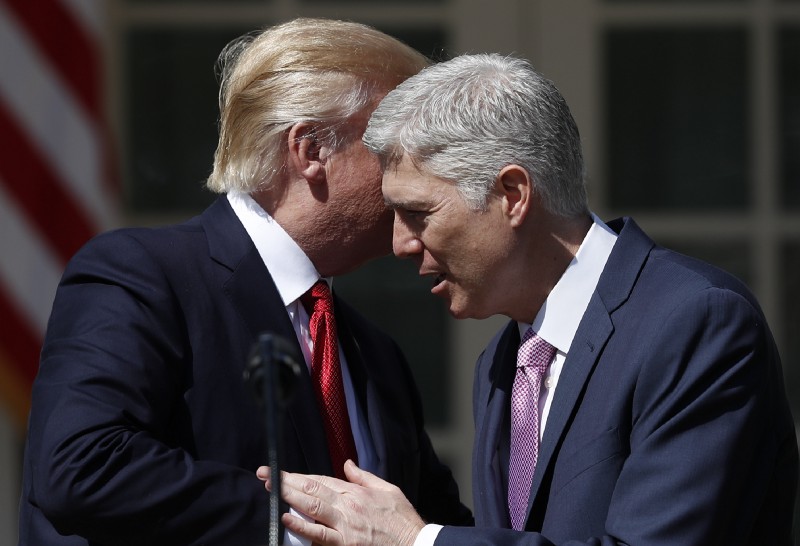
Source: AP/Dave Tulis/Larry Downing
In Part 1, we saw how Chief Justice Roberts joined decisions that saved so-called Obamacare and that protected immigrants. In those cases, he often authored the majority opinion himself, allying himself with his liberal colleagues to render decisions that triggered unconcealed outrage on the part of all or most of his conservative colleagues in dissent.

We witnessed exactly that last week in the DACA case (Department of Homeland Security v. Regents of the University of California, 2020) which was discussed in the previous post. Let's now turn to last week's other momentous decision, as well as an earlier related one that is, perhaps, even more revealing about the role and direction of Roberts as the primus inter pares.

LGBTQ Rights.  In a long-awaited decision--it took over 8 months from oral arguments on October 8, 2019--the Court ruled last week that the prohibition against "sex" discrimination in the Civil Rights Act of 1964 protects gay and transgender employees. The Chief Justice joined his 4 liberal colleagues, as well as one of the Trump-appointed conservative Justices, Neil Gorsuch, to whom he assigned the writing of the majority opinion.
Over the dissents of the 3 remaining Republican appointees [Thomas, Alito, and Kavanaugh], the Roberts-assigned/Gorsuch-penned majority opinion agreed with the fired employees that discrimination on the basis of "sex" necessarily covered discrimination against gays and transgenders. The crux of the argument [distilled from what I found to be a mostly insufferable 33 pages] was that the term "sex," as a matter of sheer linguistics and logic, does apply to gays and transgenders, even if that application was not within the underlying legislative intent of the law.
The 3 remaining conservatives wrote 134 combined pages of dissent. Justice Samuel Alito's seething 107-page opinion, joined by Justice Clarence Thomas, as well as the separate dissent of Justice Brett Kavanaugh, evinced frustration triggered not only by the Court's decision, but no doubt also by the loss of another Roberts vote to the liberals--this time, together with Gorsuch's vote as well. Bostock v. Clayton County, 2020.

[I feel compelled to add that, regardless of my unqualified agreement with the Court's result, I find much of the majority opinion unnecessary, unpersuasive, and perilous. The same decision could have been reached by simply sticking to the inexorable logic of what sex discrimination necessarily includes. (E.g., if a woman prefers men, that's ok. But if a man does, that's not? The only difference is the different sex of the person who prefers men.)
Beyond that, a far better majority opinion, in my view, would have embraced the overarching principle in prohibiting sex discrimination. Sex and sex-related characteristics are utterly irrelevant for most purposes. For like reason, most disparate treatment on those bases is born of bigotry or some other form of ignorance, rather than some justified reason--which is precisely what discrimination means.
On the other hand, Gorsuch’s "it’s clear from the original understanding of the plain terms of the statute" argument (I’m paraphrasing) can be expected to be used in the future to support reactionary results. The 6 votes his opinion received will surely be used as a strong endorsement of his insistent originalism—i.e., the “ordinary public meaning” of the terms of the law “at the time of the enactment" (his language)—about which he waxed and waned ad nauseam. This will be thrown back at the liberals--all of whom joined his opinion without a whisper of discomfort--when he and the other conservatives (including those in dissent in this case) use it in future cases to undercut past progress and block attempts to move the law forward.
I wish at least one of the liberal Justices had authored a separate concurrence making clear that they weren’t endorsing Gorsuch’s originalist interpretive approach. The need to do so should have been especially clear in light of Alito's dissenting opinion. Regarding what "sex discrimination" was understood to mean "at the time of enactment," Alito's dissent had the much stronger argument. Just consider this: would the law's prohibition of "sex discrimination" have been passed--"at the time of enactment" in 1964--if legislators were told that those terms protected gays and transgenders as well as women? Now ask the same question about progressive interpretations of countless other statutory and constitutional provisions. The liberals should at least have expressed their reservations about the originalism touted by Gorsuch.
Others have raised similar concerns. See e.g., Neil Gorsuch Lays Landmines Throughout LGBTQ Discrimination Opinion. https://abovethelaw.com/2020/06/neil-gorsuch-lays-landmines-throughout-lgbtq-discrimination-opinion/]

An earlier decision of the Court, three years before Bostock, was arguably more revealing about Roberts' view of his role as Chief Justice (as well as of Gorsuch's view of LGBTQ rights). Roberts' position in that earlier case took many by surprise because he had dissented two years before in Obergefell v. Hodges (2015).  In Obergefell, Roberts, together with the other Republican appointees-- except for Justice Anthony Kennedy--had rejected the notion that the Constitution guarantees same-sex couples the right to marry. But in 2017, Roberts broke with the Court's conservatives and, aligning with the Obergefell majority, helped reaffirm that landmark decision.
In a per curiam opinion, with the Chief Justice in the 6-3 majority, the Court invalidated an Arkansas rule that treated same-sex and opposite-sex spouses differently on their children's birth certificates. While the male spouses of biological mothers were entitled to be identified, female spouses were not. Repeatedly quoting from the Obergefell majority opinion--against which the Chief Justice had originally dissented--Roberts, together with his 4 liberal colleagues and Justice Kennedy, summarily granted review, reversed the state's supreme court, and struck the Arkansas practice on the ground that "the Constitution entitles same-sex couples to civil marriage 'on the same terms and conditions as opposite-sex couples.'”
Justice Gorsuch, this time writing a dissent, which was joined by Thomas and Alito, argued that, although the Obergefell decision held that "a State must recognize same-sex marriages," it said "nothing" about "a birth registration regime based on biology." In response, the Roberts-joined per curiam majority noted that opposite-sex spouses identified on Arkansas birth certificates need not be biological parents. Applying another line excerpted from Obergefell, the Chief Justice and his more liberal colleagues concluded that Arkansas has "denied married same-sex couples access to the 'constellation of benefits that the Stat[e] ha[s] linked to marriage.'” Pavan v. Smith, 2017.

Roberts had thus apparently decided that his role as Chief Justice included adhering to the Court's recent progressive landmark and opposing attempts to undermine it--regardless of his original position on the matter.

Death Penalty/Intellectual Disability. A similar pattern is evident in positions taken by Roberts in some recent death penalty cases. He had dissented in Moore v. Texas when that case came before the Court in 2017. The Court's majority ruled that the state court's judgment that the death row inmate was mentally competent to be executed "had no grounding in prevailing medical practice." Accordingly, the case was remanded for a determination "informed by the medical community’s diagnostic framework." Roberts dissented on the ground that the "independent basis for [the state court's] judgment" was adequate.
When the case returned to the Supreme Court two years later, the majority once again disapproved the state court's determination that the inmate was competent. This time, however, the Chief Justice broke with the conservative dissenters [Thomas, Alito, and Gorsuch] and joined the majority [which notably included Justice Kavanaugh]. Despite Roberts' own previous dissent, he acknowledged that the Texas determination "did not pass muster under this Court’s analysis last time" and, because "[i]t still doesn’t," he joined the majority's opinion to again reverse the state court's judgment. Moore v. Texas, 2019.

The Chief Justice joined his liberal colleagues in several other related death penalty cases in 2019. A few weeks prior to the Court's decision in Moore, Roberts signaled his break with his conservative colleagues in White v. Kentucky. In that early 2019 decision, he joined the majority's order [over the dissent of Thomas, Alito, and Gorsuch] to grant review and simultaneously, without argument, reverse a judgment of the state's supreme court--on the basis of the Court's earlier 2017 Moore decision.
Similarly, in Madison v. Alabama, also decided in early 2019, Roberts again broke with his conservative colleagues [Thomas, Alito, and Gorsuch]. In that case, he sided with the liberals to vacate the judgment of the state court that had approved an execution. He joined Justice Elena Kagan's majority opinion that the Constitution prohibits executing a person who is unable to understand why he's being punished, regardless of the particular intellectual disability he suffers, dementia or psychosis.
One more. In Murphy v. Collier, decided several weeks thereafter, the Chief Justice again sided with his liberal colleagues to halt to another execution. Over Justice Alito's dissenting opinion, which was joined by Thomas and Gorsuch, the Roberts-joined majority summarily enjoined Texas from carrying out the execution, at least until it first granted the inmate's request to be accompanied into the chamber by a Buddhist chaplain.

To be sure, Chief Justice Roberts' positions in the cases thus far discussed do not mean that he has transformed into an ideological liberal. But they do demonstrate a pattern of willingness to break with his more natural political allies on the Court and, moreover, to do so on some of the most highly charged issues of the day.
We'll look at a few more of these in the next and final post in this series.

Thursday, June 11, 2020

Trump's Justices: Gorsuch to Date (Part 3)

Pandemic restrictions, transitioning to remote teaching, exams, grading, other projects, preoccupation with breaking news, etc. Now back at last.
In the first post in this series, we took a look at Justice Niel Gorsuch's voting record immediately following his appointment in the final few months of the 2016-17 term. As shown in that post, Gorsuch voted for the politically conservative side of every politically charged issue in cases involving the death penalty (pro), campaign finance restrictions (con), gun rights (pro), gay rights (con), workers' rights (con), separation of church and state (con), President Trump's travel ban (pro), and similar politically divisive matters.

Yes, there were legitimate (or semi-legitimate) arguments that supported each side in these cases. A reasonable, good-faith judge might have voted either way. But Gorsuch always chose arguments that supported the politically conservative side. Never the other side. In short, connect the dots! Moreover, Gorsuch's 100% politically conservative record was more than double the 41% conservative decisional record of the Court as a whole.

Juxtaposing his record with that of the other conservatives on the Court, as well as of the Court as a whole, in that spring of 2017 looks like this (click to enlarge).


Then, in the second post in this series, we saw that Gorsuch continued to amass a very politically conservative record throughout the 2017-18 term, his first full term on the Court. As noted in that post, in cases involving highly charged matters, Gorsuch voted for the politically conservative side virtually every time: Trump's travel ban (again, pro), immigrant rights (con), abortion rights (con), gay rights (con), union representation (con), worker rights (con), voting rights (con), ending gerrymandering (con), search and seizure protections (con), and international human rights (con). Again, connect the dots.

And again, let's juxtapose Gorsuch's voting with that of the other conservatives on the Court, as well as of the Court as a whole. His record for the first full term on the Court, the 2017-18 term, looks like this (click to enlarge).


Now, let's take a look at Gorsuch's record for the last completed term, 2018-19, his second full year on the Court. Among the cases involving those "hot-button" or politically charged issues, these were his positions:
  • American Legion v. Amer. Humanist Assn. (2019) [re: the 40 Foot Cross maintained by Maryland state government]--the majority approved the cross; Gorsuch's separate concurring opinion would have lowered the separation of church and state even more by disallowing concerned groups even to complain.
  • Dept. of Commerce v. New York (2019) [re: the Trump administration's proposed citizenship question on the census form]--the majority, in an opinion by the Chief Justice, disallowed the question because the administration's claimed justification was a lie; Gorsuch joined the dissenters' argument that the administration did have some legitimate reasons.
  • June Med. Servs. v. Gee (2019) [re: the Louisiana abortion services restriction law]--the majority summarily blocked the law from going into effect; he joined the dissenters to approve the law until it actually resulted in unduly burdening the right to choose.
  • Rucho v. Common Cause (2019) [re: partisan gerrymandering]--he voted with the majority which held that the Court should do nothing about it.
  • Bucklew v. Precythe (2019) [re: lethal injection]--he authored the majority opinion to approve the use of a method of execution on an inmate, despite the inmate's particular's medical condition that would make that method excruciating.
  • Moore v. Texas (2019) [re: intellectual disability of a death row inmate]--in this and several similar cases, the majority (which included Chief Justice Roberts and Justice Kavanaugh) halted the execution because the state applied outdated mental health standards which the Court had previously invalidated; he joined the dissent in each case to nevertheless allow the executions.
  • Murphy v. Collier (2019) [re: the Buddhist chaplain case]--the majority (which again included Roberts and Kavanaugh) halted an execution until the state honored the inmate's request to be visited by a chaplain of his faith; he joined the dissent to excuse the state and allow the execution to go forward.
  • Garza v. Idaho (2019) [re: ineffective counsel]--the majority (once more including Roberts and Kavanaugh) ruled that the defense counsel's failure to file an appeal violated the defendant's right to effective counsel; he joined the dissent arguing that the defendant's waiver of appeal upon his guilty plea disposed of the question.
  • Flowers v. Mississippi (2019) [re: race-based juror discharges]--the majority (which this time included Roberts, Alito, and Kavanaugh who authored the opinion) condemned as unconstitutional the “relentless” use of peremptory challenges by the prosecution to strike all black jurors, throughout 6 trials and retrials; he joined the dissent which declined to condemn the pattern.
Well, speaking of patterns, Gorsuch's voting pattern should be quite evident. Whether it's church and state, abortion rights, the death penalty, race-related questions, the Trump administration's initiatives, and other politically charged issues, Gorsuch voted like a conservative Republican partisan. And he did so even more than some other conservatives on the Court.

Take a look (click to enlarge):

Gorsuch's 89% politically conservative voting record for the 2018-19 term contrasts dramatically with the 50% decisional record of the Court as a whole. And remember, this is a Court where a majority of the Justices are political conservatives--who worked in politically conservative Republican administrations before being appointed by Republican presidents. It is compared to just such a politically conservative Court that Gorsuch's record is so extreme!

Indeed, Gorsuch's record for the 2018-19 term is not only significantly more politically conservative than that of conservative Chief Justice Roberts, 89% to 58%. But his record is notably more politically conservative than that of the second Trump appointee to the Court, Brett Kavanaugh.

The difference between the two Trump appointees, 89% politically conservative for Gorsuch, 74% for Kavanaugh, is underscored by the sorts of politically charged issues on which they disagreed. Take a look at some of them (click to enlarge):
Church and state, racial discrimination, the death penalty, an accused's right to effective counsel--these are among the critical areas of constitutional law in which Gorsuch took the more politically conservative side of the issue than did Kavanaugh.

To be sure, there are many many other areas of constitutional law, as well as non-constitutional but still highly charged political issues, about which we do not yet have Supreme Court decisions in which both Gorsuch and Kavanaugh participated. There are some of those in cases to be handed down by the Court within the next few weeks. That will give us more evidence of the individual and the comparative ideological leanings of the two Trump appointees. Stay tuned!

Tuesday, May 8, 2018

Living on Death Row

LIVING ON DEATH ROW: THE PSYCHOLOGY OF WAITING TO DIE 

Edited by Hans Toch, James R. Acker, and Vincent Martin Bonventre

I had the privilege of assisting the eminent Hans Toch and James Acker, of the School of Criminal Justice of the University of Albany, in producing this volume. It was my high honor to be working with these extraordinarily distinguished scholars.
(click to enlarge)


Wednesday, August 2, 2017

Gorsuch, Part 6: The Now-Justice Like the Then-Judge

We've seen how Neil Gorsuch's record as an appeals court judge was ultra-conservative. Reviewing those cases where he stuck his neck out to disagree publicly with his colleagues by writing a dissenting opinion--presumably because he felt strongly that his colleagues were wrong on an important issue--reveals a clear ideological pattern. (See Part 4 and Part 5.)

In civil cases, he repeatedly sided against the worker and for the employer; sided against consumer protection; sided against Planned Parenthood; sided against the separation of church and state. In criminal cases, he argued that correction and police officers should be immune from liability despite majority findings that the vindicated suspects' constitutional rights had been violated; and he argued that convictions should be upheld despite findings that the defendants' lawyers were ineffective, or that Miranda rights were violated, or that the incriminating evidence was unconstitutionally obtained.

Perhaps most notable (and in my view most worrisome), is that even when Gorsuch sided with the defendant, he set forth the very narrow, literalist view of the 4th Amendment that it does not prohibit unreasonable searches or seizures. Rather, it only prohibits unreasonable searches and seizures if they involve one of the few particular items mentioned in that amendment--i.e., "persons, houses, papers, and effects." But nothing else. This is a view, by the way, based on long-overruled decisions of the Supreme Court from an earlier era. This also just happens to be the same narrow, literalist view of search and seizure protections taken by Gorsuch's hero, the late Justice Antonin Scalia, to whose vacancy he was appointed. And it is the view condemned in recent years by, among others, conservative Justice Samuel Alito, whose separate concurring opinion in U.S. v. Jones, 565 US 400 [2012] exposed the dangers of that view which was embraced in Scalia's opinion in that case.

Sooooooo, has Gorsuch's record on the federal appeals court been reflected in his record to date at the Supreme Court? He has been a justice for only a short time. Confirmed by the Senate in April, he has only participated in those cases which the Court considered as it was wrapping up its term. And yet....

Let's take a look.

Death Penalty
McGehee v. Hutchinson: In Gorsuch's first public vote, he sided with execution. He broke the Court's 4-4 tie to allow Arkansas to proceed with several executions that the state wanted to complete before its supply of lethal drugs expired. Each of the death inmates had already been imprisoned for 10 years; a few for more than 20. Each of them had legal claims challenging their convictions or sentences or even insisting on innocence. State and federal courts at various stages of the litigations had found some merit in their claims. But the Supreme Court declined to review the claims and, with Gorsuch's vote making a bare majority, approved the executions.

Campaign Finance
Republican Party of Louisiana v. FEC: The Supreme Court majority summarily affirmed--in a four word entry--the decision of the court below to uphold a particular provision of the federal campaign finance law (the Bipartisan Campaign Finance Reform Act of 2002, aka “McCain-Feingold”). The provision in question prohibits the use of unregulated contributions made to political parties for federal election activities. Gorsuch, together with Justice Thomas, noted his disagreement with the majority's disposition of the case and would have proceeded with the full review process.

Indigent Criminal Defense
McWilliams v. Dunn: The Alabama courts had denied the death penalty defendant the assistance of a mental health expert. By a typical 5-4 ideological split, with Justice Kennedy casting his vote with the liberals, the Court held that indigent defendants who have raised serious mental health issues do have such a right, and it sent the case back to the lower courts to apply the law correctly. Gorsuch joined Justice Alito's dissenting opinion, taking the position that the decision of the state courts should have been affirmed, because the Supreme Court had not previously "clearly establish[ed] that a defendant is entitled to an expert."

Employee Grievance
Perry v. Merit Systems Protection Board: A 7-2 majority of the Court ruled that an employee could seek judicial review of his "mixed" grievance (i.e., discrimination underlying a civil service grievance) in federal district court; significantly, such a court is not required to defer to an administrative ruling which, in this case, was adverse to the employee. Gorsuch dissented. In an opinion joined by Thomas, Gorsuch argued that an employee seeking judicial review of an adverse administrative ruling on his civil service grievance can do so only in the Federal Circuit Court. And, again here's the significance: that court must affirm the employee-adverse administrative ruling unless it is utterly irrational.

Trump's Travel Ban
Trump v. Int'l Refugee Asst Project: The Court unanimously agreed to review the constitutionality of President Trump's executive order that suspended the entry of certain foreign nationals into the United States. At the same time, by a  6-3 majority, the Court mostly upheld the orders of the courts below that had temporarily barred enforcement of the executive order. The Court did, however, partially reverse the courts by allowing the executive order to be enforced "with respect to foreign nationals who lack any bona fide relationship with a person or entity in the United States." Gorsuch joined Thomas's dissenting opinion, arguing that the executive order should be allowed to be enforced in its entirety--i.e., including its enforcement against those with "a close familial relationship" with an American--because the "Government’s interest in preserving national security" outweighed the resulting hardships to affected individuals.

Church-State Separation
Trinity Lutheran Church v. Comer: By a 5-2-2 majority, the Court held that Missouri engaged in unconstitutional religious discrimination when it denied the church's request for funding for its playground--which funding was generally available to non-religious institutions. [Missouri is one of those state's with an strict (originally anti-Catholic immigrant) prohibition against aiding religious institutions.] Chief Justice Roberts' majority opinion, in a footnote, underscored that "This case involves express discrimination based on religious identity with respect to playground resurfacing. We do not address religious uses of funding or other forms of discrimination." Gorsuch, joined by Thomas, wrote a separate concurring opinion disassociating himself from that limiting footnote. Anticipating other applications of law to religious institutions, he wrote that "general [constitutional] principles here do not permit discrimination against religious exercise—whether on the playground or anywhere else." [Hmmm, such as laws requiring equal treatment of gays and lesbians and same-sex married couples, even in the face of religious objections? And see immediately below!]

Gay Rights
Pavan v. Smith: This case involved Arkansas's refusal to include the name of a biological mother's same-sex spouse as a parent on the child's birth certificate. By a 6-3 majority, the Court summarily granted review and reversed on the ground that, in accord with the Court's 2015 decision in Obergefell v. Hodges, same-sex married couples are equally entitled to “the constellation of benefits that the State has linked to marriage.” Gorsuch dissented. In his opinion joined by Thomas and Alito, Gorsuch insisted that "nothing in Obergefell indicates that a birth registration regime based on biology...offends the Constitution."

Gun Rights
Peruta v. California: The Court declined to review a decision of the 9th Circuit that “the Second Amendment does not preserve or protect a right of a member of the general public to carry concealed firearms in public.” The California law, which generally prohibits concealed guns in public places, was thus upheld. Gorsuch joined Thomas's dissent. The dissenters complained that the majority's decision not to take the case "reflects a distressing trend: the treatment of the Second Amendment as a disfavored right." They were also unequivocal about their position on the California law. As Thomas concluded for himself and Gorsuch: "the Framers made a clear choice: They reserved to all Americans the right to bear arms for self-defense. I do not think we should stand by idly while a State denies its citizens that right."

Well there it is. By his votes and separate opinions in these ideologically-laden cases, Neil Gorsuch has in short order left little doubt about his strong ideological leanings. And beyond ideology or political philosophy or jurisprudence, consider his partisan bent. How would a typical Republican politician vote on these issues? Not a judicially retrained judge or strict constructionist or believer in federalism (i.e., states' rights) or any other actual, coherent judicial or political philosophy. But a partisan Republican.

What's the common thread through his positions on issues as varied as gun rights and gay rights, Trump's travel ban and campaign finance, worker rights and rights of the accused? That's right, connect the dots. His record on the Supreme Court already screams "ultra-conservative partisan Republican."

Some--like the Federalist Society and the Heritage Foundation and other very conservative groups and individuals who recommended him to Trump--undoubtedly are pleased with Justice Gorsuch's record thus far. Others, more moderate or liberal, much less so. But whether pleased or not with Gorsuch's Supreme Court record to date, it is undeniably what it is: politically partisan, conservative Republican.

Saturday, January 21, 2017

Want Scalia-type Justices? Really? (Part 4: Punishment)

Here's wishing the newly inaugurated President lots of success in doing what's best for our country.

If Scalia's view of gay rights--"homosexual sodomy," as he insisted on putting it--was anachronistic and offensive, his positions on crime and punishment were downright medieval.

Yes, this may sound like over-the-top criticism. But even self-proclaimed Scalia admirers, at least most of them, would find the positions he advocated to be startling. Indeed, very few Scalia enthusiasts are likely aware of his actual record on legally acceptable punishment. They are almost certainly unaware of his extreme views on what constitutes "cruel and unusual."

Let's review Scalia's actual record. The positions he actually advocated. And again, let's consider whether the supposed Scalia fans--the newly inaugurated President, his prospective Supreme Court nominees, and the Senators who will vote on confirmation--are really fans of that, or would be willing to admit it.

Scalia insisted that excessive punishments, no matter how extremely excessive, were perfectly constitutional. In fact, he insisted that the Constitution's "cruel and unusual" prohibition only prohibited "flaying alive" and similarly barbaric punishments. Nothing else.

Yes, you read that correctly. (I wish I were kidding.)

Let's first look at Scalia's major judicial writing on "cruel and unusual punishments."

Harmelin v. Michigan (1991)
This case involved a state law that mandated life imprisonment, without the possibility of parole, for possession of a large quantity (6.5+ grams = ~1 1/2 pounds) of cocaine. By a 5-4 vote, the Court upheld the sentence.
Justice Scalia wrote the opinion for the Court's majority.

To be precise, however, only 6 paragraphs of Scalia's 36 page writing in Harmelin constituted the majority opinion. As for the rest of what Scalia wrote, only Justice Thomas signed on.

Of the remaining 7 Justices on the Court, 3 voted in a separate concurring opinion written by Justice Kennedy. They concludd that the life sentence for that drug crime was not too harsh. Together with Scalia and Thomas, that made a majority of 5 votes to uphold the sentence, for one reason or another. The remaining 4 Justices dissented. They argued that that the sentence was too harsh. In sum, 7 of the 9 Justices--the 3 who concurred in the result and the 4 who dissented--disagreed vehemently with all but a few paragraphs of Scalia's 36 page opinion.

Why? What was it that Scalia wrote in those 36 pages that 7 of the 9 Justices would not join?

Other than the 6 paragraphs that garnered a 5-4 majority, Scalia devoted his 36 page opinion to his view that harsh sentences, regardless of how excessive, did not violate the Constitution. Yes, the 8th Amendment explicitly prohibits "excessive bail" and "excessive fines." But as for "punishments," the 8th Amendment only prohibits what is "cruel and unusual." And in Scalia's view, even the most excessive punishments are not covered by "cruel and unusual."

Here are his own words:
[T]here is no cause to believe that the provision was meant to exclude the evil of a disproportionate punishment. [The opposite] argument has force only for those who believe that the Constitution prohibited everything that is intensely undesirable -- which is an obvious fallacy.
[My emphasis added. ("No cause" at all? And an "obvious" fallacy?)]
He further explained his rather stingy reading of the 8th Amendment's prohibition:
[A] disproportionate punishment can perhaps always be considered "cruel," but it will not always be (as the text also requires) "unusual."
He then argued that the Court's previous decision on the subject, which had held exactly the opposite of his view,
was simply wrong; the Eighth Amendment contains no proportionality guarantee.
[T]here is no proportionality requirement in the Eighth Amendment.
[My emphasis added.]

Along the way, in support of his position, Scalia cited with approval a decision that upheld a sentence of 40 years imprisonment for the possession and sale of marijuana. He also approvingly cited another decision that upheld a life sentence for a third minor offense--i.e., the fraudulent use of a credit card to obtain a mere $80 worth of purchases. Scalia even refused to concede that a life sentence imposed for a parking violation would be unconstitutional. Instead, he insisted that such extremely excessive punishments would be rare and that, even if they were adopted, the choice of the voters or legislators should be respected.

Again, 7 of the other Justices refused to join those sections of Scalia's opinion in Harmelin and would only sign onto a different 6 paragraphs of what he wrote. Justice Thomas was alone in agreeing with Scalia's entire 36 pages.

So, one might ask, what, according to Scalia, does the 8th Amendment prohibit? He did discuss that in exhausting detail in that 36 page opinion. The "cruel and unusual" prohibition, in his view, prohibited "only certain modes of punishment." He repeated that several times: "the clause only outlawed certain modes of punishment."

So what exactly are those "certain modes" that are prohibited by the Constitution? Scalia explained what he meant by quoting some early 19th century commentators. Those commentators had written that the "cruel and unusual" prohibition
'would not tolerate the use of the rack or the stake, or any of those horrid modes of torture, devised by human ingenuity for the gratification of fiendish passion.'
[And]
'various barbarous and cruel punishments inflicted under the laws of some other countries...furnish sufficient reasons for this express prohibition. Breaking on the wheel, flaying alive, rending assunder with horses, various species of horrible tortures inflicted in the inquisition, maiming, mutilating and scourging to death, are wholly alien to the spirit of our humane general constitution.'
[My emphasis added.]
One might well agree with those commentators. The "cruel and unusual" prohibition would certainly seem, at the very least, to prohibit such punishments. But according to Scalia in Harmelin, such "'horrid modes" were the only punishments that were prohibited by the 8th Amendment. Not to be misunderstood, Scalia proceeded to dismiss the views expressed by other commentators of the same time period, as well as in judicial decisions, that "cruel and unusual" referred to more than that. Those contrary views, according to him, were either wrong or irrelevant.

Now, someone might suggest that Scalia was overstating his position. Maybe he was only emphasizing his real point that the Constitution does not prohibit punishments just because they are excessive. Well, no. Scalia later made clear that he meant exactly what he wrote in Harmelin. For example, there was the lethal injection case 17 years later.

Baze v. Rees (2008)
In this case, a 7-2 majority of the Court upheld the lethal injection procedure used by Kentucky and other states. Writing for the Court, Chief Justice Roberts explained that punishment would be unconstitutionally "cruel and unusual" if it presented an "objectively intolerable risk" of "severe pain," and if that pain could be "significantly reduce[d]" by a "feasible, readily implemented" alternative. In short, the Constitution is violated if there is no "legitimate penological justification for adhering" to that currently used painful punishment.

Justices Scalia and Thomas agreed that the lethal injection at issue was valid. But they refused to join the Chief Justice's opinion. They emphatically rejected his formulation for "cruel and unusual."

Scalia, and Scalia alone, joined Thomas's separate concurring opinion to express their shared view about the 8th Amendment. The "cruel and unusual" prohibition only prohibits punishments with
the defining characteristic of burning at the stake, disemboweling, drawing and quartering, beheading, and the like...[that] were designed to inflict torture as a way of enhancing a death sentence; [that] were intended to produce a penalty worse than death.
[My emphasis added.]
That's right. Just like Scalia had written in Harmelin, the Constitution only prohibits punishments like  "maiming, mutilating" and "drawing and quartering, beheading, and the like." Today, with Scalia gone, Thomas is the only Justice remaining who embraces that extremely constricted view of "cruel and unusual punishments."

Do the avowed Scalia admirers, including the supposed Scalia-types that are being touted as prospective Supreme Court nominees, share that extremely cramped view of the 8th Amendment? Are they even aware that Scalia had such a view?

Would they--the new President, the Senators, and the nominees--be willing to admit and defend that view at Supreme Court confirmation hearings? Excessive punishments, even extremely excessive ones--fine? Painful punishments, even unnecessarily painful, except for disemboweling and the like--fine? I guess we shall soon see.

Before concluding, mention should be made of another one of Scalia's views, expressed in Atkins v. Virginia (2002), about executing the severely mentally disabled. By a 6-3 vote, the Court held in that case that the death penalty imposed on a defendant who had a 59 IQ was unconstitutional. Scalia disagreed. He joined the dissenting opinion of Chief Justice Rehnquist disagreeing with the Court's decision. But Scalia also wrote a separate opinion himself to add his own protest that
mental retardation does not render the offender morally blameless [and]
that society’s moral outrage sometimes demands execution of retarded offenders.
Then there's the related matter of torture. Scalia repeatedly insisted that government's torturing of an inmate, a prisoner, or a detainee does not violate the Constitution. His reasoning? The Constitution only prohibits "cruel and unusual punishment." So unless torture is an explicit part of a judicially imposed criminal sentence, it is not per se "punishment" and thus, according to Scalia, it is not constitutionally prohibited. (Once more, not kidding.)
(See e.g., Antonin Scalia's Case for Torture, The Atlantic [2014]; Justice Scalia on the Record, 60 Minutes' Lesley Stahl Interview [2008].)

Then there's the execution of someone who is innocent. Scalia actually dissented when the Court ordered a federal trial judge to consider a substantial claim of innocence by a murder defendant who might have been wrongfully convicted and sentenced to death. (In re Davis [2009].) Scalia-- in an opinion joined only by Thomas-objected to the Court's ruling. Why? This is what he wrote:
This Court has never held that the Constitution forbids the execution of a convicted defendant who has had a full and fair trial but is later able to convince a habeas court that he is ‘actually’ innocent.
That position was nothing new or out of the ordinary for Scalia. It was actually just a repetition of a view  he had advocated for a long time. So, for example, 16 years earlier, in Herrera v. Collins (1993), he wrote a separate concurring opinion to express his view that:
There is no basis in text, tradition, or even in contemporary practice (if that were enough), for finding in the Constitution a right to demand judicial consideration of newly discovered evidence of innocence brought forward after conviction.
Well, we could go on. But hopefully the point is well made. Scalia had some....uh...very curious, even frightening, views about punishment and what the Constitution permitted. Do his self-proclaimed admirers really admire those views? Really agree with them? Are they even aware of his views? Well, that is Scalia's actual record.

Next in this series, we'll take a look at yet another aspect of Scalia's actual record.

Monday, March 28, 2016

Justice Scalia's Record (Part 5: Punishment)

Back from spring break and the Easter holiday. Yes, the big news concerning the high court is President Obama's nomination of federal appeals court judge Merrick Garland to fill the Scalia vacancy. As we continue with the examination of  Justice Scalia's record, readers who are eager to learn more about Judge Garland might want to take a look at 2 posts on New York Court Watcher from 2010 (Merrick Garland [1] & Merrick Garland [2]) and listen to an interview last week on Susan Arbetter's Capitol Pressroom [@ ~21:50 mins]).

photo: AP/Manuel Balce Ceneta
The 8th Amendment prohibits "cruel and unusual" punishments. Justice Antonin Scalia viewed that prohibition as outlawing only punishments that are both extremely gruesome and extremely rare. Applying those criteria, he voted to uphold the 8th Amendment constitutionality of whatever sentence came to the Court for review.

A look at a few cases in which Scalia participated and wrote an opinion will illustrate his rather narrow and unyielding perspective on what qualifies as "cruel and unusual."

Punishment
Harmelin v. Michigan (1991): the 5-4 majority held that a life sentence, without the possibility of parole, for possession of 650 grams of cocaine was not unconstitutionally excessive.
Three Justices in the majority concluded that the sentence was not so excessive as to be "cruel and unusual."
Four dissenting Justices viewed the sentence as so disproportionate that it did violate the 8th Amendment.
That made 7 of the 9 Justices who agreed that the "cruel and unusual" prohibition of the 8th Amendment did include an excessiveness component.
Justice Scalia, on the other hand, had a different view. Writing for himself and Chief Justice Rehnquist [The majority joined only part 5 of his 5-part opinion.], he took the position that the sentence was clearly constitutional. But that was so, according to him [I.e., in the 4 of 5 parts of his opinion that the majority did NOT join.], because "the Eighth Amendment contains no proportionality guarantee." Instead, the "cruel and unusual" prohibition only "disables the Legislature from authorizing particular forms or 'modes' of punishment — specifically, cruel methods of punishment that are not regularly or customarily employed." Quoting with approval from some historical studies, Scalia insisted that the "cruel and unusual" prohibition referred only to such punishments as "[b]reaking on the wheel, flaying alive, rending assunder with horses, various species of horrible tortures inflicted in the inquisition, maiming, mutilating and scourging to death to punishments."

Atkins v. Virginia (2002): the 6-3 majority held that the death penalty for a severely mentally disabled murder defendant--an IQ of 59--was unconstitutionally "cruel and unusual."
In his dissent, Scalia protested that "mental retardation does not render the offender morally blameless." Moreover, according to Scalia, "[t]he fact that juries continue to sentence mentally retarded offenders to death for extreme crimes shows that society’s moral outrage sometimes demands execution of retarded offenders."

Roper v. Simmons (2005): the 5-4 majority held that it was unconstitutional to impose the death penalty for a murder committed by a juvenile.
In his dissenting opinion joined by Chief Justice Rehnquist and Justice Thomas [Justice O'Connor wrote her own dissent.], Scalia berated the majority for "reach[ing] this implausible result by purporting to advert, not to the original meaning of the Eighth Amendment, but to 'the evolving standards of decency.'"

Baze v. Rees (2008): the 7-2 majority upheld the constitutionality of a common method of lethal injection.
In his opinion for the Court, Chief Justice Roberts explained that a "method of execution is unconstitutional if it entails an 'intolerable risk' of 'severe pain.'" He concluded that lethal injection was acceptable under that standard.
In dissent, Justice Ginsburg refused to approve lethal injection until those seeking to impose it proved that any risk of pain was actually unavoidable.
Scalia agreed with the Court's decision to uphold lethal injection, but disagreed with the intolerable-risk-of-severe-pain standard. He authored a separate concurring to criticize Justice Stevens for generally questioning the justification for the death penalty. Beyond that, Scalia explicitly stated at the outset that he was joining Justice Thomas's own concurring opinion.
In that opinion, Thomas repeated the view shared by him and Scalia about the very limited contours of the "cruel and unusual" prohibition. To them, the 8th Amendment was only "intended to prohibit torturous modes of punishment." And in accord with early case law and commentary, this meant that the constitutional prohibition was confined to "burning at the stake, crucifixion, breaking on the wheel, or the like.”

Kennedy v. Louisiana (2008): the 5-4 majority held that the death penalty for raping a child is unconstitutional; that capital punishment is almost exclusively reserved for homicidal crimes.
Justice Alito, in his opinion for the 4 dissenters including Scalia, posed the following question: Consider "a previously convicted child rapist [who] kidnaps, repeatedly rapes, and tortures multiple child victims. Is it clear that [any murder] defendant is more morally depraved than the [child rapist]?"
Subsequently, Scalia himself authored a "Statement" when the Court refused to rehear the case. He mocked the majority's initial decision in the case, and specifically its view that "the Constitution contemplates that in the end [the Court's] own judgment will be brought to bear on questions about the death penalty." Scalia's retort: "Of course the Constitution contemplates no such thing; the proposed Eighth Amendment would have been laughed to scorn if it had read 'no criminal penalty shall be imposed which the Supreme Court deems unacceptable.' But that is what the majority opinion said."

[Disclosure: I disagree with the positions argued by Scalia in every one of these cases. I actually do agree with his votes in 2 of these cases: in Baze v. Rees (to uphold the constitutionality of lethal injection) and Kennedy v. Louisiana (to uphold the constitutionality of the death penalty for child rape--at least in the worst cases). But in those cases, I agree with the positions taken by others in their opinions, not Scalia in his.
So, in Baze v. Rees, I agree with Roberts' view that the "cruel and unusual" prohibition does outlaw "intolerable risk[s]'' of "severe pain;" and in Kennedy v. Louisiana, with Alito's view that some crimes of child rape are even more morally depraved than some homicides and, thus, justify the death penalty even more than some homicides (if, of course, the death penalty is ever justified).
I find Scalia's and Thomas's position in Baze v. Rees (which Scalia had previously expressed), that the 8th Amendment only prohibits punishments such a crucifixion, burning alive, disemboweling, etc., absolutely repugnant to any civilized and enlightened view of criminal justice.
And I find Scalia's view in Kennedy v. Louisiana, criticizing the Court for actually believing that the Constitution calls for the exercise of judgement, to be an astonishingly puerile--or disingenuous--denial of the judicial role.
I disagree with his position, expressed in Harmelin v. Michigan, that the "cruel and unusual" prohibition can never be violated by an excessive sentence, regardless of how extremely disproportionate to the crime. The death penalty for blasphemy? For gay sex? Both were imposed in the past. For that reason, or for the rejection of any disproportionality consideration in "cruel and unusual," must such punishments really be upheld?
I also strenuously disagree with Scalia's positions in Atkins v. Virginia and Roper v. Simmons that a defendant's mental disability or youth have no bearing on the constitutionality of the death penalty.
Scalia's positions on punishment--much like his consistent rejection of racial minority protection and gay rights--were, in my view, among the most unattractive (i.e., deplorable and antediluvian--ok, maybe immediately post-diluvian) aspects of his jurisprudence.]

In the next and final post on Scalia's record, we'll take a look at his positions in search and seizure cases involving technology.

Thursday, December 3, 2015

The Supreme Court's Last Term: Review & Implications (PPT)

Having now presented several reviews of the Supreme Court's 2014-2015 Term ["October 2014 Term"] since that term concluded in June, it's perhaps time to post and retire the power point.
The presentations ranged from 1 to 3  hours; the power point and corresponding remarks were tailored to the time requirements. Here is the unabridged version of  the power point, including  the most recent updates I used today as part of New York State's Annual Legislative Continuing Legal Education Program. It includes all the graphs on decisional and voting patterns prepared to help underscore the implications of the past term.


_____________________________
To view the complete slide presentation, open HERE.
(Then, for the best view, click File + Download, and Open the download.)

Monday, June 15, 2015

Supreme Blockbusters Coming (Part 3--Lethal Injection)

Seven years ago, the Justices upheld lethal injection as a constitutional means of execution. A few weeks ago, they heard arguments in another lethal injection case. This one was precipitated by a number of botched procedures that resulted in extremely painful deaths.

Lethal-Injection Procedures (Glossip v. Gross)
In its 2008 decision in Baze v. Rees, the Supreme Court rejected a challenge to death sentences carried out by injection with lethal drugs. The challenge was based upon the possibility that the procedures could cause serious pain if they were not properly followed.

By a vote of 7-2, the Justices held that such a possibility did not render execution by lethal injection unconstitutional. A mere possibility did not mean that such executions were "cruel and unusual" within the meaning of the 8th Amendment (or the 14th Amendment, as applied to the states). That decision is the "governing" precedent for this latest case.

But it's not so clear what that "governing" precedent actually established that's precedential. The lopsided vote in Baze is misleading. Despite being 7-2, it did not produce a majority rule or rationale. There were 7 separate opinions written, and collectively they asserted at least 3 different ways to analyze these death penalty cases.

The leading opinion, authored by Chief Justice Roberts, was joined only by Justices Kennedy and Alito. In that plurality opinion, Roberts surveyed past "cruel and unusual" decisions and concluded that a method of execution is unconstitutional if it entails an "intolerable risk" of "severe pain." Applying that test, he determined that the lethal injection procedure in that case was acceptable.

In an opinion by Justice Thomas, he and Justice Scalia made clear their view that only the most torturous, barbaric, and gratuitously excruciating punishments were "cruel and unusual." So only executions by burning alive, disemboweling, crucifixion, drawing and quartering, and the like would violate the constitution. Lethal injection was clearly acceptable to these two Justices.

In dissent, Justice Ginsburg, joined by Justice Souter, argued that the test for "cruel and unusual" was whether the procedure created an "avoidable risk"of "unnecessary pain." They refused to approve lethal injection unless or until it was shown that the risk could not be avoided.
(Justices Stevens and Breyer each wrote a separate opinion. Stevens kind of agreed with Roberts. Breyer agreed with Ginsburg's test, but believed that lethal injection passed.)

So that's where the law, such as it is, stands.

Now in the current case, the question is about the use by Oklahoma (and some other states) of a particular 1st drug in a 3 drug protocol. The 2nd and 3rd drugs in the sequence stop the person's breathing and stop his heart. But it's the 1st drug administered that is supposed to anesthetize the person so that he is unconscious and feels no pain.

Because of a shortage of the commonly used 1st drug (in large measure because of the efforts of death penalty opponents), states like Oklahoma began to use an alternative. That drug is actually a sedative, not an anesthetic. In large enough doses, however, the so-called midazolam is supposed to be effective in inducing an unconscious state.

Nevertheless, in several executions, in a few different states, in which midazolam was used, the person was not rendered unconscious and, instead, suffered a gruesome and extremely painful death. Is that enough for the Court to rule that lethal injection with midazolam is unconstitutional?

Putting that question another way: is the apparent unreliability of the sedative midazolam--to induce unconsciousness and, thereby, to prevent an intensely painful execution--enough to persuade at least 5 Justices that lethal injection with that drug violates the constitutional prohibition against "cruel and unusual" punishment?

Let's consider the Justices and their possible votes.

First, there are the easiest ones. Scalia and Thomas, as we've already noted, believe that only punishments similar to disembowelment, burning alive, crucifixion, and drawing and quartering are prohibited by the Constitution. There's very little chance they will consider the unreliable or botched lethal injections sufficiently gruesome.

On the other hand, there are the liberals--Ginsburg, Breyer, Sotomayor, and Kagan. Some of them are openly hostile to the death penalty. All of them seemed extremely skeptical at oral argument, if not utterly contemptuous of Oklahoma's defense of its lethal injection protocol. It's very likely that all 4 of these Justices will vote that what Oklahoma is doing is unconstitutional.

That leaves Roberts, Kennedy, and Alito. They joined together to form the plurality in the 2008 Baze case. It was they who stated that the test for "cruel and unusual" is whether there is an "intolerable risk" of "severe pain."

So is the risk with midazolam "intolerable?" Less subjective and amorphous than that, how great is the actual risk ? And how great must that risk be for Roberts or Kennedy or Alito to conclude that lethal injection with midazolam flunks their constitutional test?

At oral argument, Alito seemed quite unsympathetic to the claims against Oklahoma's use of that alternate drug. He seemed to blame the death penalty opponents for making the more reliable drugs so scarce. But would he really think that's a legitimate reason to uphold the use of the risky drug? Of a drug that risks seriously painful executions? It would be no surprise if he voted to approve Oklahoma's protocol.

As for Roberts and Kennedy, they expressed similar concerns to Alito's. But--at least from several reports of the oral arguments--neither seemed to be as openly hostile to death penalty opponents generally, or to be directing that hostility toward the opponents of the midazolam protocol as much as Alito.

Moreover, Kennedy has not been a staunch supporter of the death penalty. Indeed, he has occasionally joined the liberals to invalidate it in certain circumstances. The unreliability of using midazolam as an anesthetic might just nudge Kennedy over to the liberals in this case.

Roberts has also shown some ambivalence about the death penalty in the past. Not as much as Kennedy. But he is certainly nowhere near the camp of Scalia and Thomas.

So the bottom line on this one?
As with the same-sex marriage and Obamacare subsidies cases, the 4 liberals are virtually certain to vote on the same side and, in this case, to vote against Oklahoma's lethal injection protocol. And as in those other cases, they need just one more vote for a majority.
One thing's for sure: they will not get Scalia or Thomas.
And they will very likely not get Alito.
That's 4-3.

The most likely 5th vote for the liberals, if they're going to get one, is--no surprise here--Kennedy. He seemed to acknowledge at oral argument that the use of midazolam created much more risk than other drugs. Whether he will hold the shortage of more reliable anesthetics against the opponents of midazolam is, of course, anyone's guess. But Kennedy has never seemed as petty and belligerent as some others on the Court.

Roberts wouldn't be a shock if he applied his Baze standard and found midazolam to be too risky. Again, he is certainly no Scalia or Thomas. But, if I were the liberal Justices, I wouldn't count on him.

So the vote on this one, as on the cases we previously discussed, will likely be deeply split.
If I had to bet, I'd say 5-4--but I have no confidence whatsoever which way that will be.
(Ok, if I'm ordered from on high to say? Kennedy goes with the Libs.)


In the next post: the confederate flag on a license plate?

Tuesday, October 16, 2012

[more of] Roberts in the Middle: The Chief Justice as Moderate (Part 2--In the Majority)

Clearly, some were very upset with Chief Justice Roberts' deciding vote to uphold Obamacare.
[The photo on the left is from Republic Magazine: The Voice of the Patriot Movement. See "John Roberts, Constitutional Traitor: Chief Justice Approves Obamacare Tax Mandate," June 28, 2012.]

As noted in the last post, the Obamacare case was not the first one in which Roberts departed from the other conservative Justices on his Court. In some cases he actually sided with the liberals. In some, he voted with the conservatives, but adopted a less hard-line position. In some, he endorsed a middle ground which literally split the difference between the Court's two ideological wings.

More than that, some of these cases were ideologically significant and politically charged. The Chief Justice's vote and position in each of them was less conservative than that of the most conservative Justices. And collectively, his votes and positions evinced more moderation--at least in these cases--than either the conservative or liberal poles of his Court.

Let's look at a few examples. Let's start with some cases in which Roberts was part of the majority.
Arizona's Immigration Law
Three of the Court's conservative Justices--Scalia, Thomas, and Alito--voted to uphold all (or in Alito's case, most) of the provisions of the Arizona law. According to them, the additional restrictions and criminal penalties imposed on illegal immigrants were within the power of the states to police activities within their borders.
The liberal Justices (together with Justice Kennedy) voted to invalidate every challenged provision of the law, but one. They argued that federal immigration law comprehensively regulated the treatment of illegal immigrants and, therefore, preempted any state interference.
Roberts joined the liberals, plus Kennedy, thereby giving them a majority. (Arizona v. U.S., 2012 [the same week as the Obamacare decision].)
Worker Anti-Retaliation Protection
The Court's most conservative Justices--Scalia and Thomas--voted to dismiss a claim of retaliatory discharge brought by a worker who was fired after he complained that employees were being shortchanged on work-time. The two argued that the Fair Labor Standards Act only protected workers who filed formal complaints, either with a government agency or in court.
The liberal Justices (as well as Kennedy and Alito) took the position that oral complaints sufficed. That a worker's person-to-person complaints to his supervisor and to company managers were adequate to trigger the law's protections against retaliation.
Roberts joined the Court's 4 liberals, plus Kennedy and Alito, in rejecting the view of Scalia and Thomas. (Kasten v. Saint-Gobain, 2011.)

Thursday, July 3, 2008

Supreme Court: No Death Penalty for Child Rape (Part 2: Oops, What About that Military Law?)

As reported this week in the New York Times, the Supreme Court majority misstated a fact that it had identified in support of its decision that the death penalty for child rape is unconstitutional. In Kennedy v. Louisiana, decided last week among the Court’s final rulings, the 5 – 4 majority argued that death was a cruel and unusual punishment for child rape, in large measure because of a perceived national consensus to limit such a penalty to homicidal crimes. Authored by Justice Anthony Kennedy, the opinion for the majority pointed to the fact that only six states—and not the federal government—had laws making child rape a capital crime. Unfortunately, as explained by Linda Greenhouse in two separate articles in the Times, the majority was wrong.

In fact, the federal government does have such a law. It was passed just two years ago. That law made child rape a capital crime in the military. Apparently, neither the nation’s legislature nor the nation’s chief executive had considered the death penalty to be an inappropriate punishment for child rape. So much for that strong, dispositive “national consensus” found by the majority. But in Kennedy, the prosecution, the defense, the federal Department of Justice—and ultimately, the Court as well—missed that fact. [Linda Greenhouse’s two articles in the Times can be found at: http://www.nytimes.com/2008/07/02/washington/02scotus.html?ex=1215748800&en=f9ad2c4e68f361d7&ei=5070&emc=eta1

and http://www.nytimes.com/2008/07/03/us/03scotus.html?ex=1215748800&en=3df542c2888fe2a4&ei=5070&emc=eta1 .]

Not surprisingly, there are calls to ask the Court to reconsider its decision. The thinking being that, but for this factual mistake, the Court might well have ruled the other way. The 5 – 4 ruling might have been the opposite. Justice Kennedy, the swing vote as well as the majority’s writer, might well have found this added information to be critical.

Well....those who are extremely upset by the majority’s ruling might convince themselves that this is so. They might turn hope into belief that there is a good chance the Court would actually reverse itself. But as one who himself disagrees with the decision in Kennedy, and who himself finds the majority’s opinion woefully unpersuasive (see “Supreme Court: No Death Penalty for Child Rape,” posted June 25, 2008 on the New York Court Watcher blog), I find such a scenario to be far-fetched.

The majority is hardly going to be receptive to a request to admit that its constitutional decision was wrong. Certainly not because of a single factual error. But more than that, any educated reading of the majority’s opinion could hardly deduce that its reason for striking the death penalty for child rape was really because there were only six jurisdictions, as opposed to seven, that had such laws. Or really because there is an actual consensus in the nation against such punishment for that crime. And the fact that such punishment was made available for the highly disciplined life of the armed forces is not exactly the best proof that such punishment is appropriate for civilians. More than that, the existence of such a law for the military can scarcely be translated into a national consensus contrary to that discerned by the majority—again, if “national consensus” really was the basis, or one of the bases, for the Court’s decision.

The truth, as any legal realist would readily understand, is simply that the majority of the justices do not believe that execution is a fitting punishment for child rape. And their reasons are almost certainly varied. It may be that some justices believe the death penalty itself to be barbaric or uncivilized or contrary to deeply held religious or moral beliefs. It may be that some justices simply distrust the criminal justice system to mete out such a punishment fairly; they may, therefore, want to restrict its application as much as possible. It may be that some justices subscribe to a just desert, eye-for-an-eye notion of justice, especially when it comes to taking a life. The possible reasons are many. It is very unlikely that the reasons are the same for all the justices. And those real reasons are not necessarily the ones to be emphasized—if revealed at all—in a legally argued decision.

The very same, of course, is no less true for the justices in dissent.

[That the real bases for judges’ decisions are typically unstated, and often even unconscious, are best discussed in the classic works by two of the finest and most thoughtful judges in American history: Holmes in “The Path of the Law” and Cardozo in “The Nature of the Judicial Process.”]

The point here is simply that the law passed for the military is extremely unlikely to tip the scales of the Court’s 5 – 4 decision the other way.

Wednesday, June 25, 2008

Supreme Court: No Death Penalty for Child Rape

Today’s Supreme Court decision in Kennedy v. Louisiana will be warmly welcomed by those who unqualifiedly oppose the death penalty and vehemently condemned by those who enthusiastically support it. The rest of us, with ambivalence about the death penalty, are likely to be ambivalent about this decision as well. Indeed, the Court’s 5 – 4 split in Kennedy seems fairly to reflect the nation’s generally mixed feelings about capital punishment.

[Disclosure: I do not oppose the death penalty. It seems to me to be well deserved in some cases. I do, however, have serious reservations based on the racial and economic disparities in its imposition, as well as on the claims of its deterrent or other penological purpose(s). I would not have been upset if the Court in Kennedy had ruled the other way. But I am hardly outraged that the Court ruled the way it did.]

The gist of the majority opinion in Kennedy, authored by Justice Anthony Kennedy, is twofold. First, there is a national consensus that the death penalty should be restricted to crimes involving the taking of human life. Second, the death penalty is justified only for the most morally depraved crimes—intentional murder fits that characterization; child rape does not.

Let’s be honest. These propositions are questionable at best. Would anyone be persuaded except the already converted and the choir? As for the first proposition, is there really any such national consensus? Can Justice Kennedy, the majority, or anyone else really be confident that the American people or their representatives generally agree that the death penalty should only be for homicidal crimes? Nothing else? Not for any other crime regardless of how violent or inhumane? Not for the rape of a child, no matter how young the child and no matter how brutal the rape? In fact, isn’t the opposite much more likely? That the people and their representatives, if put to a vote, would generally favor the extreme penalty for some other crimes? At least for the most extreme child rapes? Does anyone really doubt that? And if the response is that constitutional decisions by the Supreme Court ought not to be driven by what the people or their representatives happen to think at any given time, then the majority ought not to be relying on it as a basis for its decision. Especially when the majority is very likely wrong about it.

As for the second proposition, that child rape is not as morally depraved as an intentional killing, what metric, whose metric is the majority using? And by whatever metric, can it really be said that child rape—regardless of how wretched or how physically, emotionally, and psychologically damaging or how often or how many victims—cannot equal the depravity of a killing? What notion, whose notion of depravity is that? Some contemporary notion, some current consensus again? But does Justice Kennedy, the majority or anyone else really believe that the American people or their representatives think that a child rape—no matter how aggravated the circumstances—is never as depraved as an intentional homicide? Never sufficiently depraved to justify the sentence reserved for the worst crimes? This proposition is as dubious as the first.

If the response to all this is that only a killing justifies being killed, then that is an entirely different argument. That is not the Kennedy majority’s argument about national consensus or about the level of moral depravity. Nor does that argument get us any closer to the question—i.e., why? Indeed, it’s not an answer at all. It’s the question! And if the underlying point is the ancient prescription of an eye-for-an-eye, then of course we must still confront the consequences of that equation. If death is the equal punishment for a killing, what is the equal punishment for child rape? For the most aggravated crimes of child rape? Not an easy question. And not one satisfactorily addressed in the Kennedy decision.

A final note. The single opinion for the four dissenters in Kennedy, authored by Justice Samuel Alito, criticized the majority opinion along lines similar to those presented here. As has been typical of Alito, the writing was measured, analytical, and devoid of the histrionics and other injudicious nonsense that too often marr dissents in such particularly difficult, divisive, and emotionally-charged cases. [See, for example, Justice Scalia’s dissenting opinion in Boumediene as well as numerous other cases. See also the discussion in “Not Exactly ‘Scalito’ (Part 2),” the June 22 posting on the New York Court Watcher blog.]