Research & Commentary on the Supreme Court, the New York Court of Appeals, More
Tuesday, October 4, 2022
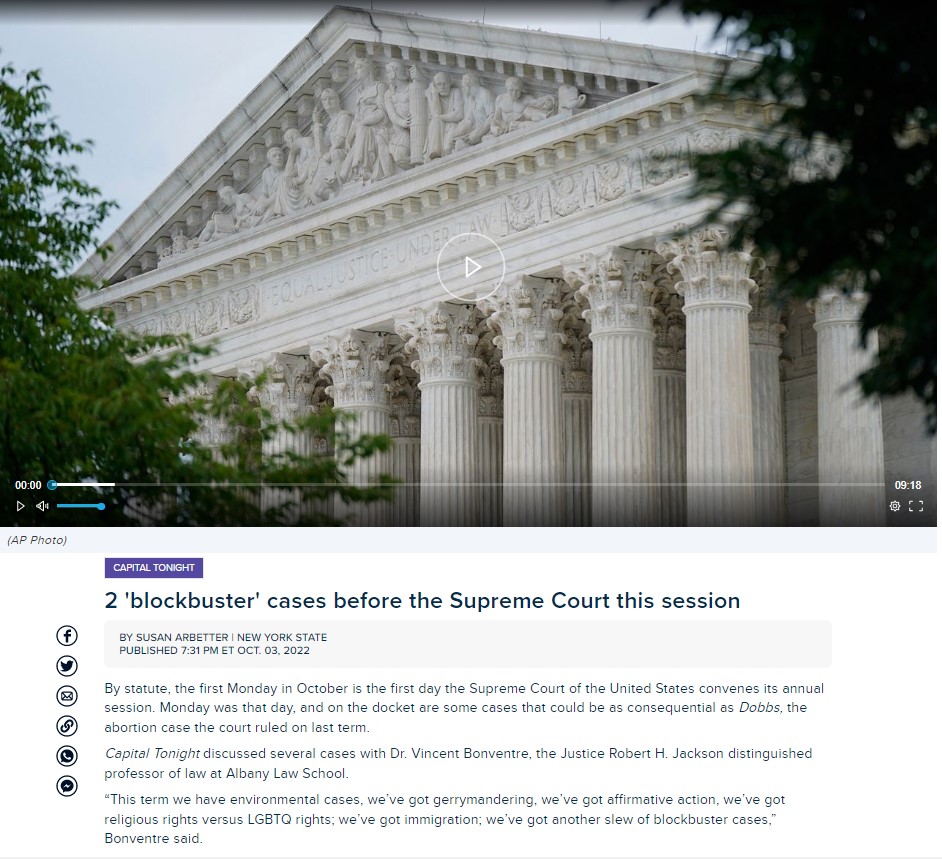
Capital Tonight: Previewing Some Major Cases This Supreme Court Term
Wednesday, February 9, 2022
What's with Gorsuch?
As widely reported, Justice Neil Gorsuch has decided to go maskless on the bench. Everyone else on the Court has been wearing a mask. Well, we can't say that about Sonia Sotomayor. She has avoided the bench and participated in oral arguments remotely. Notably, she is a diabetic. Good enough reason to keep her distance from the unmasked colleague.
Relatedly, it has become pretty well known among Supreme Court watchers that Gorsuch's colleagues find him annoying, self-righteous, arrogant, and not nearly as bright as he apparently thinks. One might say insufferable. Yes, I'll say it.Actually, none of this is new. Shortly into his tenure, Court watchers described Gorsuch as an impudent upstart who was preaching to his veteran colleagues. He quickly took to telling them that he, not they, understood the role of a Supreme Court Justice. As one observer reported about an early Gorsuch opinion, "He instructed his senior colleagues, who collectively have a total of a hundred and forty years’ experience on the Court, about how to do their jobs." [See, How Badly Is Neil Gorsuch Annoying the Other Supreme Court Justices? by Jeffrey Toobin, The New Yorker, September 29, 2017.]
Another observed that "He’s the new kid in class with his hand always up. He is in his colleagues’ faces pointing out the error of their ways, his snarky tone oozing disrespect toward those who might, just might, know what they are talking about." [See, Trump’s Life-Tenured Judicial Avatar, by Linda Greenhouse, New York Times, July 6, 2017.]
Several years into his tenure on the Court, Gorsuch remains just as smug. Dissenting last year against the Chief Justice in "an unmistakably parental tone," Gorsuch "scolded the majority." John Roberts' opinion for the Court, Gorsuch sneered, "says so little about the Constitution’s terms because so little can be said that might support its ruling.” [See, Neil Gorsuch Couldn’t Stop Complaining About the Rest of the Justices Today, by Elura Nanos, Law & Crime, Mar 25th, 2021.]
As one long-time Court watcher, well-known for her inside sources, put it recently, "Gorsuch, from the beginning of his tenure, has proved a prickly justice, not exactly beloved even by his conservative soulmates on the court." [See, Gorsuch didn't mask despite Sotomayor's COVID worries, leading her to telework, by Nina Totenberg, NPR, January 18, 2022.]
Gorsuch seems so cocksure of his own perspectives. Less pompous and more perceptive Justices understand how difficult and close the legal questions typically are that confront the Court. There are, almost always, strong legal arguments supporting each side of the controversies that come before the Court. But Gorsuch, even when he agrees with a result reached by his colleagues, often feels compelled to write separately to instruct them, as well as any Justices on the opposing side, of his own superior and certain description of the case and analysis of the issues. These separate writings are oftentimes snide, and not nearly as persuasive as the leading majority or dissenting opinions.
Take the case where the Court struck New York's pandemic restrictions on church attendance. [Roman Catholic Diocese v. Cuomo (2021).] The unsigned per curiam opinion for the majority was measured and, even if one disagreed, thoughtful and certainly arguable. And yet, Gorsuch couldn't help himself. Despite his agreement with the majority decision to invalidate the state's restrictions, he had to write his own opinion, taking potshots at Chief Justice Roberts who dissented in the case. He accused the Chief Justice of "a serious rewriting of history" about Roberts's reliance on the 1905 Jacobson landmark in a recent opinion, supporting similar pandemic restrictions in California. [In that 100 plus-year-old landmark, Jacobson v. Massachusetts, the Court had upheld a mandate for smallpox vaccinations against constitutional "liberty" challenges.]
The Chief Justice, perceptibly irritated with his junior colleague, responded to "One solo concurrence." Roberts's previous reliance on Jacobson, he reminded Gorsuch, was for an axiomatic proposition that “[o]ur Constitution principally entrusts ‘[t]he safety and the health of the people’ to the politically accountable officials of the states." "It is not clear," the Chief Justice added, "which part of this lone quotation [the unnamed Gorsuch] finds so discomfiting."
Gorsuch also seemed impressed with his own proof of religious discrimination in the New York restrictions. Some non-church activities were treated more favorably than religious ones, according to Gorsuch, for mere "secular convenience." He variously emphasized, for example, that, under the state's restrictions, "it may be unsafe to go to church, but it is always fine to pick up another bottle of wine." Apples and oranges anyone?
The point is not that the decision reached by the majority and Gorsuch was legally wrong--remember, these cases are close. Rather, it is Gorsuch's arrogant certainty in his own less-than-compelling arguments.
The point is likewise not about Gorsuch's taking politically conservative positions. Even when he takes positions that political liberals would favor, he can't seem to avoid the self-assured certainty in rather lame--and unnecessary--legal analysis.
Sunday, August 25, 2019
Trump's Justices: Gorsuch to Date (Part 2)
In fact, together with Justice Clarence Thomas, his record on politically charged issues was the most politically conservative on the Court. Indeed, 100% politically conservative voting in cases involving the death penalty, campaign finance restrictions, gun rights, gay rights, workers' rights, church and state, President Trump's travel ban, and similar politically divisive matters. Significantly, Gorsuch's 100% politically conservative voting record contrasted sharply with the 41% conservative decisional record of the Court as a whole. (See Trump's Justices (Part 1): Gorsuch to Date.)
Now what about Gorsuch's voting record for the next two terms on the Court—2017-18 and last term, 2018-19? Specifically, how did his voting record compare to that of the Court's other strongly politically conservative members, Justices Thomas and Samuel Alito, and to the Court as a whole? Let's take a look at the very next term, Gorsuch's first full one on the Court, the 2017-18 term (click to enlarge):
The politically charged issues confronted by the Court during the 2017-18—and voted on by Gorsuch—included Trump's travel ban (again), immigrant rights, abortion rights, gay rights, union representation, worker rights, voting rights, gerrymandering, search and seizure protections, and international human rights. In virtually every case, Gorsuch voted for the politically conservative position.
In fact, in some cases, Gorsuch took a position that was even more politically conservative than the already conservative majority or dissenting opinions. For example, in the Masterpiece Cakeshop case, where the bakery refused to create a cake for a same-sex marriage celebration, the majority of the Court ruled for the bakery on very narrow grounds. It held that the Colorado civil rights commission's decision, that the bakery was guilty of sexual orientation discrimination, was tainted by the commission members' explicit hostility to the baker's religion--comparing it to Nazi hatred of the Jews. In short, the Court majority ruled that the baker did not receive a fair hearing. But not that businesses were free to violate state anti-discrimination laws, even for religious reasons.
That decision of the Court was inadequate for Gorsuch. He authored a separate concurring opinion making the claim that the bakery did not actually engage in any discrimination at all—unlawful or otherwise. Gorsuch's rationale? The bakery would not create a same-sex cake for any couple, whether same-sex or opposite-sex. So the bakery was treating everyone the same. Not kidding!
(You know, like the old anti-miscegenation laws did not really discriminate against anyone. Everyone—black or white or Asian—was required to marry within their own race. So those laws treated everyone the same. Gorsuch's argument was reminiscent of that nonsense.)
Let's finish this post by taking a look at the ideological voting spectrum of the entire Court. Here it is (click to enlarge):
Monday, June 4, 2018
The Cakeshop case: What the Court Did NOT Decide
BUT! And the BUT is the critical part of the case.
Listening to some commentators and some partisans this morning, it's doubtful they had actually read the Court's decision. Or maybe they have simply been characterizing the decision to fit their preconceptions or preferences.
The 7-2 decision, authored by Justice Anthony Kennedy, held--and only held--that Colorado's Civil Rights Commission was hostile to the baker's religious beliefs and thus did not give him a fair and neutral hearing. Period!
The Court did NOT decide that bakers may refuse to bake cakes for gays or lesbians or same-sex couples.
The Court did NOT decide that bakers may refuse to bake a cake for a same-sex marriage celebration.
The Court did NOT decide that bakers (or any other business) may violate a state's anti-discrimination law.
The Court did NOT decide that bakers (or any other business) may violate such a law even on religious grounds.
The Court did NOT decide that religious freedom outweighs the rights of gays, lesbians or same-sex couples.
The Court did NOT decide that exceptions to anti-discrimination laws must be made for religious objections.
The Court did NOT decide First Amendment religious freedom entitles religious objectors to exemptions from an anti-discrimination law--or any law at all.
The Court did NOT overturn its 1990 decision in Oregon v. Smith that any "an otherwise valid law" defeats religious objections.
The Court did NOT rule any of the foregoing ways on the basis of freedom of expression either.
And the Court certainly did NOT decide that discrimination or other unequal treatment of gays, lesbians, or same-sex couples in public accommodations was constitutionally permissible--for religious or any other reasons.
In fact, the Supreme Court actually reaffirmed that neither "religious [n]or philosophical objections...allow business owners and other actors in the economy to deny protected persons [which includes "gay persons and gay couples"] equal access to goods and services under a neutral and generally applicable public accommodations law."
In this case, the Supreme Court merely found that the determination of the Colorado commission against the baker was not "neutral." In terms of the Court's 1990 Oregon v. Smith precedent, that Colorado determination was not "otherwise valid" because it unlawfully assessed the baker's religious belief as illegitimate and subjected it to ridicule. In the Supreme Court's own words, the Colorado commission "disparage[d]" the baker's religious faith "by describing it as despicable, and also characterizing it as merely rhetorical--something insubstantial and even insincere."
The Court made clear that Colorado's anti-discrimination "interest could have been weighed against [the baker's] sincere religious objections in a way consistent with the requisite religious neutrality." But that, instead, the Colorado commission treated the baker's beliefs with contempt and consequently failed to conduct a fair hearing.
For that reason the Court sided with the baker in this case.
NOT because religious objections to same-sex marriage outweigh the equal rights of same-sex couples to goods and services in the marketplace.
Sunday, October 1, 2017
A Supremely Blockbuster New Term?
For the 2017-18 term of Court that is to begin Monday, October 2--the iconic First Monday in October--the cases that are already on the Court's docket strongly suggest that this will be a year of blockbuster decisions. It is always possible, of course, that the Justices will bob and weave and avoid confronting some of the hot-button constitutional questions at the heart of these cases. But with four Justices who lean very politically conservative, and four very politically liberal--oftentimes leaving Justice Anthony Kennedy to cast the deciding vote-- the Court can be expected to resolve some very ideologically-contentious issues with some very ideologically-charged rulings.
Here are several of the most significant issues the Court will tackle this term:
Partisan Gerrymandering
As in extreme gerrymandering. As in extreme mathematical efficiency to virtually guarantee that the political party in power remains in power. As in making it extremely difficult for that party to lose elections.
So, for example, in the case to be heard by the Court this week, Gill v. Whitford, the Republican party in power in Wisconsin has carved up voting districts in the state in ways that severely dilute the effect of Democratic votes. This gerrymandering has, in fact, produced a near certainty that the Republicans retain control of the legislature. Indeed, even when the Democratic party has won a substantial majority of the statewide vote in recent years, the Republicans have still won a substantial majority of the voting districts.
[Yes, Democrats have done the same thing when they can.]
Racial gerrymandering is unconstitutional. But what about partisan gerrymandering? Is it just another "political question" which the majority of the Court believes should be resolved in the political process? Or is partisan gerrymandering, at least in extreme cases, a fundamental violation of our democratic voting process that calls for a judicial redress?
Gay Rights/Religious Liberty
What happens when equal rights for gays and lesbians competes with religious objections to supporting their life choices? In Masterpiece Cakeshop v. Colorado, a baker refused on religious grounds to make a cake for a same-sex wedding. Colorado ruled that this refusal was a violation of the state's public accommodation law which, among other things, prohibits sexual-orientation discrimination.
There are many legal and constitutional ingredients relevant to this case. Nevertheless, it is a pretty sure bet that predetermined positions on LGBT rights will be reflected in the voting of most, if not all, of the Justices. For example, it is very very difficult to conceive of Justices Ginsburg and Sotomayor siding with the religiously objecting baker against the same-sex couple. It is at least as difficult to imagine Justices Thomas and Alito and Gorsuch siding with the same-sex couple against the baker. On the other hand, it is not difficult to see Justice Kennedy--or even Chief Justice Roberts--actually balancing the competing interests and determining the outcome of the case.
There are a few wrinkles that may affect the Court's decision. One has to do with the requested design of the cake in question--would the baker be required to include a message on the cake that expresses support for same-sex marriage, perhaps infringing on the baker's free speech?
Another wrinkle involves the current state of 1st Amendment religious liberty under which any "otherwise vaild law" defeats religious objections--thanks to the 1990 Scalia-authored decision, in Oregon v. Smith, derogating the religious freedom of Native Americans. [See Justice Scalia's Record (Part 1), New York Court Watcher, Feb. 18, 2016; The Fall of Free Exercise, 70 Alb. L. Rev. 1399 (2007).]
One last wrinkle to mention is that Colorado apparently does allow exemptions from its public accommodations law--e.g., an African-American baker need not include a white supremacy message. That raises the question of whether the state is discriminating against religious requests for exemptions.
Technology-Enabled Searches
When seeking a cell phone company's location records on a cell phone user, must law enforcement first obtain a warrant? Or as the Court has often styled the issue in other cases, when the government seeks to obtain and examine such records, is that a "search" within the meaning of the 4th Amendment? If it is, then a warrant supported by probable cause is required. If it's not a "search," then no warrant is required. This is the question presented in Carpenter v. U.S.
Whether or not the Court will view obtaining and examining cell phone location records as a "search"--thus triggering the warrant requirement--depends upon whether or not a majority of the Justices adhere to some search and seizure doctrines it has applied in the past. Some of these doctrines were, until recently, thought to have been permanently rejected by the Court. Others have never been explicitly rejected, but seem to have been weakened in Court decisions involving technology.
One of these doctrines is that a search is not a "search" unless there is a "trespass"--some illegal entry or contact--by the government on one of the things mentioned in the 4th Amendment. Sooooo, since the location records kept by a cell company do not belong to the cell phone user, there is no "trespass" upon something he owns and, thus, there is no "search." Additionally, cell phone location records are obviously not mentioned or even implicated by any of the items listed in the 4th Amendment which was ratified in 1792 (or its state government application via the 14th Amendment of 1868).
Then there's the 3rd party doctrine. Since the cell phone company--the 3rd party--has access to the cell user's location, there is no "reasonable expectation of privacy" in such records and, thus, the government's examining of those records is not a "search" under the 4th Amendment.
[Hey, those aren't my doctrines. Like others--other courts, other judges and justices, other rulings--I disagree with those doctrines and, indeed, believe they are preposterous and were developed to approve very questionable, warrantless searches. See Is a Search a Search.]
We might see whether the Court abandons or at least further undermines those doctrines--or sticks to them.
Union Dues
May a state require non-members of a public employees union to pay some reduced dues (aka "agency fees") to help defray the expenses of collective bargaining and other services that the union provides for all the covered public employees, whether members or not?
The Court approved such dues in its 1977 decision in Abood v. Detroit Bd of Ed. But since then, some of the Justices have made clear their disagreement with Abood. Then, in 2016, following Scalia's death, the Court split 4-4 on that issue in Friedrichs v. California Teachers Assn.
Now, in Janus v. American Federation of St, Cnty, and Munic Employees (AFSCME), which the Justices just granted review last week, that question is back before the Court.
The issue pits the need of public employee unions in representing the rights of the workers against the counter claims of free speech and association of non-members who do not wish to support the positions of the unions--bargaining or otherwise.
Gorsuch would seem to be the tipping vote, ending the 4-4 tie, and that should not give comfort to the unions. But will both Roberts and Kennedy agree to actually overturn Abood? Stay tuned.
Anti-Gay Employment Discrimination (possible case)
Is discrimination against gays and lesbians a violation of the civil rights laws? The 11th Circuit Court of Appeals--the federal appellate court that sits in Atlanta, GA--recently ruled, in Evans v. Georgia Regional Hospital, that discrimination against a worker because she is a lesbian does not violate Title VII of the Civil Rights Law. That 1964 law prohibits sex discrimination, but it does not explicitly prohibit sexual-orientation discrimination.
The Obama administration took the position that sexual orientation discrimination is a form of sexual discrimination. Among other things, it is based on discriminatory sexual stereotyping--e.g., a man may partner with a woman, but a woman may not; a woman may partner with a man, but a man may not. By contrast, the Trump administration has argued that sex discrimination covers no such thing.
The 7th Circuit, the federal appeals court that sits in Chicago, recently took the position in Hively v. Ivy Tech that prohibited sex discrimination does include discrimination based on sexual-orientation. Notably, that court's position was supported by several of the federal judiciary's well-recognized heavyweights, including Judges Diane Wood, Frank Easterbrook, and Richard Posner--the latter authoring a separate concurring opinion arguing the irrational bigotry of discrimination against gays and lesbians, and even listing some gays throughout history who have contributed immensely to civilization.
With this split among the circuits, and the challenge of Posner to any legitimate defense of sexual-orientation discrimination, it seems very likely that the Supreme Court will grant review to address the issue.
Gun Rights (possible case)
Does it violate the individual right to bear arms to require a license to carry a concealed weapon, based on some actual need for self-protection? The D.C. Circuit recently held that the D.C. law requiring such a license was invalid. That the law was contrary to the Supreme Court's 2008 decision, in D.C. v Heller, that the 2nd Amendment guarantees an individual right to bear arms.
This D.C. Circuit decision, in Wrenn v. D.C., seems to conflict with the 9th Circuit's 2016 decision in Peruta v. San Diego County, upholding a similar concealed-carry licensing requirement. Adding to the intrigue, the Supreme Court, just this past spring, declined to review that 9th Circuit's decision. Adding to that, Justices Thomas and Gorsuch dissented from the Court's decision not to review that case. Those dissenters argued that the Supreme Court was disparaging gun rights.
So it's pretty clear how Thomas and Gorsuch would vote if the Supreme Court now granted review in Wrenn in order to resolve the conflict among the circuits. But how the others would vote--especially after denying review in Peruta--is another question.
Trump's Travel Ban (moot?)
President Trump's original travel ban was replaced by a second. And last term, by a 6-3 majority in Trump v. Int'l Refugee Asst Project, the Court partially upheld the orders of the courts below that had temporarily barred enforcement of that executive order. The Court did, however, unanimously reverse the lower courts "with respect to foreign nationals who lack any bona fide relationship with a person or entity in the United States"--i.e., the Trump ban could be enforced against them. At the same time, the Court agreed to hear the case this term.
However, on the way to the hearing, which had been scheduled for this week, the Trump administration promulgated travel ban 3.0. That certainly seemed to make the case involving travel ban 2.0 moot--i.e., no longer an ongoing case or controversy in need of judicial resolution. So the Court cancelled oral arguments and asked for briefing on the question of mootness.
In short, the original case involving travel ban 2.0, which had been granted review, is no longer on the Court's schedule.
There are surely other significant cases which the Court has already accepted for review, and others which it will accept. But the foregoing six--which have been granted review or are very likely to be granted soon--are certainly among the most hot-button and ideologically-charged among the cases that promise to make this 2017-18 term a blockbuster one.
Thursday, January 12, 2017
Want Scalia-type Justices? Really? (Part 3: Discrimination Against Gays & Lesbians)
Do self-proclaimed Scalia admirers really want President-elect Trump to appoint Justices who agree with that? That is Scalia's record. Not someone's personal view or conjecture about it.
Now let's continue.
![]() |
| Photo: Atlantic Wire |
Scalia never supported equal protection or due process rights for gays and lesbians. More than that, he explicitly did support and approve animosity and discrimination against them.
Let's review each of the relevant cases in which Scalia participated. First, here are those cases in which he wrote an opinion:
Romer v. Evans (1996)
This case involved a Colorado law that prohibited any local law that sought to protect gays and lesbians from discrimination. The Supreme Court ruled that the state law was unconstitutional. By singling out a group to be denied legal protection, the law violated the constitutional guarantee of equal protection.
Scalia dissented.
In Scalia's view, the state law was an appropriate disapproval of homosexuality. In his own words, the law was a "constitutionally permissible" and "eminently reasonable" effort by the state's citizens--who are "entitled to be hostile toward homosexual conduct"--to deny protection "to those with a self-avowed tendency or desire to engage in the conduct." [My emphasis added.]
Lawrence v. Texas (2003)
In this landmark gay rights case, the Court ruled that laws that made same-sex intimacy a crime were unconstitutional.The case specifically involved a Texas law that criminalized "deviate sexual intercourse," defined in part as sexual activity "with another individual of the same sex." The Court held that there was no legitimate government purpose that justified prohibiting and punishing the personal intimacy targeted by the law.
Scalia dissented.
In Scalia's view, it was perfectly permissible to make "homosexual sex" a crime. According to him, the law was a legitimate expression that such conduct is "immoral and unacceptable." He protested that "homosexual sodomy is not a fundamental right" and, therefore, that it could legitimately be made a crime just like "fornication, bigamy, adultery, adult incest, bestiality, and obscenity." [My emphasis added.]
U.S. v. Windsor (2013)
In this case, the Court invalidated that part of the so-called Defense of Marriage Act (federal DOMA) that denied federal marriage benefits to legally married same-sex couples. The Court explained that a "bare congressional desire" to treat "a politically unpopular group" differently was not a legitimate justification for denying them benefits that are available to other legally married couples.
Scalia dissented.
In Scalia's view, DOMA was a valid defense of traditional marriage. He again complained, and claimed, that the majority had "declared a constitutional right to homosexual sodomy." Likewise, he again insisted that the Constitution "let['s] the People decide" whether or not to "enforce traditional moral and sexual norms." [My emphasis added.]
Obergefell v. Hodges (2015)
In yet another landmark gay rights case, the Court ruled that the right to marry may not be denied to same-sex couples. The Court explained that the right to marry is fundamental, that personal choices concerning marriage are part of constitutionally protected liberty, and that there is no legally relevant difference between same- and opposite-sex couples with respect to these matters.
Scalia dissented.
Scalia ridiculed the majority's "extravagant praise of liberty" that "robs the People" of their right to pass the laws they choose. As with equal rights for women, he insisted that the issue of same-sex marriage was settled "[w]hen the Fourteenth Amendment was ratified in 1868." Although that amendment guarantees equal protection and liberty against state laws, Scalia argued that "every State limited marriage to one man and one woman" when the amendment was ratified, and because "no one doubted the constitutionality of doing so" at that time, "[t]hat resolves these cases." [My emphasis added.]
Two additional major gay rights cases deserve mention. Scalia did not author an opinion in these cases, but he did cast a vote:
Boy Scouts v. Dale (2000)
In this case, the Court held that New Jersey's anti-discrimination law--which among other classifications included sexual orientation--could not be applied to the Boy Scouts. According to the majority's opinion, the Boy Scouts' choice to exclude gays from leadership positions was an exercise of their constitutional "freedom of expressive association."
The dissenting Justices, on the other hand, argued that "eliminating discrimination is a compelling state interest" that justified enforcement of the state's law.
Not surprisingly, Scalia approved the disparate treatment of gays. He joined the majority and sided with the Boy Scouts against the state's prohibition of sexual orientation discrimination.
Christian Legal Society v. Martinez (2010)
This case involved a California state college that refused to recognize and fund a student organization that excluded all gay and lesbian students from membership. The Court upheld the college's non-discrimination policy, which it applied to all student groups, that membership must be open to all students.
The dissenting Justices, on the other hand, argued that the student group was rightfully exercising its constitutional freedom to express its view about sexual morality.
Again, not surprisingly, Scalia voted with the dissenters and, thus, as in every other case, he opposed the position for equal treatment of gays and lesbians.
Yes, in every one of these cases there were arguments and interests presented on both sides. In every case, there were precedential, historical, interpretive, and other policy and legally relevant support proffered for both sides. Indeed, that's the very reason such cases get to the Supreme Court. But in every case, no matter what the arguments or interests, Scalia adopted those against the rights of gays and lesbians.
When a state chose to prohibit local laws that protected gays and lesbians from discrimination, Scalia insisted that the Court should defer to the state's prerogative. But when states chose to actually prohibit such discrimination, he disregarded the supposed need to defer and sided against those state policies.
Regarding laws that criminalized same-sex intimacy and a law that denied government benefits to legally married same-sex-couples, he insisted that "homosexual sodomy" was not a constitutional right. But when confronted with anti-discrimination laws protecting gays and lesbians, he found fundamental rights to exclude them from the Boy Scouts and to exclude them from student organizations.
The inconsistencies in Scalia's legal positions abound. But there is one consistency that only deliberate blindness would fail to see. Scalia was utterly hostile to the protection of gays and lesbians from discrimination. In Scalia's view, such discrimination was perfectly reasonable and constitutionally justified.
To Scalia, the Constitution's guarantee of "equal protection" was to be read as "equal protection except for gays and lesbians, and [as we saw in the last post] except for women."
Once again: Scalia-admirers, do you really want Justices like that? Potential Trump nominees, do you really agree with Scalia on that? And one more question: Would you really be willing to say so when asked at a Senate confirmation hearing? I guess we shall see.
In the next post, we'll take a look at Scalia's positions on cruel and unusual punishment.
Tuesday, March 1, 2016
Justice Scalia's Record (Part 3: "Homosexual Sodomy")
Or as he would refer to the issue--with raw hostility, exasperation, and rather peculiar frequency--the "fundamental right of homosexual sodomy."
During Scalia's tenure on the Court, the Justices confronted numerous questions of constitutionally protected liberty and equality as applied to gays and lesbians.
It is no surprise, at least to those who actually follow the Court and the positions taken by its members, that Scalia sided against gays and lesbians in every case.
Let's review the positions taken by Scalia in those cases where he wrote an opinion.
Gay Rights
Romer v. Evans (1996): the Court's majority invalidated a state law that had prohibited any local law that sought to protect gays and lesbians from discrimination. Scalia dissented and argued that the state law was a legitimate exercise of the popular disapproval of homosexuality.
In its opinion for the Court, the majority took the position that it was a violation of the constitutional guarantee of equal protection of the law to single out a group to be denied legal protection from discrimination.
Scalia disagreed, protesting that the law was a "constitutionally permissible" and "eminently reasonable" effort by the state's citizens--who are "entitled to be hostile toward homosexual conduct"--to deny protection "to those with a self-avowed tendency or desire to engage in the conduct."
Lawrence v. Texas (2003): the Court's majority invalidated a state law that criminalized "homosexual sex." Scalia dissented again and argued that the law was a legitimate expression of the state's belief that certain sexual conduct was "immoral and unacceptable."
In its opinion for the Court, the majority held that there was in fact no legitimate government interest that justified the law's (or similar "anti-sodomy" laws') intrusion into the intimate private lives of individuals.
Scalia protested that "homosexual sodomy is not a fundamental right" and, therefore, that a state may criminalize such behavior just as it may criminalize other sexual conduct it considers immoral such as "fornication, bigamy, adultery, adult incest, bestiality, and obscenity."
U.S. v. Windsor (2013): the Court's majority invalidated that part of the so-called Defense of Marriage Act (federal DOMA) that denied federal marriage benefits to legally married same-sex couples. Scalia dissented once again and argued that the law's denial of benefits was a valid defense of traditional marriage.
In its opinion for the Court, the majority held that a "bare congressional desire" for disparate treatment of "a politically unpopular group" was not a legitimate reason for denying benefits to legally married same-sex couples that are available to other legally married couples.
Scalia repeated his previous complaint that the Court's majority had "declared a constitutional right to homosexual sodomy," as well as his argument that the Constitution "let['s] the People decide" whether to "enforce traditional moral and sexual norms."
Obergefell v. Hodges (2015): the Court's majority ruled that the right to marry may not be denied to same-sex couples. Scalia dissented one more time and argued that the majority had "rob[bed] the People" of their "freedom to govern themselves" on the issue.
In its opinion for the Court, the majority took the position that the right to marry is fundamental, that personal choices concerning marriage are among the most intimate aspects of constitutionally protected liberty, and that there is no legally relevant difference between same- and opposite-sex couples with respect to these matters.
For Scalia, however, the issue of same-sex marriage was easily resolved and the majority was clearly wrong: "When the Fourteenth Amendment was ratified in 1868 [protecting 'liberty' from undue deprivation by the states], every State limited marriage to one man and one woman, and no one doubted the constitutionality of doing so. That resolves these cases."
There were two additional major cases involving gay rights in which Scalia participated. In these, he voted but did not author an opinion:
Boy Scouts v. Dale (2000): the Court's majority held that a state's anti-discrimination law could not be applied to the Boy Scouts. According to the majority's opinion, the choice to exclude gays from leadership positions was constitutionally protected by "the Scouts’ freedom of expressive association."
The dissenters in that case took the position that "eliminating discrimination is a compelling state interest" that justified application of the state law.
Scalia joined the majority, siding with the Boy Scouts.
Christian Legal Society v. Martinez (2010): the Court's majority upheld a state college's decision to deny student activity funding, recognition, and other benefits to a campus organization that refused membership to all gay and lesbian students.
On the other hand, the dissenting Justices argued that the state college's application of its non-discrimination policy to the campus group violated that group's right to express its viewpoint about sexual morality.
Scalia joined the dissenters, siding with the student group.
[Disclosure: I disagree with Scalia's position in every one of those cases.
Connect the dots. Scalia always sided against gays and lesbians. He always found the competing interest or the competing argument or the competing theory to outweigh any liberty and equality rights of gays and lesbians.
So, in his view, a popular majority's disapproval of gays and lesbians was reasonable and justified laws criminalizing "homosexual sodomy." Similarly, hostility towards gays and lesbians justified denying them any legal protection from sexual orientation discrimination.
So too, according to Scalia, the enforcement of traditional moral and sexual norms justified denying marriage benefits to same-sex couples even if they were legally married. Also, the view of marriage from nearly 150 years ago sufficed, without more, to justify prohibiting same-sex marriage today.
Beyond that, Scalia supported the notion that an organization's disapproval of gays and lesbians outweighs a state law that prohibits discrimination. And a state college should be required to subsidize and recognize a student group despite the group's open discrimination against gays and lesbians.
Contrary to Scalia's positions in all these cases, my own view is that there is simply no legitimate government reason--as opposed to some individual's or majority's religious, or moral, or traditional view--to deny gays and lesbians the same liberties and equal treatment as heterosexuals. And the application of equal protection and anti-discrimination laws to rectify the historic savage discriminatory treatment and persecution of gays and lesbians more than justifies overriding the associational preferences of organizations and activities, except perhaps for those that are truly private.]
In Part 4, we'll look at Scalia's positions on issues of race.
Thursday, December 3, 2015
The Supreme Court's Last Term: Review & Implications (PPT)
To view the complete slide presentation, open HERE.
(Then, for the best view, click File + Download, and Open the download.)
Sunday, September 13, 2015
Supremely Awful Arguments: Constitutional Nonsense (Part 2)
The Whitney, the Jim Dandy, the Alabama, the Travers, the Woodward, plus, plus, plus.)
So, "It's not mentioned in the Constitution."
Another one we hear all the time.
This one may even be worse than "Leave it to the states" or "to the people." (See Part 1.)
At least those arguments appeal to sentiments of federalism and democracy.
"It's not mentioned" simply appeals to ignorance.
Ignorance about the Constitution itself. About the Bill of Rights. About the very notion of free government.
We hear it whenever the Supreme Court protects a right or liberty--i.e., what the Court rules to be a right or liberty--that isn't specifically identified in the Constitution.
Those who disagree with the decision, be they talk radio hosts or "expert" commentators or Justices themselves, will parrot this one.
It's utter nonsense.
Indeed, the only virtue in this supremely awful argument is that it's bi-partisan and bi-ideological.
Conservative Republicans dredge this one up whenever an unexplicit right they don't like is protected by the Court--e.g., the right of privacy, the right to choose, Miranda warnings, etc.
And liberal Democrats resort to it when the Court protects some unspecified right that they disfavor--e.g., campaign spending, business freedoms, individual gun rights unconnected to state militias, etc.
But whenever the argument is raised, and whoever raises it, it's utter nonsense.
Let's consider the recent Obergefell v. Hodges decision recognizing the equal right of same-sex couples to marry.
"The right to same-sex marriage is not mentioned in the Constitution."
That's what we've heard from those who disagree with the decision, including some of the dissenting Justices.
The correct response to them should be, "Yes, and therefore what?"
The right to marry, itself, isn't mentioned--opposite or same sex.
The right to choose who to marry is not mentioned--opposite or same sex.
The right of a married couple to have sex is not mentioned.
The right of a married couple to have children is not mentioned.
The right of a married couple to raise their children--same.
The right of a married couple to seek advice about raising their children--same.
The right of a married couple, or anyone else, to have friends--same.
To join a group--same.
To have friendly gatherings--same.
Even to have family gatherings--same.
Etc., etc., etc.
Would anyone doubt that all of those are pretty basic rights?
Essential aspects to life in a free society?
Would anyone think that government in America should be permitted to deny them with impunity?
Deny them without some very very strong reason, like public health or safety or some other societal necessity?
Even though none of those rights are mentioned in the Constitution?
Even though none of them are even implied?
Well, except for the word "liberty."
That word is in the Constitution a few times.
But nothing more specific than that to refer to any of those unmentioned rights.
Benjamin Cardozo helped explain the notion of basic rights--mentioned or unmentioned--in the Supreme Court's 1937 decision in Palko v. Connecticut. His opinion is the foundational expression in American law for determining which rights are "fundamental" and, therefore, constitutionally protected from violation by any government--federal, state, or municipal.
The critical point, as Cardozo put it, is whether a claimed right is "implicit in the concept of ordered liberty." Whether a claimed right is "essential" to a free and just society.
Not whether it happens to be one of the few guarantees actually listed in the Bill of rights.
Indeed, we nearly didn't have a Bill of Rights because of fear that the "it's not listed" or "it's not mentioned" argument would be raised in the future. The Founders and Framers were worried that, by listing some rights, those freedoms that were left unspecified might later be denied.
Yes, ultimately the arguments favoring a Bill of Rights--e.g., that a partial list was better than none at all--won the day. (See e.g., Jefferson's correspondence with Madison on the subject of a "declaration of rights.")
But the fears about the "it's not mentioned" argument have become reality.
That argument is precisely the nonsense we hear regularly about rights not specified in the Bill of Rights.
But the "it's not mentioned" argument is even worse than the foregoing suggests.
In an effort to foreclose such an argument, a provision was added to the Bill of Rights. The 9th Amendment. That addition makes clear, in no uncertain terms, that the list of rights specified in the Constitution is necessarily very limited, and that unlisted rights are not to be denied.
(9th Amendment: "The enumeration in the Constitution, of certain rights, shall not be construed to deny or disparage others retained by the people.")
This was James Madison's attempt to put a nail in the coffin of the "it's not mentioned" argument.
It was his more delicate way of saying that that supremely awful argument is utter nonsense.
Of course, not every right that might be claimed is deserving of constitutional recognition and protection--i.e., is implicit in and essential to the American scheme of liberty.
But the fact that such a right is not "enumerat[ed] in the Constitution" is irrelevant.
Now, before concluding, let's be clear that the "it's not mentioned" argument is not the sole province of conservatives and Republicans. Liberals and Democrats resort to this utter nonsense as well.
Let's take campaign spending.
The dreaded Citizens United decision.
Right or wrong, wise or foolish, the fact that spending money on political campaigns or issues is unmentioned in the Constitution is itself irrelevant.
Yes, the 1st Amendment speaks of free "speech." And spending money on political campaigns or issues is not speech.
No, it certainly is not.
But picketing--e.g., to protest a company's low wages--is similarly not mentioned in the Constitution, nor is it exactly speech either.
Marching--e.g., against the Boy Scouts' or other private organizations' discrimination against gays and lesbians--is not mentioned and not exactly speech.
Wearing some symbol--e.g., a black armband to protest war or a red ribbon to support AIDS research--is not mentioned and not exactly speech.
Burning the American flag--for whatever reason--is not mentioned and not exactly speech.
Etc., etc., etc.
Yes, all of those activities are engaged in for the purpose of expressing support or opposition or other opinions.
But the terms "expression"and "activity"are nowhere to be found in the 1st Amendment.
It specifies only "speech."
Well, it might be asserted, but aren't all those "expressive activities" kind of part of the broad notion and purpose and principle of free speech?
Indeed!
And so is spending money to produce a political documentary--just like the one at issue in Citizens United.
And so is spending money in support of a political party or candidate.
They are ways of expressing one's views, akin to speech.
To be sure, there may be some very strong arguments for limiting such political spending.
But not because "it's not mentioned."
There are strong reasons for limiting or prohibiting some expressive activities.
For some, the reasons are clear--e.g., setting fire to property to express opposition to the owner's bigotry or to police brutality.
But the fact that picketing and marching and wearing a symbol and burning the flag--and campaign spending--do not happen to be specifically mentioned in the Constitution is a wholly illegitimate reason for rejecting a claim that they are, or ought to be, protected constitutional rights.
Regardless of the possible reasons for limiting or prohibiting certain expressive activities, the "it's not mentioned" argument is not one of them. That argument, whether applied to expressive activities or the right to privacy or any other unspecified right, is utter nonsense, devoid of historical or constitutional basis.
In fact, it's contrary to both.
Next up: a related supremely awful argument--"Textualism, literalism, or that's not exactly what it says."
Monday, August 3, 2015
Supremely Awful Arguments: Constitutional Nonsense (Part 1)
Pure nonsense. [And that's euphemistic.]
We hear plenty of these arguments from talk show hosts, from "expert" commentators, and from the Justices themselves--either fuming or ecstatic about some constitutional ruling. They are spewed by both conservatives and liberals, Republicans and Democrats, on and off the bench. But only when those arguments support their respectively preferred results. They are otherwise disregarded--as they should always be.
To be clear. This is NOT about whether a particular constitutional ruling (e.g., on same-sex marriage, campaign finance, abortion rights, gun rights) is legally correct or sound policy. This is solely about the bona fides of some of the arguments repeated incessantly as though they were compelling. In fact, they are utterly without merit in constitutional cases. Again, pure nonsense.
Let's begin with this favorite:
This matter should be left to the states
Where to start with this one?
First, it totally begs the question.
It begs the question at the very heart of virtually every constitutional issue for which it is raised.
That question is whether a constitutional right is involved in the first place.
If such a right is involved, then it's certainly not up to the states whether to honor that right or violate it.
[N.B., we are discussing United States Constitutional rights. The states are generally free to protect a claimed right under their own State constitutions or their own laws--whether or not the same right is protected under the federal constitution or other federal law. We are here addressing arguments made about United States Constitutional matters at issue at the United States Supreme Court]
It's certainly not up to the states whether to honor or violate freedom of speech, or free exercise of religion, or the right to counsel, or the right to trial by jury, or the prohibition against forced self-incrimination or against cruel and unusual punishment--or any other right protected under the United States Constitution.
Nor is it up to the states whether to treat persons equally on the basis of race, or gender, or religion, or ethnicity, or any other classification that the United States Constitution protects against discrimination.
No, the states don't get to choose when it comes to United States Constitutional rights.
If such a right is involved, the states are not free to violate it.
So the threshold question--before leaving it to the states--is whether such a right is involved.
If no such right is involved, then the matter can be left to the states.
Stated otherwise, to argue that the matter should be left to the states is to presume that no United States Constitutional right is involved. But that's the essential question to be decided.
And who decides that?
Second, under our system, the courts decide whether a constitutional right is involved and whether it has been violated. Ultimately, regarding the United States Constitution, it's the United States Supreme Court that has the last word.
Not the states.
States don't get to decide whether same-sex marriage, campaign spending, abortion rights, gun rights, or any other claimed right or liberty is protected under the United States Constitution.
States don't get to choose whether they can abridge, infringe, or deny a claimed right that is protected under the United States Constitution.
No, in our system, the judicial branch decides those matters--i.e., judicial review.
And the ultimate authority in making such decisions under the United States Constitution is the United States Supreme Court--i.e, Chief Justice John Marshall, Marbury v. Madison, the Federalist Papers.
So, in cases involving a claim of right under the United States Constitution, it is of course pure nonsense to argue that the issue should be left to the states.
Nonsense to argue that the states get to construe the United States Constitution for themselves.
Nonsense to argue that the states get to decide what is a United States Constitutionally protected right.
And, if it is such a protected right, nonsense to argue that the states get to decide whether to honor or violate it.
Unless, of course, we are to do away with the Supreme Court's power of judicial review.
And unless we do that....
No, whether something is a United States Constitutional right--and thus must be honored--is not up to the states.
Whether it's gun rights or campaign spending that conservatives and Republicans generally favor.
Or the right to choose or rights of the criminally accused that liberals and Democrats generally support.
Whether those rights must be recognized and protected under the United States Constitution is a matter for the United States Supreme Court, not the states.
Now, with all the foregoing in mind, consider this:
A case at the United States Supreme Court to interpret the United States Constitution and to decide whether something is a United States Constitutional right and whether such a right has been violated.
An argument is made that the matter should be left to the states.
Left to the states--not the United States Supreme Court--to interpret the United States Constitution?
Left to the states--not the United States Supreme Court--to decide whether or not something is right protected by the United States Constitution?
Left to the states--not the United States Supreme Court--to decide whether to honor or violate a United States Constitutional right?
Yes, there is a certain appeal to the "leave it to the states" argument in our federal system of government in which the states do retain sovereignty over many matters.
But not about the meaning of the United States Constitution, and not about honoring or violating a United States Constitutional right.
So leave it to the states?
(Yes, I'm now repeating myself for emphasis about this utterly nonsensical argument that's repeated ad nauseam.)
That begs the entire issue of whether a United States Constitutional right is involved.
That must be answered first.
If the question is answered in the affirmative, then the states certainly don't have a choice.
Only if it's answered in the negative--only if there is no right protected under the United States Constitution--may it be left to the states to decide whether or not to recognize such a right themselves under their own laws.
Then there's the closely related argument:
Leave this matter to the "people"--i.e., to the voters
As before, not if a United States Constitutional right is involved.
Whatever was said above about the "leave it to the states" argument applies here as well.
Just as nonsensical.
No, whether something is a United States Constitutional right is not subject to a vote by the people.
And no, if something is a United States Constitutional right, it's not subject to a vote by the people to honor or violate it.
Again, unless we are to do away with the United States Supreme Court's power of judicial review.
And yet, we hear these arguments repeatedly. By those who don't know any better and, worse, by those who do or should.
Next Supremely Awful Argument: It's not mentioned in the Constitution.
We'll deal with that in the next post.
Monday, July 6, 2015
Marriage Decision: Recap
Disclosure: No surprise to readers of New York Court Watcher or anyone who knows me, I am extremely pleased that the Supreme Court has recognized the equal right of same-sex couples to marry. My personal opinion aside, here's an unadorned outline of the Court's decision and the dissenting opinions.As readers of this....No, as readers and listeners of the news around the world now know, the United States Supreme Court ruled that same-sex couples have the same right to marry as do opposite-sex couples. The Justices released their decision near the end of the term, along with several other blockbusters. (See e.g., posts on Wrap Ups, Supremely Polarized, Obamacare Subsidies, Confederate Flag, Lethal Injection.)
The dust is now settling--at least the bare fact of the decision is sinking in to both ecstatic supporters and enraged opponents. There's been an awful lot of commentary. Emphasis on awful. But some that is thoughtful and even wise.
There will be no attempt here at being thoughtful or wise--or awful. Just some straightforward distillation of the actual constitutional arguments made by the majority, and those offered in the several dissenting opinions.
[We will examine some of the awful commentary and analysis in a later post.]
Here's the recap of Obergefell v. Hodges:
Decision
- Same-sex couples are constitutionally entitled to the same right to marry as are opposite sex couples.
- The vote was 5 to 4.
- Majority: Justice Kennedy, joined by Ginsburg, Breyer, Sotomayor, and Kagan [I.e., Kennedy + the 4 liberals]
- Dissent: separate opinions by Chief Justice Roberts, and Justices Scalia, Thomas, and Alito [I.e., by each of the Court's 4 more conservative Justices--1) Roberts's opinion was joined by Scalia and Thomas; 2) Scalia's opinion was joined by Thomas; 3) Thomas's opinion was joined by Scalia; 4) Alito's opinion was joined by Scalia and Thomas]
- [Procedurally, the decision reversed the decision of a federal appeals court (the 6th Circuit) that sustained "one man-one woman" laws in Kentucky, Michigan, Ohio, and Tennessee. The other federal appeals courts around the country to address the issue had all held such laws to be unconstitutional.]
- Marriage is an institution of transcendent importance, and the right to marry has long been constitutionally protected by the Court.
- The legal status of gays and lesbians, previously viewed as immoral and ill, has shifted greatly since the late 20th century.
- This Court has previously invalidated laws that discriminated against gays and lesbians--e.g., laws that denied them the right to claim discrimination, that made same-sex intimacy a crime, and that denied federal benefits to legally married same-sex couples.
- The "liberty" protected by the 14th Amendment [The provision in the Constitution that guarantees protection against infringement by state governments.] has been interpreted by this Court to include most of the rights listed in the Bill of Rights, as well as other fundamental liberties of "individual dignity and autonomy," such as the rights to privacy, to childrearing, to procreation, and to marry.
- The issue in this case is not whether there is a right to same-sex marriage, but whether there is "sufficient justification for excluding" same-sex couples from the fundamental right to marry.
- The exclusion demeans and stigmatizes same-sex couples.
- It does this even though there is no difference between same- and opposite-sex couples when it comes to the fundamental right to marry and to the many government rights, benefits, and responsibilities tied to a valid marriage.
- Laws against same-sex marriage not only violate the fundamental right to marry, but also the equal protection of the laws.
- As with the laws prohibiting inter-racial marriage, which this Court held to be unconstitutional in Loving v. Virginia (1967), the laws prohibiting same-sex marriage are unjustified, unsupportable, and incompatible with the requirements of equality.
- Individuals denied fundamental rights need not wait for legislative action to be protected.
- There are strong arguments in social policy and fairness for allowing same-sex couples to marry.
- While the policy arguments may be compelling, the legal arguments are not.
- A state's choice to retain the meaning of marriage that has persisted throughout history and across cultures cannot be called irrational.
- The right to marry does not include the right to change that meaning.
- The Court ought not to impose its will upon the states and shortchange the democratic process.
- A more modest and restrained view of this Court's role would be more skeptical of its moral insights and more sensitive to its unelected status.
- If you favor expanding same-sex marriage, "by all means celebrate today's decision...Celebrate the opportunity for a new expression of commitment to a partner."
- "But do not celebrate the Constitution. It had nothing to do with it"
- I don't have strong personal feelings about the substance of today's "decree" or what the law says about marriage.
- But I do care about "who it is that rules me."
- Today's decision is the furthest extension of the Court's "naked judicial claim" to create "liberties."
- That claim is fundamentally contrary to our system of democracy in which the People, the States are free to adopt laws, even if they offend the "reasoned judgment" of the Justices.
- The opinion--"judicial Putsch"--of the majority reflects "hubris," and is "pretentious," "egotistic," and "profoundly incoherent."
- The majority recognizes a "liberty" in the Constitution that the Framers would not recognize.
- The decision is detrimental to the liberty that the Framers did seek to protect.
- The decision distorts the text of the Constitution and inverts the constitutional relationship between individual and government.
- In light of history, the term "liberty" in the Constitution refers to "the power of loco-motion...without imprisonment or restraint"--to nothing "broader than freedom from physical restraint."
- The American people have been engaged in a debate about same-sex marriage.
- The federal courts have now put an end to that.
- "The Constitution says nothing about a right to same-sex marriage."
- Some states worry that abandoning the traditional understanding of marriage will lead to marriage's further decay.
- It is beyond this Court's authority to say that a state may not adhere to that view.
Thursday, July 2, 2015
Supreme Court Wrap Ups (On Air Commentary)
Plus, at the state level, New York Court of Appeals Judge Susan Read announced her early retirement for the state's high court.
For anyone interested, here are links to a few of the interviews:
Fred Dicker: Live from the State Capitol! (6/30/15)
New York State STOPS...to hear Fred Dicker!
TUESDAY: ALBANY LAW SCHOOL PROF. VIN BONVENTRE: MY TAKE ON THE IMPORTANT ROUND OF NEW U.S. SUPREME COURT DECISIONS.
Link: www.talk1300.com/CMT/podcast/LiveFromtheStateCapitolJune302015.mp3 (@ 29:00 -49:00 mins)
Fred Dicker: Live from the State Capitol! (7/31/15)
New York State STOPS...to hear Fred Dicker!
WEDNESDAY: ALBANY LAW SCHOOL PROF. VIN BONVENTRE PART II: A CONTINUING DISCUSSION ON THE U.S. SUPREME COURT'S FINAL DECISIONS, PLUS THE SIGNIFICANCE OF COA'S ASSOCIATE JUDGE SUSAN READ'S DECISION TO RETIRE.
Link: www.talk1300.com/CMT/podcast/LiveFromtheStateCapitolJuly12015.mp3
(@ 29:30 - 49 mins)
The John Gomez Show, LI News Radio (6/29/15)Gomez with Professor BonventreLink: https://soundcloud.com/jvcbroadcasting/gomez-with-professor-bonventre?in=jvcbroadcasting/sets/the-john-gomez-show-on-li-news
Capital Tonight (6/29/15)
Monday was the last day of the Supreme Court's term for this year, and while their two blockbuster decisions came last week the judges did weigh in on some big issues, including the death penalty and redistricting. Albany Law professer and New York Court Watcher blogger Vin Bonventre joined us to talk more about these issues.
Link: http://www.twcnews.com/nys/capital-region/capital-tonight-interviews/2015/06/29/vin-bonventre-062915.html#
Capital Tonight (6/29/15)
The US Supreme Court delivered a huge victory to President Obama today, upholding a key part of the Affordable Care Act. That decision means millions of Americans across the country who enrolled through state health exchanges will not lose their insurance. Vin Bonventre from Albany Law School joined us to discuss.
Link: http://www.twcnews.com/nys/capital-region/capital-tonight-interviews/2015/06/25/vin-bonventre.html