The Supreme Court today ruled in favor of the baker in Masterpiece Cakeshop v. Colorado Civil Rights Commission. In short, the baker had refused on religious grounds to create a cake for a same-sex couple's marriage celebration. The state of Colorado determined that the baker violated the state's law which prohibits discrimination by businesses on the basis of sexual-orientation. The Supreme Court has now reversed that determination and did so on the basis of religious freedom.
BUT! And the BUT is the critical part of the case.
Listening to some commentators and some partisans this morning, it's doubtful they had actually read the Court's decision. Or maybe they have simply been characterizing the decision to fit their preconceptions or preferences.
The 7-2 decision, authored by Justice Anthony Kennedy, held--and only held--that Colorado's Civil Rights Commission was hostile to the baker's religious beliefs and thus did not give him a fair and neutral hearing. Period!
The Court did NOT decide that bakers may refuse to bake cakes for gays or lesbians or same-sex couples.
The Court did NOT decide that bakers may refuse to bake a cake for a same-sex marriage celebration.
The Court did NOT decide that bakers (or any other business) may violate a state's anti-discrimination law.
The Court did NOT decide that bakers (or any other business) may violate such a law even on religious grounds.
The Court did NOT decide that religious freedom outweighs the rights of gays, lesbians or same-sex couples.
The Court did NOT decide that exceptions to anti-discrimination laws must be made for religious objections.
The Court did NOT decide First Amendment religious freedom entitles religious objectors to exemptions from an anti-discrimination law--or any law at all.
The Court did NOT overturn its 1990 decision in Oregon v. Smith that any "an otherwise valid law" defeats religious objections.
The Court did NOT rule any of the foregoing ways on the basis of freedom of expression either.
And the Court certainly did NOT decide that discrimination or other unequal treatment of gays, lesbians, or same-sex couples in public accommodations was constitutionally permissible--for religious or any other reasons.
In fact, the Supreme Court actually reaffirmed that neither "religious [n]or philosophical objections...allow business owners and other actors in the economy to deny protected persons [which includes "gay persons and gay couples"] equal access to goods and services under a neutral and generally applicable public accommodations law."
In this case, the Supreme Court merely found that the determination of the Colorado commission against the baker was not "neutral." In terms of the Court's 1990 Oregon v. Smith precedent, that Colorado determination was not "otherwise valid" because it unlawfully assessed the baker's religious belief as illegitimate and subjected it to ridicule. In the Supreme Court's own words, the Colorado commission "disparage[d]" the baker's religious faith "by describing it as despicable, and also characterizing it as merely rhetorical--something insubstantial and even insincere."
The Court made clear that Colorado's anti-discrimination "interest could have been weighed against [the baker's] sincere religious objections in a way consistent with the requisite religious neutrality." But that, instead, the Colorado commission treated the baker's beliefs with contempt and consequently failed to conduct a fair hearing.
For that reason the Court sided with the baker in this case.
NOT because religious objections to same-sex marriage outweigh the equal rights of same-sex couples to goods and services in the marketplace.
Research & Commentary on the Supreme Court, the New York Court of Appeals, More
Showing posts with label SupCt: Discrimination. Show all posts
Monday, June 4, 2018
Monday, May 8, 2017
Gorsuch--Yes, Backward and Extreme (Part 2)
It's now Justice Neil Gorsuch, having been confirmed by the Senate following the Republicans' deployment of the nuclear option. I've been tied up with (over)commitments--not that I could have affected the outcome--but let's continue with this series because Gorsuch's record is at least as important now as it was when he was a nominee.
We saw how Judge, now Justice Gorsuch's avowed approach to judicial decision-making is "focusing backward, not forward." It's viewing constitutional rights in accordance with "what a reasonable reader at the time...would have understood the law to be." Judicial decision-making is "not a forward-looking but a backward-looking authority." Those are his words. That is his judicial creed. That is what he has reaffirmed repeatedly in speeches and writings, and applied in cases.
At first blush, Gorsuch's approach might sound perfectly reasonable. You know, it's a specie of the bromide that "judges should just apply the law and not make it." But any thoughtful consideration exposes Gorsuch's judicial creed as drastically reactionary. As a prescription for undoing our nation's cherished advances in fundamental constitutional protections.
That is no exaggeration. That is just plain fact and history. That might be his and others' preference. But that is what it is.
Gorsuch's judicial creed, which had been famously professed by his predecessor, Antonin Scalia, is part of a tradition that has opposed constitutional advances and has condemned those advances after they have been made. Yes, opposed them and condemned them--at least until those advances have become part of our culture, a cherished part of our culture, and to oppose them any longer is too embarrassing.
So, for example, as mentioned previously [See Part 1.], the Gorsuch-Scalia creed would have precluded the landmark protections of equal rights for African-Americans, for women, for gays and lesbians, etc. Consider again the consequences if the Supreme Court had adopted the Gorsuch-Scalia approach to decision-making--i.e., looking "backward" to what the constitutional provisions meant "at the time":
- Racial segregation would have been upheld, not outlawed--the Supreme Court in Brown v. Board of Education (1954) deliberately re-construed the 14th Amendment to prohibit segregation, contrary to what had long been permitted and to what that amendment meant "at the time" it was ratified in 1868.
- State laws preventing women from owning property or running a business or going to law school, etc., would have been upheld, not overruled--the Supreme Court in Reed v. Reed (1971) extended "equal protection" beyond what it meant "at the time" of ratification and invalidated laws that treated men better than women.
- State laws that discriminated against and even criminally punished gays and lesbians would have been upheld, not declared unconstitutional--the Supreme Court in Lawrence v. Texas (2003) held that "equal protection" and "due process" protected gays and lesbians, even though those constitutional provisions certainly did not mean that "at the time."
- And so many others, such as Loving v. Virginia (1967) [invalidating laws that prohibited inter-racial marriage]; Griswold v. Connecticut (1965) [invalidating laws that prohibited birth control]; Heart of Atlanta Motel v. U.S. and Katzenbach v. McClung (1964) [upholding civil rights laws that prohibit racial discrimination in privately owned lodging and restaurants]; West Virginia v. Barnette (1943) [upholding the right of religious-objecting Jehovah Witnesses not to salute the flag].
In every one of those landmark cases, and so many others, the Supreme Court rejected the Gorsuch-Scalia approach. Instead of confining constitutional provisions to what might have been their narrow, specific meanings "at the time" they were written and ratified, the Court gave life to the overriding, fundamental principles that those provisions reflected.
So the 14th Amendment's guarantee of "equal protection" in those cherished landmarks was not confined to "separate but equal" treatment for the newly freed black slaves. Instead, overruling Plessy v. Ferguson (1896) and breaking from the "backward-looking" "at the time" meaning of the 14th Amendment, the Court in Brown gave life to the overriding principle of equality under the law to put an end to legalized segregation of the races. Likewise, repudiating a long series of precedents that permitted disparate treatment of women, including some then-recent decisions, the Court in Reed expanded "equal protection" to invalidate gender as well as racial discrimination. And so forth.
Historically, the Gorsuch-Scalia brand of "backward-looking," "at the time," so-called "originalist-textualist" jurisprudence has always reared its head--yes, its ugly head--whenever the Supreme Court has advanced equal rights for minorities or women. Whether the Court was outlawing segregation, or protecting inter-racial marriages, or upholding the civil rights laws, or requiring that women have the same rights as men, or invalidating laws that discriminated on the basis of sexual orientation, the jurisprudence embraced by now-Justice Gorsuch has always been used to oppose those advances and to denounce them as illegitimate.
Yes, the repeated condemnation of all those cherished landmarks and so many others has been the same: "That's not what the constitutional provision meant at the time; that's not its original meaning." Fortunately for our country, that "originalist-textualist" approach has historically been rejected whenever the Court has understood that fundamental equality and fairness and decency were far more important constitutional principles than some avowed method of interpretation.
And it's not just the equal rights and privacy rights landmarks. The same is true for those landmarks that gave life to the rights of the accused. The Gorsuch-Scalia jurisprudence would have precluded those advances in criminal justice as well. We'll take a look at some of those in the next part of this series.
Tuesday, April 4, 2017
Gorsuch--Yes, Backward and Extreme (Part 1)
The Democrats in the Senate are right on this one. Judge Neil Gorsuch, President Trump's nominee for the Supreme Court, is indeed backward and extreme. Not necessarily him personally--I don't know him nor do I know others who do. But to be sure, his jurisprudence, as he himself has explained it and as he has applied it in deciding cases, is backward and extreme.
In fact, that is why he is supported so strongly by conservative Republicans, and other social conservatives. That is why he was placed on the list of recommended nominees from which Trump picked him. That list was produced by the Federalist Society and the Heritage Foundation, They are two very ideologically conservative organizations. They do their homework. They know his record.
Those strong supporters may not prefer the labels "backward" and "extreme." But no doubt, that is why they really like him.
Let's consider Gorsuch's own words.
Judges, he has said, should apply the law "focusing backward, not forward," in accordance with "what a reasonable reader at the time...would have understood the law to be."
And again, "judicial power" is "not a forward-looking but a backward-looking authority." In short, apply what the words originally meant.
Ah, no wonder social conservatives like him so much. Looking "backward," applying what constitutional provisions meant "at the time," as Gorsuch urges, just happens to produce decisional results that social conservatives would prefer. It's also no wonder why some of the most socially and politically conservative judges--and politicians and commentators who support them--embrace this so-called "originalism" and "textualism."
So, for example, consider the Constitution's "equal protection of the laws" guarantee. That provision has long been a major battleground between conservatives and liberals. It became part of the Constitution after the Civil War, with the ratification of the 14th Amendment in 1868.
Looking "backward," to what it meant "at the time," would certainly exclude equal rights for gays and lesbians. Certainly, in 1868, the ratification of the 14th Amendment was not meant to protect gays and lesbians. Applying the equal protection guarantee in a "backward""at the time" manner, as Gorsuch urges, would still permit laws that criminally punish private, consensual, same-sex intimacy between adults--let alone same-sex marriage. It would also permit laws that intentionally discriminate against gays and lesbians in employment, housing, restaurants, hotels, etc., etc.
That's right. The Constitution's equal protection guarantee says nothing about gays or lesbians or transgenders. And those persons were absolutely not--looking "backward"--what equal protection was about "at the time" in 1868.
Indeed, Judge Gorsuch's hero, the late Antonin Scalia--the foremost proponent of this so-called "originalist-textualist" approach that Gorsuch has ardently embraced--took exactly that position. The Supreme Court modern era decisions that have extended equal protection to gays and lesbians and same-sex couples were among the most hated and denounced by Scalia. What was Scalia's claimed reason? That the equal protection guarantee did not mean that in 1868. [Scalia on gay rights.]
But this looking "backward" and "at the time" approach goes well beyond allowing discriminatory treatment of gays and lesbians. How about women?
The equal protection guarantee was certainly not intended, in 1868, to insure equal rights for women. It would never have been ratified in 1868 if its purpose was to require that women be treated equally with men. That laws treating women differently and unequally were no longer valid. Looking "backward," equal protection of the laws for women was not what was meant "at the time." In fact, it was not until 100 years later that the Supreme Court finally did give equal protection that meaning and outlaw gender discrimination.
Again, Gorsuch's hero, the "originalist-textualist" Scalia, openly insisted that constitutional equal protection did not apply to women. And why? Because that's not what it meant when it was ratified. [Scalia on women's rights.]
Then there's racial segregation.
Equal protection was certainly not intended to end racial segregation when added to the Constitution in 1868. It would never have been ratified if its purpose was to require that African-Americans be allowed to share the same schools, restaurants, hotels, spaces on the bus and railroads, etc., with white persons. At most, "separate but equal" was as far as equal protection was intended to go "at the time." Indeed, it was not until 1954 that the Supreme Court expanded the meaning of equal protection to abandon "separate but equal' and to outlaw segregation.
So, should the Supreme Court really have looked "backward" and applied the law according to what it meant "at the time"--really? And allowed racial segregation to continue? And should judges today look "backward" and restore the racial segregation that was allowed "at the time" the 14th Amendment was ratified in 1868?
Well, of course, almost all self-avowed "originalist-textualist" judges, politicians and commentators are far too embarrassed to endorse a return to racial segregation. They will attempt to rationalize how their approach would not necessarily support that result. But it does do just that. Just as that "originalist-textualist" approach would deny equal protection of the laws to women. And--as most "originalist-textualist" devotees still do acknowledge--would undo all the gay rights and same-sex rights decisions of the Supreme Court in recent years. That "originalist-textualist" approach, looking "backward," supports a return to allowing racial segregation because it was allowed "at the time."
Of course, the same could be said for so many other constitutional guarantees--e.g., the right to the assistance of counsel, search and seizure protections, free "speech," the right to private sexual choice (even between married couples), etc., etc. Looking "backward" to what they meant "at the time," these were not the rights we enjoy and cherish today as Americans. They were much narrower, much more limited, and didn't mean then what they mean now.
We'll look at some of them in the next post.
But for now, even without looking further, it should be clear that Judge Gorsuch's approach to the law is backward--the term he himself uses--and extreme.
In fact, that is why he is supported so strongly by conservative Republicans, and other social conservatives. That is why he was placed on the list of recommended nominees from which Trump picked him. That list was produced by the Federalist Society and the Heritage Foundation, They are two very ideologically conservative organizations. They do their homework. They know his record.Those strong supporters may not prefer the labels "backward" and "extreme." But no doubt, that is why they really like him.
Let's consider Gorsuch's own words.
Judges, he has said, should apply the law "focusing backward, not forward," in accordance with "what a reasonable reader at the time...would have understood the law to be."
And again, "judicial power" is "not a forward-looking but a backward-looking authority." In short, apply what the words originally meant.
Ah, no wonder social conservatives like him so much. Looking "backward," applying what constitutional provisions meant "at the time," as Gorsuch urges, just happens to produce decisional results that social conservatives would prefer. It's also no wonder why some of the most socially and politically conservative judges--and politicians and commentators who support them--embrace this so-called "originalism" and "textualism."
So, for example, consider the Constitution's "equal protection of the laws" guarantee. That provision has long been a major battleground between conservatives and liberals. It became part of the Constitution after the Civil War, with the ratification of the 14th Amendment in 1868.
Looking "backward," to what it meant "at the time," would certainly exclude equal rights for gays and lesbians. Certainly, in 1868, the ratification of the 14th Amendment was not meant to protect gays and lesbians. Applying the equal protection guarantee in a "backward""at the time" manner, as Gorsuch urges, would still permit laws that criminally punish private, consensual, same-sex intimacy between adults--let alone same-sex marriage. It would also permit laws that intentionally discriminate against gays and lesbians in employment, housing, restaurants, hotels, etc., etc.
That's right. The Constitution's equal protection guarantee says nothing about gays or lesbians or transgenders. And those persons were absolutely not--looking "backward"--what equal protection was about "at the time" in 1868.
Indeed, Judge Gorsuch's hero, the late Antonin Scalia--the foremost proponent of this so-called "originalist-textualist" approach that Gorsuch has ardently embraced--took exactly that position. The Supreme Court modern era decisions that have extended equal protection to gays and lesbians and same-sex couples were among the most hated and denounced by Scalia. What was Scalia's claimed reason? That the equal protection guarantee did not mean that in 1868. [Scalia on gay rights.]
But this looking "backward" and "at the time" approach goes well beyond allowing discriminatory treatment of gays and lesbians. How about women?
The equal protection guarantee was certainly not intended, in 1868, to insure equal rights for women. It would never have been ratified in 1868 if its purpose was to require that women be treated equally with men. That laws treating women differently and unequally were no longer valid. Looking "backward," equal protection of the laws for women was not what was meant "at the time." In fact, it was not until 100 years later that the Supreme Court finally did give equal protection that meaning and outlaw gender discrimination.
Again, Gorsuch's hero, the "originalist-textualist" Scalia, openly insisted that constitutional equal protection did not apply to women. And why? Because that's not what it meant when it was ratified. [Scalia on women's rights.]
Then there's racial segregation.
Equal protection was certainly not intended to end racial segregation when added to the Constitution in 1868. It would never have been ratified if its purpose was to require that African-Americans be allowed to share the same schools, restaurants, hotels, spaces on the bus and railroads, etc., with white persons. At most, "separate but equal" was as far as equal protection was intended to go "at the time." Indeed, it was not until 1954 that the Supreme Court expanded the meaning of equal protection to abandon "separate but equal' and to outlaw segregation.
So, should the Supreme Court really have looked "backward" and applied the law according to what it meant "at the time"--really? And allowed racial segregation to continue? And should judges today look "backward" and restore the racial segregation that was allowed "at the time" the 14th Amendment was ratified in 1868?
Well, of course, almost all self-avowed "originalist-textualist" judges, politicians and commentators are far too embarrassed to endorse a return to racial segregation. They will attempt to rationalize how their approach would not necessarily support that result. But it does do just that. Just as that "originalist-textualist" approach would deny equal protection of the laws to women. And--as most "originalist-textualist" devotees still do acknowledge--would undo all the gay rights and same-sex rights decisions of the Supreme Court in recent years. That "originalist-textualist" approach, looking "backward," supports a return to allowing racial segregation because it was allowed "at the time."
Of course, the same could be said for so many other constitutional guarantees--e.g., the right to the assistance of counsel, search and seizure protections, free "speech," the right to private sexual choice (even between married couples), etc., etc. Looking "backward" to what they meant "at the time," these were not the rights we enjoy and cherish today as Americans. They were much narrower, much more limited, and didn't mean then what they mean now.
We'll look at some of them in the next post.
But for now, even without looking further, it should be clear that Judge Gorsuch's approach to the law is backward--the term he himself uses--and extreme.
Monday, July 6, 2015
Marriage Decision: Recap
Disclosure: No surprise to readers of New York Court Watcher or anyone who knows me, I am extremely pleased that the Supreme Court has recognized the equal right of same-sex couples to marry. My personal opinion aside, here's an unadorned outline of the Court's decision and the dissenting opinions.As readers of this....No, as readers and listeners of the news around the world now know, the United States Supreme Court ruled that same-sex couples have the same right to marry as do opposite-sex couples. The Justices released their decision near the end of the term, along with several other blockbusters. (See e.g., posts on Wrap Ups, Supremely Polarized, Obamacare Subsidies, Confederate Flag, Lethal Injection.)
The dust is now settling--at least the bare fact of the decision is sinking in to both ecstatic supporters and enraged opponents. There's been an awful lot of commentary. Emphasis on awful. But some that is thoughtful and even wise.
There will be no attempt here at being thoughtful or wise--or awful. Just some straightforward distillation of the actual constitutional arguments made by the majority, and those offered in the several dissenting opinions.
[We will examine some of the awful commentary and analysis in a later post.]
Here's the recap of Obergefell v. Hodges:
Decision
- Same-sex couples are constitutionally entitled to the same right to marry as are opposite sex couples.
- The vote was 5 to 4.
- Majority: Justice Kennedy, joined by Ginsburg, Breyer, Sotomayor, and Kagan [I.e., Kennedy + the 4 liberals]
- Dissent: separate opinions by Chief Justice Roberts, and Justices Scalia, Thomas, and Alito [I.e., by each of the Court's 4 more conservative Justices--1) Roberts's opinion was joined by Scalia and Thomas; 2) Scalia's opinion was joined by Thomas; 3) Thomas's opinion was joined by Scalia; 4) Alito's opinion was joined by Scalia and Thomas]
- [Procedurally, the decision reversed the decision of a federal appeals court (the 6th Circuit) that sustained "one man-one woman" laws in Kentucky, Michigan, Ohio, and Tennessee. The other federal appeals courts around the country to address the issue had all held such laws to be unconstitutional.]
- Marriage is an institution of transcendent importance, and the right to marry has long been constitutionally protected by the Court.
- The legal status of gays and lesbians, previously viewed as immoral and ill, has shifted greatly since the late 20th century.
- This Court has previously invalidated laws that discriminated against gays and lesbians--e.g., laws that denied them the right to claim discrimination, that made same-sex intimacy a crime, and that denied federal benefits to legally married same-sex couples.
- The "liberty" protected by the 14th Amendment [The provision in the Constitution that guarantees protection against infringement by state governments.] has been interpreted by this Court to include most of the rights listed in the Bill of Rights, as well as other fundamental liberties of "individual dignity and autonomy," such as the rights to privacy, to childrearing, to procreation, and to marry.
- The issue in this case is not whether there is a right to same-sex marriage, but whether there is "sufficient justification for excluding" same-sex couples from the fundamental right to marry.
- The exclusion demeans and stigmatizes same-sex couples.
- It does this even though there is no difference between same- and opposite-sex couples when it comes to the fundamental right to marry and to the many government rights, benefits, and responsibilities tied to a valid marriage.
- Laws against same-sex marriage not only violate the fundamental right to marry, but also the equal protection of the laws.
- As with the laws prohibiting inter-racial marriage, which this Court held to be unconstitutional in Loving v. Virginia (1967), the laws prohibiting same-sex marriage are unjustified, unsupportable, and incompatible with the requirements of equality.
- Individuals denied fundamental rights need not wait for legislative action to be protected.
- There are strong arguments in social policy and fairness for allowing same-sex couples to marry.
- While the policy arguments may be compelling, the legal arguments are not.
- A state's choice to retain the meaning of marriage that has persisted throughout history and across cultures cannot be called irrational.
- The right to marry does not include the right to change that meaning.
- The Court ought not to impose its will upon the states and shortchange the democratic process.
- A more modest and restrained view of this Court's role would be more skeptical of its moral insights and more sensitive to its unelected status.
- If you favor expanding same-sex marriage, "by all means celebrate today's decision...Celebrate the opportunity for a new expression of commitment to a partner."
- "But do not celebrate the Constitution. It had nothing to do with it"
- I don't have strong personal feelings about the substance of today's "decree" or what the law says about marriage.
- But I do care about "who it is that rules me."
- Today's decision is the furthest extension of the Court's "naked judicial claim" to create "liberties."
- That claim is fundamentally contrary to our system of democracy in which the People, the States are free to adopt laws, even if they offend the "reasoned judgment" of the Justices.
- The opinion--"judicial Putsch"--of the majority reflects "hubris," and is "pretentious," "egotistic," and "profoundly incoherent."
- The majority recognizes a "liberty" in the Constitution that the Framers would not recognize.
- The decision is detrimental to the liberty that the Framers did seek to protect.
- The decision distorts the text of the Constitution and inverts the constitutional relationship between individual and government.
- In light of history, the term "liberty" in the Constitution refers to "the power of loco-motion...without imprisonment or restraint"--to nothing "broader than freedom from physical restraint."
- The American people have been engaged in a debate about same-sex marriage.
- The federal courts have now put an end to that.
- "The Constitution says nothing about a right to same-sex marriage."
- Some states worry that abandoning the traditional understanding of marriage will lead to marriage's further decay.
- It is beyond this Court's authority to say that a state may not adhere to that view.
Well there it is.
To be sure, I've had to restrain myself from commenting while outlining the various opinions.
But I have tried to present a fair representation of the majority's and various dissenters' arguments.
And I have tried to do so without including or excluding too much or too little, hoping to capture the essentials.
Anyone interested in reading the entire decision, here is the link to Obergefell v. Hodges on the Supreme Court's website.
In the next New York Court Watcher post on the Supreme Court, I'll address some of the awful commentary I alluded to above. There may well be legitimate arguments, both pro and con, about the legal issue of same-sex marriage--and about the role of the Supreme Court. But much of what has been and will undoubtedly continue to be spouted is nonsense. We'll examine some of those arguments.
Additionally, we'll return our attention to the New York Court of Appeals--some important decisional and personnel developments.
AND, it's 2 1/2 weeks till the Saratoga meet opens. For psychological and emotional preparation, we need to recall some of last year's highlights. (If you can't wait for a Saratoga fix, here's a link to a previous year's highlights.)
Wednesday, January 28, 2015
Supreme Court: Justices' Voting in Gay Rights Cases (Part 2)
So what can be gleaned from the list of gay rights decisions and the Justices' votes which we laid out in the last post? A few interesting facts emerge.
Of the 7 cases--from Bowers v Hardwick in 1986 to U.S. v Windsor in 2013--all but one resulted in a deeply divided Court. In that one exception, Hurley v Irish American Gay, Lesbian, and Bisexual Group (1995), the unanimous Court sided with the organizers of Boston's St. Patrick's Day Parade who, contrary to Massachusetts' anti-discrimination law, refused to permit openly gay and lesbian marchers.
In Hurley, Republican and Democratic Justices, conservatives and liberals, joined together to favor the expressive rights of parade organizers over the equal rights of gays and lesbians.
But that unanimity was an outlier. Typically--meaning, in all the other cases--there has been division, strongly worded dissents, bitterness separating the Justices.
There have been Justices who adamantly and consistently have opposed gay rights. Justices seemingly opposed to recognizing any gay rights or protections whatsoever. Not just when gay rights are in competition with the [apparently sacrosanct] rights of parade organizers.
So, Justices Scalia and Thomas--as well as Rehnquist while he was on the Court--have always voted against gay rights. They favored parades-as-free-speech over equal protection for gays and lesbians, just as the other Justices did, in Hurley. But they also sided with a state law that denied gays and lesbians the right to sue for discrimination (Romer v Evans). Sided with the Boy Scouts' claimed right of association to exclude gay troop leaders (Boy Scouts of America v Dale). Sided with state laws that made gay and lesbian intimacy a crime (Lawrence v Texas). Sided with a student religious group that refused to admit gay and lesbian members (Christian Legal Society [CLS] v Martinez). And sided with a federal law (i.e., the so-called Defense of Marriage Act [DOMA]) that denied any recognition and all marriage benefits to legally married same-sex couples (U.S. v Windsor).
In short, Scalia and Thomas--and Rehnquist while he was on the Court--have sided with whatever interest might have competed with or conflicted with the rights of gays and lesbians.
Among the more recently appointed Justices, Roberts and Alito have voted in 2 of the cases. In both, they opposed the assertion of gay rights. In CLS, they voted to support a student group's entitlement to state college benefits, despite the group's membership policy to exclude gays and lesbians. In Windsor, they approved DOMA's denial of federal recognition and benefits to state married same-sex couples.
Notably, all 5 of the aforementioned anti-gay rights voting Justices--Rehnquist, Scalia, Thomas, Roberts, and Alito--are Republicans, were appointed by Republican Presidents, and had worked in Republican administrations, Notably also, all of them have voting records that, as a whole, are strongly politically conservative.
On the other end of the spectrum, there's Justices Ginsburg and Breyer--as well as Stevens and Souter while they were on the Court. Other than in the unanimous Hurley (St. Patrick's Day parade) decision, these Justices voted to protect gay rights in every case in which they participated. So whether it was the state law denying gays and lesbians the right to sue (Romer), the Boy Scouts excluding gays as troop leaders (BSA v Dale), state laws criminalizing same-sex intimacy (Lawrence), the college group denying membership to gays and lesbians (CLS), or the federal law disqualifying legal same-sex marriages from federal recognition and benefits (Windsor), these Justices always supported equal protection and due process rights for gays and lesbians over the asserted opposing interests.
The most recently appointed members of the Court, Sotomayor and Kagan, have cast a total of only 3 votes between them in these cases. Sotomayor in CLS, and both Sotomayor and Kagan in Windsor. All 3 of those votes were cast in support of gay rights.
Justices Ginsburg, Breyer, Sotomayor, and Kagan are all Democrats, appointed by Democratic Presidents, and have voting records that overall are politically liberal--from moderately to strongly so.
As for Stevens and Souter, however, they are each Republicans who were appointed by Republican Presidents. But both of them compiled voting records that turned sharply politically liberal over the course of their tenures on the Court. They were reliable pro-gay rights votes.
Then there is Justice Kennedy. Other than in the Boy Scouts case, in which he voted with the Republican Justices to uphold the claimed associational right to exclude gay troop leaders, Kennedy has been with the liberal Justices in each case. So he supported gay rights against the state law denying gays and lesbians the right to sue for discrimination (Romer), against state laws criminalizing homosexual intimacy (Lawrence), against the student group that excluded gays and lesbians (CLS), and against the federal law denying recognition and benefits to same-sex marrieds (Windsor).
Ironically, Kennedy is not only a Republican whose overall record is at least moderately conservative, but he was appointed by Ronald Reagan, perhaps the most politically conservative Republican President in modern history. Beyond that, Kennedy has not only been a, if not the, deciding vote in cases supporting gay rights, but as Supreme Court watchers know, he has authored many of the majority opinions. And he has done so in grand, lofty language that certainly suggests that his support for gay rights is not tepid, but rather that he places gay rights alongside the nations' other great civil rights struggles.
To sum this all up, as it now stands the Court has 4 virtually certain votes to support a constitutional right to marry for same-sex couples. Yes, Ginsburg, Breyer, Sotomayor, and Kagan. To be sure, it would be a shock if any of them voted otherwise.
It also seems pretty reasonable to expect that Justice Kennedy will vote the same and, thus, assure a pro same-sex marriage majority. A contrary vote by Kennedy would not be as much of a shocker as would be such a vote by one of the 4 liberal Democratic Justices. Nevertheless, it is hard to imagine that Kennedy will suddenly halt the direction in which he has been a leader in taking the Court.
On the far opposite side of the Court's ideological spectrum, it is equally hard to imagine that Scalia or Thomas would suddenly switch course and support same-sex marriage. They have been utterly and vehemently unsympathetic to every claim of right by gays and lesbians. As already noted, those 2 have opposed gay rights in every case in which they've voted. They have, instead, found every and any asserted competing interest to be superior to equal protection and due process for gays and lesbians.
Similarly, if not identically, Roberts and Alito have thus far displayed little sympathy for gay rights. They have, however, participated in only the 2 most recent cases, CLS and Windsor. Of those two Justices, Alito's record seems the more conservative and traditional, and he will likely vote to uphold the right of states to ban same-sex marriage.
But, who knows. Alito's dissenting opinion in Windsor (the DOMA case) was more about whether the Court should go so far so soon while, in his view, the jury was still out about the societal ramifications of same-sex marriage. His argument might not have been terribly sympathetic to gay rights. But neither was it the sort of hateful, disingenuous anti-gay nonsense we've come to expect from others. So Alito's vote is likely a no on same-sex marriage, but a yes would not seem entirely out of the question.
As for Roberts, again, he has shown little sympathy for gay rights. But--and this is the critical but--does he want to go down in history as being on its wrong side? Does he want to go down in history as the Chief Justice who opposed what surely represents the inevitable progress of enlightened, free societies throughout the civilized world to recognize equal rights for gays and lesbians? Does he want to go down in history as the Chief Justice who opposed his own Court's march in that direction?
Roberts' political background, his clear ideological leanings, his voting record all say one thing: no to same-sex marriage. But his leadership, his reputation, his legacy--what history will say about "The Roberts Court"--suggest his support. We shall see.
Tuesday, January 27, 2015
Supreme Court: Justices' Voting in Gay Rights Cases (Part 1)
We'll return to Gov. Cuomo's two yet-to-be-confirmed nominees to New York's Court of Appeals. But first, last post's look at the party affiliation of gubernatorial appointees to the high court suggested a brief detour. Let's review the party affiliation and ideological leaning of the Supreme Court Justices' votes in cases involving equal treatment for gays and lesbians.
Everyone with the slightest interest in national politics is aware that the United States Supreme Court has agreed to decide the issue of same-sex marriage. Virtually every federal court to have confronted the issue has invalidated state bans on gay and lesbian marriages. These courts have all agreed that there is simply no legitimate reason for denying same-sex couples the same right to marry that is enjoyed by opposite sex couples.
One federal appeals court has recently decided otherwise. Now, with this newly arisen conflict among the federal courts, the Justices have agreed to settle the question for the entire country--i.e., do laws that prohibit same-sex marriage violate the federal constitutional guarantees of equal protection, or of due process, or of the right to marry? (Or, maybe, of the federal taxing power which Chief Justice Roberts dredged up to uphold Obamacare? Just kidding).
Of course, the answer to whether same-sex marriages are constitutionally protected depends upon 5 out of 9 votes. If 5 of the Justices vote that gay and lesbian couples have the same constitutional right as do straight couples, then that's what the Constitution guarantees. If 5 of them say the opposite, then the Constitution provides no such guarantee.
Sorry, but to borrow from Oliver Wendell Holmes, Constitutional law just ain't some brooding omnipresence already out there. In a nation with judicial review, and with the Supreme Court as the final arbiter of federal law, the Constitution is what a majority of the Justices say it is. And before the Court actually rules, constitutional law is--again to borrow from Holmes--little more than a prediction of what the Justices will do. Of course, it certainly helps to know the voting records.
So with that in mind, let's take a look at how the Justices have voted in previous cases dealing with gay equality issues. Specifically, as mentioned above, let's look at the party affiliation and overall ideological leaning (i.e., across all issues) of the Justices and their votes in those past decisions.
In the modern era, there have been 7 major cases in which the Supreme Court has ruled on some substantive question of equal treatment for gays and lesbians. (There may be other decisions. But I've tried to include all those--pro or con--that directly confronted an issue of discrimination on the basis of sexual orientation.)
Here they are, together with the Justices, their votes, and their party affiliations and overall ideological leanings:
BOWERS v HARDWICK (1986)
Ruling: 5-4; states may criminalize homosexual intimacy.
(I hasten to add that this decision was rendered in Justice Byron White's shameful, hateful, dishonest opinion for the majority--one of the Court's all-time worst--based on his contemptuous and contemptible argument that there is no fundamental constitutional right to engage in "homosexual sodomy." It was explicitly overruled in Lawrence v Texas [see below].
Indeed, Justice Lewis Powell, who gave the majority its 5th and winning vote, later identified this vote as one of the mistakes of his career.)
Majority against gay rights:
Warren Burger (Republican [Nixon appointee], moderate conservative)
Byron White (Democrat [Kennedy appointee], moderate liberal/turned increasingly conservative)
Lewis Powell (Democrat [Nixon appointee], moderate conservative/Court centrist)
William Rehnquist (Republican [Nixon appointee], conservative)
Sandra Day O'Connor (Republican [Reagan appointee], moderate conservative)
Dissent for gay rights:
William Brennan (Democrat [Eisenhower appointee], liberal)
Thurgood Marshall (Democrat [Johnson appointee], liberal)
Harry Blackmun (Republican [Nixon appointee], moderate conservative/turned liberal)
John Paul Stevens (Republican [Ford appointee], moderate conservative/turned liberal)
HURLEY v IRISH AMERICAN GAY, LESBIAN, AND BISEXUAL GROUP (1995)
Ruling: 9-0; state anti-discrimination law cannot be enforced against private parade organizers who wish to exclude openly gay participants.
Unanimous vote against gay rights:
William Rehnquist (Rep [Nixon/Reagan], conservative)
John Paul Stevens (Rep [Ford], moderate conservative/turned liberal)
Sandra Day O'Connor (Rep [Reagan], moderate conservative/Court centrist)
Antonin Scalia (Rep [Reagan], conservative)
Anthony Kennedy (Rep [Reagan], moderate conservative/Court centrist)
David Souter (Rep [Bush Sr.], liberal)
Clarence Thomas (Rep [Bush Sr.], conservative)
Ruth Bader Ginsburg (Dem [Clinton], liberal)
Stephen Breyer (Dem [Clinton], liberal)
ROMER v EVANS (1996)
Ruling: 6-3; states may not deny gays and lesbians the right to sue against discrimination.
Majority for gay rights:
John Paul Stevens (Rep [Ford], moderate conservative/turned liberal)
Sandra Day O'Connor (Rep [Reagan], moderate conservative/Court centrist)
Anthony Kennedy (Rep [Reagan], moderate conservative/Court centrist)
David Souter (Rep [Bush Sr.], liberal)
Ruth Bader Ginsburg (Dem [Clinton], liberal)
Stephen Breyer (Dem [Clinton], liberal)
Dissent against gay rights:
William Rehnquist (Rep [Nixon/Reagan], conservative)
Antonin Scalia (Rep [Reagan], conservative)
Clarence Thomas (Rep [Bush Sr.], conservative)
BOY SCOUTS v DALE (2000)
Ruling: 5-4; state anti-discrimination law cannot be enforced against Boy Scouts who wish to exclude gays as troop leaders.
Majority against gay rights:
William Rehnquist (Rep [Nixon/Reagan], conservative)
Sandra Day O'Connor (Rep [Reagan], moderate conservative/Court centrist)
Antonin Scalia (Rep [Reagan], conservative)
Anthony Kennedy (Rep [Reagan], moderate conservative/Court centrist)
Clarence Thomas (Rep [Bush Sr.], conservative)
Dissent for gay rights:
John Paul Stevens (Rep [Ford], moderate conservative/liberal)
David Souter (Rep [Bush Sr.], liberal)
Ruth Bader Ginsburg (Dem [Clinton], liberal)
Stephen Breyer (Dem [Clinton], liberal)
LAWRENCE v TEXAS (2003)
Ruling: 6-3; states may not criminalize homosexual intimacy--overruling Bowers v Hardwick.
Majority for gay rights:
John Paul Stevens (Rep [Ford], moderate conservative/turned liberal)
Sandra Day O'Connor (Rep [Reagan], moderate conservative/Court centrist)
Anthony Kennedy (Rep [Reagan], moderate conservative/Court centrist)
David Souter (Rep [Bush Sr.], liberal)
Ruth Bader Ginsburg (Dem [Clinton], liberal)
Stephen Breyer (Dem [Clinton], liberal)
Dissent against gay rights:
William Rehnquist (Rep [Nixon/Reagan], conservative)
Antonin Scalia (Rep [Reagan], conservative)
Clarence Thomas (Rep [Bush Sr.], conservative)
CHRISTIAN LEGAL SOCIETY v MARTINEZ (2010)
Ruling; 5-4; a state college may deny recognition and benefits to a student religious group that excludes gay and lesbian students from membership.
Majority for gay rights:
John Paul Stevens (Rep [Ford], moderate conservative/turned liberal)
Anthony Kennedy (Rep [Reagan], moderate conservative/Court centrist)
Ruth Bader Ginsburg (Dem [Clinton], liberal)
Stephen Breyer (Dem [Clinton], liberal)
Sonia Sotomayor (Dem [Obama], liberal)
Dissent against gay rights:
John Roberts (Rep [Bush Jr.], conservative)
Antonin Scalia (Rep [Reagan], conservative)
Clarence Thomas (Rep [Bush Sr.], conservative)
Samuel Alito (Rep [Bush Jr.], conservative)
U.S. v WINDSOR (2013)
Ruling: 5-4; federal law ("Defense of Marriage Act") may not deny federal marriage benefits to legally married same-sex couples.
Majority for gay rights:
Anthony Kennedy (Rep [Reagan], moderate conservative/Court centrist)
Ruth Bader Ginsburg (Dem [Clinton], liberal)
Stephen Breyer (Dem [Clinton], liberal)
Sonia Sotomayor (Dem [Obama], liberal)
Elena Kagan (Dem [Obama], liberal
Dissent against gay rights:
John Roberts (Rep [Bush Jr.], conservative)
Antonin Scalia (Rep [Reagan], conservative)
Clarence Thomas (Rep [Bush Sr.], conservative)
Samuel Alito (Rep [Bush Jr.], conservative)
(I have not included Hollingsworth v Perry [2013]--the case involving California's Proposition 8--despite the ultimate consequences of the Court's decision, because the ruling was based on the procedural/jurisdictional concept of standing, not on any substantive question of gay rights.)
Well there are the 7 major gay rights cases, spanning a 30 year period of Supreme Court decision-making.
Hmmm.
Anything to glean from the foregoing?
Numbers, patterns, implications?
In the next post, we'll see what we see, as well as what we might be seeing.
Monday, June 2, 2014
(Part 13--Vin's Hypothetical Voting) The Supremes' Record in Racial Discrimination Cases: Decisional & Voting Figures for the Roberts Court
Purely in the interest of full disclosure.
No particular significance to how I would have voted in these cases. But just to see what my biases might be. As I put in in an earlier post:
I've previously noted my agreement with Justice William O. Douglas's view that legal analysts and commentators ought to disclose their predilections. At least from time to time. In this way, the reader or listener has a better idea of the possible biases that might be influencing what is being presented. (See William O. Douglas, Law Reviews and Full Disclosure, 40 Wash. L. Rev. 227 [1965]. And see, e.g., a recent post on New York Court Watcher: Supreme Court: Highlights...(Disclosure--How I Would Have Voted in the Free Speech Values Cases), Oct. 29, 2010.)So without further delay, here goes. My hypothetical record on complaints brought by Whites raising issues of racial discrimination:
Also, readers of this blog seem to respond to the "disclosure" posts more than any others--those and the post-season "Saratoga Highlights" posts. And, yes, like the "Saratoga Highlights," I have fun doing the "Disclosures." Self-therapy? [From Supreme Court: Highlights...(Part 15--Full Disclosure in Pics: How I Would Have Voted ).]
(click graphs to enlarge)
GRAPH 1
I would definitely not have voted, as did every Republican Justice, to support every complaint brought by Whites in the close, non-unanimous cases. But I would have voted that way more frequently than the Democrats on the Court.
[E.g., I would have voted with the White complainants--and the Republican Justices in the majority--in Ricci v. DeStefano, where White firefighters in New Haven who performed well on an exam were nevertheless denied promotion in favor of Black firefighters who did less well. That exam was supposed to be the basis for promotion, and it had been pre-approved as being non-discriminatory. The treatment of those firefighters who did well on the exam seemed blatantly unfair.]
What about complaints by Racial Minorities?
GRAPH 2
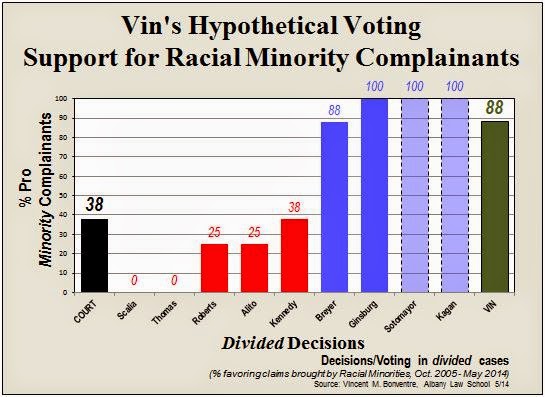
In most of the cases commenced by Racial Minorities complaining about some matter of racial discrimination, I would have sided with them. So I would usually have cast my vote with the Democratic Justices, and rarely with the Republicans.
[E.g., in University of Texas SW Med Cntr v. Nassar, I would have voted withe the Democratic Justices in dissent in support of the employee who claimed retaliation for complaining about racial discrimination. I would uphold such complaints as long as retaliation was a significant reason for the adverse treatment--as opposed to being the specifically definitive "but for" reason, which is what the Republican Justices voted to require before such a claim could be sustained. In League of United Latin American Citizens v. Perry, I would also have voted with the Democratic Justices, this time in the majority with Justice Kennedy, to uphold the Racial Minority complaint against the redistricting in Texas which deliberately diluted Latino voting strength for partisan Republican advantage.]
Friday, May 30, 2014
(Part 12--Summary w/ Update) The Supremes' Record in Racial Discrimination Cases: Decisional & Voting Figures for the Roberts Court
Before disclosing my own hypothetical voting, perhaps it makes sense to offer a quick recap. And we'll update the figures to include the recent decision in Schuette v. Coalition to Defend Affirmative Action, where the divided Court upheld a Michigan law prohibiting racial preferences in college admissions. So the updated summary now, and next post we'll do my full disclosure.For this recap, let's reorganize the graphs a bit. They've probably become a bit too cluttered. Also, let's update the data thru May 2014. The figures and graphs will now reflect all the Court's decisions involving issues of racial discrimination, from the time John Roberts became Chief Justice in September 2005 to the present day. [The pool of cases is further described at the end of this post.]
So here is a summary of the Court's decisional record and the Justices' voting. We'll begin with those cases brought by White complainants--whether they were claiming to be victims of racial discrimination, or objecting to racial preferences for Minorities, or otherwise arguing that some race conscious or remedial policy adversely affects them.
(click graphs to enlarge)
GRAPH 1
There it is. The Court itself, as well as all 5 Republican Justices, supported every complaint about racial discrimination brought by Whites. The Democratic Justices voted to uphold the White complaints much less frequently. [N.B., the newest Justices, Sonia Sotomayor and Elena Kagan, participated in only a small number of these cases, so the figures for them may well be misleading.]
Let's contrast that with the Court's and Justices' records in cases where those complaining were Racial Minorities.
GRAPH 2
Well that's different!
Wednesday, May 28, 2014
(Part 11--Sotomayor's & Kagan's Voting) The Supremes' Record in Racial Discrimination Cases: Decisional & Voting Figures for the Roberts Court
Justices Sonia Sotomayor and Elena Kagan, both appointed by President Obama, are the Court's newest members. Sotomayor joined the Court in August 2009. Kagan in August 2010. Consequently, unlike the other Justices whose records we have already reviewed, Sotomayor and Kagan have participated in only a few of the racial discrimination cases decided by the Court under Chief Justice Roberts.
Sotomayor has participated in only 7. Kagan in only 5. That's not much of a record for either Justice. Indeed, the sample is simply too small to tell us anything meaningful for some of the categories of voting we've been considering.
On the other hand, for some categories, the voting patterns for Sotomayor and Kagan are so consistent and so clear that even the relatively small samples are revealing. Let's take a look.
We'll begin with voting on what I've been categorizing as "racial equal protection." As explained in previous posts, this category of voting reflects the degree of support for equal treatment regardless of race--e.g., support for measures to eliminate unequal treatment, whether racial discrimination or racial preferences; support for the enforcement of equal rights and benefits; support for strict equal treatment regardless of whether Whites or Racial Minorities favor the result or may be the beneficiaries in any particular case.
Notably also, in all of these cases but one, the Court was divided 5-4, with the 5 Republican Justices on one side and the 4 Democratic Justices--including Sotomayor and Kagan--on the other. Stated otherwise, in every one of those cases but one, the 5 Republican Justices opposed the enforcement of equal treatment; the 4 Democratic Justices supported it.
Sotomayor has participated in only 7. Kagan in only 5. That's not much of a record for either Justice. Indeed, the sample is simply too small to tell us anything meaningful for some of the categories of voting we've been considering.
On the other hand, for some categories, the voting patterns for Sotomayor and Kagan are so consistent and so clear that even the relatively small samples are revealing. Let's take a look.
We'll begin with voting on what I've been categorizing as "racial equal protection." As explained in previous posts, this category of voting reflects the degree of support for equal treatment regardless of race--e.g., support for measures to eliminate unequal treatment, whether racial discrimination or racial preferences; support for the enforcement of equal rights and benefits; support for strict equal treatment regardless of whether Whites or Racial Minorities favor the result or may be the beneficiaries in any particular case.
(click graphs to enlarge)
GRAPH 1
The figures depicted in graph 1 reflect voting in 5 non-unanimous cases for Sotomayor, and 4 for Kagan. Notably, although the samples are relatively small, both Justices voted in support of strict equal treatment in every one of the cases in which they participated. These involved enforcing voting rights protections, supporting racial discrimination lawsuits, enforcing laws against retaliation, and prohibiting racial preferences in college admissions absent the showing of a compelling need.Notably also, in all of these cases but one, the Court was divided 5-4, with the 5 Republican Justices on one side and the 4 Democratic Justices--including Sotomayor and Kagan--on the other. Stated otherwise, in every one of those cases but one, the 5 Republican Justices opposed the enforcement of equal treatment; the 4 Democratic Justices supported it.
Thursday, May 22, 2014
(Part 10--Alito's Voting) The Supremes' Record in Racial Discrimination Cases: Decisional & Voting Figures for the Roberts Court
Not quite Scalia or Thomas.
Far different from Ginsburg and Breyer.
Not Kennedy either.
But identical to Roberts.
Justice Alito's record and theirs, that is.
White complainants win Alito's votes.
Racial Minority complainants, not so frequently. But more often then they win Scalia's or Thomas's vote.
Those advocating simple equal treatment--i.e., race neutrality, color-blindness, same rights regardless of race--have won his vote about half the time.
Those advocating more specifically for the protection of Racial Minorities have not fared well with him.
Let's look at Alito's record graphically.
Now, to sharpen the focus, let's limit our consideration to those cases that resulted in non-unanimous decisions.
In those closer cases where the Justices were divided, Alito's voting in support of complaints brought by Racial Minorities drops to 29%. His record contrasts sharply with that of Ginsburg and Breyer who voted for the Racial Minority complainant in every one of those cases.
Far different from Ginsburg and Breyer.
Not Kennedy either.
But identical to Roberts.
Justice Alito's record and theirs, that is.
White complainants win Alito's votes.
Racial Minority complainants, not so frequently. But more often then they win Scalia's or Thomas's vote.
Those advocating simple equal treatment--i.e., race neutrality, color-blindness, same rights regardless of race--have won his vote about half the time.
Those advocating more specifically for the protection of Racial Minorities have not fared well with him.
Let's look at Alito's record graphically.
(click graphs to enlarge)
GRAPH 1
As shown in graph 1, Justice Alito--just like the other 4 Republicans on the Court--has voted in favor of the White complainants in every case involving an issue of racial discrimination. By contrast, he usually voted against Racial Minority complainants--again, like the other Republican Justices.Now, to sharpen the focus, let's limit our consideration to those cases that resulted in non-unanimous decisions.
GRAPH 2
Saturday, May 10, 2014
(Part 9--Breyer's Voting) The Supremes' Record in Racial Discrimination Cases: Decisional & Voting Figures for the Roberts Court
Now for Justice Stephen Breyer.
Like Justice Ginsburg, whose record we looked at in the immediately preceding post, Breyer is a President Clinton appointee. Meaning? A Democrat, and much more ideologically liberal than the Republican appointees on the Court.
So we would certainly expect that his voting has been more protective of Racial Minorities than that of Chief Justice Roberts and that of Justices Scalia, Kennedy, and Thomas, who we have focused on previously in this series. Let's see if Breyer's record bears that out. Take a look.
As for upholding complaints brought by Racial Minorities, Breyer's record is identical to Ginsburg's. His voting, like hers, evinces far greater support for the claims involving issues of discrimination suffered by Racial Minorities than that of any of the Republican Justices. And far greater support for complaints brought by Racial Minorities than for those brought by Whites.
Let's now zero in on those closer cases in which the Justices can't agree and must choose sides. Those cases that provide the insight gained from exposing the actual divisions on the Court that unanimous decisions conceal. Here, then, Breyer's record in the divided cases.
Like Justice Ginsburg, whose record we looked at in the immediately preceding post, Breyer is a President Clinton appointee. Meaning? A Democrat, and much more ideologically liberal than the Republican appointees on the Court.
So we would certainly expect that his voting has been more protective of Racial Minorities than that of Chief Justice Roberts and that of Justices Scalia, Kennedy, and Thomas, who we have focused on previously in this series. Let's see if Breyer's record bears that out. Take a look.
(click graphs to enlarge)
GRAPH 1
Breyer voted to uphold complaints brought by Whites (43% of the time) less frequently than did the Republican Justices (100%). But he did vote with them in Fisher v. University of Texas to require the strictest scrutiny of racial affirmative action in higher education admissions. That is, any racial preference can only be justified by proof of a compelling necessity. Breyer thus split, in that case, with Justice Ginsburg who dissented.As for upholding complaints brought by Racial Minorities, Breyer's record is identical to Ginsburg's. His voting, like hers, evinces far greater support for the claims involving issues of discrimination suffered by Racial Minorities than that of any of the Republican Justices. And far greater support for complaints brought by Racial Minorities than for those brought by Whites.
Let's now zero in on those closer cases in which the Justices can't agree and must choose sides. Those cases that provide the insight gained from exposing the actual divisions on the Court that unanimous decisions conceal. Here, then, Breyer's record in the divided cases.
Sunday, April 27, 2014
(Part 8--Ginsburg's Voting) The Supremes' Record in Racial Discrimination Cases: Decisional & Voting Figures for the Roberts Court
This past week, in Schuette v. Coalition to Defend Affirmative Action, the Court upheld Michigan's recently adopted ban on affirmative action--i.e. race conscious decisions--in state university admissions. The vote was 6-2. (Justice Kagan did not participate.) Not surprisingly, all 5 Republican Justices supported the ban . Not a single one of them thought there was a problem with the voters of a state outlawing admissions programs that had sought, for compelling reasons (the only ones constitutionally allowed), to increase the college enrollment of racial minorities. Not one. Straight party line.
Among the Democratic Justices, Breyer wrote separately to agree with the Republicans, but on narrower grounds specific to this particular case. Justice Sotomayor dissented in a lengthy opinion joined by Justice Ginsburg.
For now, let's continue with our look at voting records compiled even before the Schuette decision.
Justice Ruth Bader Ginsburg's voting record in cases involving issues of racial discrimination?
A victim of gender discrimination early in her career. The nation's foremost litigant to eliminate gender discrimination. Appointed to the Court by Democratic President Bill Clinton. A predictably liberal vote on ideologically charged issued--e.g., civil rights, rights of the accused, campaign finance, etc.
So what about Ginsburg's voting on racial discrimination issues? Even before examining her record, what would be expected? Anything like Scalia's or Thomas's records? Or the polar opposite?
Of course it's just what would be expected. (I.e., the polar opposite of Scalia's and Thomas's record, for those who might not follow the Court.) And perhaps even more so.
Let's see.
(click graphs to enlarge)
GRAPH 1
As depicted in graph 1, Justice Ginsburg voted to uphold complaints brought by Whites much less frequently than did the Republican Justices we've looked at previously in this series--i.e., Chief Justice Roberts, and Justices Scalia, Kennedy, and Thomas. She supported White claimants in 2 out of 7 cases, or 29% of the time. That compared to 7 out of 7 cases, or 100% of the time, for each of the Republican Justices.
As for the complaints brought by Racial Minorities, she voted to uphold them much more frequently than did the Republican Justices. Her record: 9 out of 11 cases, or 82% of the time she supported the Racial Minority claimants. That compared to 2 out of 11 cases (18%) for Scalia and Thomas, 4 out of 11 for Roberts (36%), and 5 out of 11 (45%) for Kennedy.
But let's now focus on those closer, divided cases. What was Ginsburg's record in those cases where the arguments on both sides were strong, and a Justice would certainly have good reason to vote either way? Here it is.
GRAPH 2
Ah, in those closer cases, Ginsburg voted against the complaint every time it was brought by Whites. She voted to uphold the complaint every time it was brought by Racial Minorities. Exactly the opposite of Scalia and Thomas.
Sunday, April 13, 2014
(Part 7--Thomas's Voting) The Supremes' Record in Racial Discrimination Cases: Decisional & Voting Figures for the Roberts Court
Let's get to Justice Clarence Thomas.
We've already looked at the records of Chief Justice Roberts, Justices Scalia and Kennedy, and the Court as a whole. The next most senior Justice is Thomas. So let's see how he's been voting in these cases involving issues of racial discrimination.
First up, as in previous posts, is a look at his support for complaints brought by Whites versus his support for those brought by Racial Minorities. Here's Thomas's record alongside those of his 3 colleagues that we've seen in previous posts.
(click graphs to enlarge)
GRAPH 1
Like Roberts, Scalia, and Kennedy, Thomas voted to uphold all of the complaints in racial discrimination cases brought by Whites. Again like those others, he voted much less frequently to uphold complaints brought by Racial Minorities. Beyond that, Thomas's support for the complaints of Racial Minorities is, like Scalia's, the lowest we've seen.
Indeed, if we exclude those clearer, more straightforward cases, where the Court was in unanimous agreement, his record is even more striking. Let's look at Thomas's voting in the closer cases, where the Justices were divided.
GRAPH 2
No change of course in the 100% support for complaints by Whites. As for the complaints brought by Racial Minorities, Thomas--again, like Scalia--did not vote to uphold any of them.Wednesday, April 9, 2014
(Part 6--Kennedy's Voting) The Supremes' Record in Racial Discrimination Cases: Decisional & Voting Figures for the Roberts Court
Thus far in this series, we've focused on the records of the Supreme Court as a whole, of Chief Justice Roberts, and of Justice Scalia. We looked at how the Court decided and how those Justices voted in cases involving issues of racial discrimination.
Now let's turn to Justice Anthony Kennedy. In doing so, we'll juxtapose his voting record alongside that of Roberts and Scalia.
As in the last two posts, let's start with the bluntest voting breakdown we've been considering: how frequently Justice Kennedy supported complaints brought by Whites and how frequently he supported complaints brought by Racial Minorities. Here are the figures for Kennedy--again, depicted alongside those for Roberts and Scalia.
(click graphs to enlarge)
GRAPH 1
As depicted in graph 1, Kennedy voted to uphold every claim (7 out of 7) involving racial discrimination brought by Whites. As we've seen previously in this series for Roberts and Scalia, Kennedy's record in support of complaints brought by Whites was a perfect 100%.
Regarding complaints brought by Racial Minorities, Kennedy supported roughly half of them. Notably, his record of 45% (5 out of 11) to uphold Racial Minority claims is higher than Roberts', and much higher than Scalia's. Kennedy's record would seem to be consistent with his reputation for being more ideologically moderate on many issues than the other conservatives on the Court.
That contrast is sharper when we exclude cases with unanimous decisions--i.e., cases where the issues seemed clear enough that all the Justices agreed, including Scalia. So, considering only the non-unanimous, closer cases--those where the Justices were divided--here's what Justice Kennedy's record looks like, alongside Roberts' and Scalia's.
GRAPH 2
Of course, the 100% pro-White claimant voting record of Kennedy, as well as that of Roberts and Scalia, does not change. The 3 of them voted to uphold the White complaint in every case, whether the racial discrimination issue was clear or close, whether the Court's decision was unanimous or divided.
As for Kennedy's voting on complaints brought by Racial Minorities, his record is virtually the same when the unanimous decisions are excluded. But the contrast between his record and that of Roberts and Scalia is even more stark.
Tuesday, March 25, 2014
(Part 5--Roberts' Voting) The Supremes' Record in Racial Discrimination Cases: Decisional & Voting Figures for the Roberts Court
In the last post in this series, we looked at Justice Antonin Scalia's record. We saw that his voting heavily favored complaints brought by Whites, and virtually never those by Racial Minorities.
We also saw that, regardless of the claimant's race, he rarely voted for the position that would help protect Racial Minorities. Moreover, we saw that his record did not correspond to support for race-blind equality either. Instead, his voting largely opposed measures and arguments for the promotion of race-blind equal treatment--except where the beneficiaries would be White.
[Disclosure: Yes, I find Scalia's record appalling--if not wholly surprising. But the description of Scalia's record is based on how he actually voted, not on my or anyone else's opinion of the Justice himself.]
Now let's turn to Chief Justice John Roberts. Let's look at his voting, and also look at how his record compares to Scalia's. First, what about voting in support of complaints brought by Whites versus those brought by Racial Minorities?
(click graphs to enlarge)
GRAPH 1
As depicted in graph 1, Chief Justice Roberts' record is somewhat less stark than Justice Scalia's. His voting has been just as supportive of complaints brought by Whites--as in perfectly so. But his voting has been more supportive than Scalia's of those brought by Racial Minorities.
Roberts' voting support of Racial Minority claimants has not been strong. But it has been double that of Scalia's. Indeed, if we exclude the unanimous decisions--where the issues were sufficiently straightforward to garner every Justice's vote, including Scalia's--the contrast becomes sharper. Take a look.
GRAPH 2
In those cases where the Justices divided--i.e., those closer cases where there apparently were strong arguments on both sides--Roberts did sometimes vote to uphold the complaint brought by Racial Minorities. As we've seen, Scalia never did.
Sunday, March 16, 2014
(Part 4--Scalia's Voting) The Supremes' Record in Racial Discrimination Cases: Decisional & Voting Figures for the Roberts Court
Let's now turn our attention to the individual Justices' records. How have they voted in racial discrimination cases?
We start with Justice Antonin Scalia. He's been on the Court the longest and he's the most--well, colorful. His detractors will no doubt view the term as overly euphemistic; his fans, disparaging.
Be that as it may, Scalia is well-known as an outspoken proponent of "originalism." He says that he interprets constitutional and statutory provisions by adhering to their original meaning. Among other things, he argues that this methodology avoids injecting personal ideological preferences into the law.
[To be blunt, I don't buy it. Neither do many other judicial scholars, on and off the bench, who are brighter and more important than me--e.g., Judge Richard Posner of the U.S. Court of Appeals for the 7th Circuit. (Like Scalia, a Reagan appointee.)]
With that in mind, let's get to the task at hand: Scalia's voting record in cases involving issues of racial discrimination.
[The pool of cases--all those before the Court since John Roberts was appointed Chief Justice--was described in part 1 of this series. An abridged description is included at the end of this post.]
First, take a look at what may be the most striking findings in examining Scalia's record.
(click graphs to enlarge)
GRAPH 1
Yes. In cases where Whites complained of racial discrimination or about some other civil rights issue, Scalia voted to uphold their claim every time. Whether claiming discrimination on the basis of their being White, or complaining about favoritism for minorities or the requirements of civil rights laws, White claimants always won Scalia's vote.
What about Scalia's record in cases where racial minorities were the ones complaining? Take a look.
GRAPH 2
Quite different!
Monday, February 17, 2014
(Part 3--White Wins vs Minority Wins) The Supremes' Record in Racial Discrimination Cases: Decisional & Voting Figures for the Roberts Court
Yes, putting it bluntly: White Wins vs Minority Wins.
In cases involving complaints of racial discrimination or related civil rights issues, how often did the Court uphold claims brought by Whites? How often did it uphold claims brought by Racial Minorities?
In the previous installments in this series, we saw that the Roberts Court's record on racial equality, in the most general sense, has been about 50-50. That is, decisions favoring the side pressing for equal racial protection in about half of the cases--and, therefore, against that side in about half. (See part 1.)
We then looked inside those figures. They did not mean that the Court was protecting racial minorities half the time. No. What we saw was that the Court sided with racial minority protection in only a quarter of those cases. That is, it ruled against the side arguing for racial minority protection 3 times as often as it ruled for that side. (See part 2.)
Among the obvious questions:
So, who is winning in the racial equal protection cases?
If the Court is siding with racial equality half of the time, but with racial minorities only a quarter of the time, who is it siding with the rest of the time--i.e., in the remaining three quarters of the cases?
Well, some things seem evident from the numbers themselves:
The Court has been siding with the individuals, businesses or government entities that have been accused of racial discrimination more frequently than with the racial minorities making the accusations.
So too, the Court has been siding with the individuals, businesses or government entities that have opposed measures intended to protect racial minorities more frequently than it has enforced or upheld such protective measures.
But, again, let's just be blunt:
How often have claims brought by Whites been winning at the Roberts Court?
And, by contrast, how often have claims brought by Racial Minorities been winning?
To begin, take a look:
(click graphs to enlarge)
Subscribe to:
Posts (Atom)