Showing posts with label Gay Rights. Show all posts

Thursday, December 7, 2023

Why I Loved Sandra Day O'Connor

Source: Annenberg Public Policy Center
We learned last week that she had passed away. We knew it was coming. We knew she was quite ill and that the Justice O'Connor we knew had already left us. But we are, nevertheless, newly aggrieved that she is gone.

I didn't know Justice O'Connor well on a personal or social level. But I did have the opportunity to meet her and to spend some time chatting informally several times. The first time was in February 1986 when she was escorting the Supreme Court Fellowship finalists, then a few times during my fellowship year, and once or twice again at some event at the Court or elsewhere.

Credit: Alan Day/Western Horseman
We usually just engaged in small talk. Nothing jurisprudential or otherwise profound, except for our shared, profound love of the Arizona desert. She would speak of her home in the Southwest and growing up on a cattle ranch--a real "cowgirl of the Arizona desert." I would talk of my two Army tours at Fort Huachuca, Arizona, and riding on post for hours every weekend--a wannabe cowboy. I confess feeling a bit special that she would remember me and our Arizona chats each time we met.

So yes, for that reason alone she has had a special place in my heart.
(A dear friend of mine who taught at the University of Arizona became close to her in her latter years on the bench and thereafter, and everything he told me about Justice O'Connor confirmed that my heart was in the right place.)

But let me speak as one who follows the Supreme Court, and who believes that the Court is at its best when it protects civil rights and liberties--limited only by legitimately overriding interests. I have certainly not always agreed with Justice O'Connor. Though she might well have had the better position on many issues.
[Yes, there's Bush v. Gore (2000), perhaps the most dishonest, unprincipled Court decision of the modern era--regardless of how one feels about the ultimate outcome. Her vote in the bare majority was inexcusable. Later in life, she seemed to recognize that.
N.B., many of the great Justices in Supreme Court history have likewise cast a deplorable vote or authored some dreadful majority opinion.]

Nevertheless, without surveying her entire body of judicial work, it would be accurate, albeit barely relevant, to say that I did agree with her on many of the most important issues of the day. Much much more important than that, however, I admired how she typically strove to strike a wise balance between the competing needs of liberty and order, as opposed to elevating some rigid ideologically-driven methodology for decision-making.

Here are just a few of Justice O'Connor's opinions that, in my view, show what a fine Justice she was:

Credit: Kevin Wolf/Invision/AP
Mississippi University for Women v. Hogan, 1982: O'Connor wrote the opinion for the 5-4 majority that the state nursing school's restriction to women was invalid sex discrimination. Rejecting the dissenters' insistence that the women-only institution was "discriminat[ing] invidiously against no one," she explained that the state was actually perpetuating "archaic and stereotypic notions" about the proper roles for men and women.

Planned Parenthood v. Casey, 1992: O'Connor co-authored a three-Justice plurality opinion to sustain a woman's right to choose. Articulating an "undue burden" standard to balance the "personal liberty" of deciding whether to carry a pregnancy to term against "the demands of organized society," she rejected the four dissenters' absurd argument that there could be no such constitutionally protected right to choose an abortion because, among other things, "the Constitution says absolutely nothing about it."
[For more on that preposterous argument, see The Leaked [Dobbs] Opinion--Constitutional Nonsense Revisited* (Part 1), May 7, 2022. Of course, Dobbs overruled O'Connor's balanced approach.]

Lawrence v. Texas, 2003: O'Connor joined the Court's 6-3 decision to invalidate Texas's law criminalizing "sodomy" engaged in by members of the same sex. She did so, in a separate concurring opinion, based on constitutional equal protection, arguing that mere "moral disapproval" does not "justify a law that discriminates among groups of persons"--notwithstanding the dissenters' reliance on "the moral opprobrium that has traditionally attached to homosexual conduct."

Grutter v. Bollinger, 2003: O'Connor authored the Court's 5-4 decision upholding the limited consideration of race to ensure the "compelling" benefits of diversity in education. But, while rejecting the dissenters' argument that racial preferences were necessarily prohibited by equal protection, she did insist that educational institutions must ensure "narrow tailoring," such that any "race-conscious admissions program [does] not unduly harm members of any racial group."
[Of course, as with her balanced approach on the right to choose in Casey, the Court recently overruled her approach to affirmative action, invalidating any consideration of race in education admissions, in Students for Fair Admissions v. Harvard (2023).]

Ewing v. California, 2003: O'Connor wrote a plurality opinion which, however, secured a majority of her colleagues for the proposition that the "cruel and unusual" prohibition of the 8th Amendment did forbid punishments that were grossly disproportionate. She rejected the view, repeated by a couple of Justices in several cases, that the Constitution prohibited only "horrid modes of punishment" such as "flaying alive, rending assunder with horses...maiming, mutilating and scourging to death." [Justice Scalia's reference to his opinion in Harmelin v. Michigan, (1991).] To O'Connor, the mere fact that the term "excessive" was not used to modify "punishments" in the 8th Amendment did not exclude the possibility that such a punishment could be "cruel and unusual."

Hamdi v. Rumsfeld, 2004: O'Connor authored the Court's opinion, holding that an American citizen imprisoned in this country as an "enemy combatant"--without charges or a hearing--does have a due process right to receive notice of the Government’s factual assertions and an opportunity to rebut them in a judicial proceeding. The dissenters argued that she was "transmogrifying the Great Writ." But she explained that, in the absence of a valid suspension of habeas corpus by Congress, "it would turn our system of checks and balances on its head" to deny a citizen the right to judicially challenge the basis for his detention government, "simply because the Executive opposes making available such a challenge."

To be sure, Justice O'Connor was not always in the majority. At least two of her dissenting opinions deserve mention as underscoring her wise sense of balance and care about preserving fundamental principles despite competing interests.

Atwater v. Lago Vista, 2001: In a case involving a seat belt violation, the majority held that the 4th Amendment permitted a warrantless arrest for any criminal offense, regardless of how minor, as well as a full custodial search and detention in a jail cell at the police precinct during "processing"--all incident to that arrest. O'Connor was appalled. Noting that the majority itself recognized that the arrest and detention of the driver--a mother with children in the back seat--was a "pointless indignity" serving no legitimate law enforcement interest, she found it incongruous that the majority could nevertheless adopt an unqualified bright line that rendered the "extraordinary intrusion" on a mere seat-belt violator to be constitutionally permissible. As she put it, "the Court's position is inconsistent with the explicit guarantee of the Fourth Amendment" that prohibits searches and seizures that are unreasonable.

Employment Division of Oregon v. Smith, 1990: In a case involving the application of a criminal drug law against the use of peyote by members of a Native American church in an ancient religious ritual, the majority reversed the decision of Oregon's high court which had ruled that a religious exemption was constitutionally required. Writing for the majority to reject any such exemption, Justice Scalia declared that the Supreme Court had "never held that an individual's religious beliefs excuse him from compliance with an otherwise valid law." In her separate concurring opinion--joined in most part by the dissenting Justices--O'Connor comprehensively detailed how Scalia's assertion was simply dishonest and "dramatically departs from well settled First Amendment jurisprudence."
As O'Connor showed, the Court had frequently repeated that only those laws that are "essential to accomplish an overriding governmental interest" could constitutionally burden religious free exercise. Indeed, despite the majority's mischaracterization of such a test as a "constitutional anomaly," she noted that it was actually the "constitutional norm" to protect fundamental rights and prohibit racial discrimination.
Source: Sandra Day O'Connor Institute
Beyond that, she took the majority to task for insisting that an unavoidable and acceptable consequence of democratic government was to "place at a relative disadvantage those religious practices that are not widely engaged in." Citing, among other decisions, Chief Justice Warren Burger's opinion for the Court in Wisconsin v. Yoder (1972), she felt compelled to remind the majority that, "the First Amendment was enacted precisely to protect the rights of those whose religious practices are not shared by the majority and may be viewed with hostility. The history of our free exercise doctrine amply demonstrates the harsh impact majoritarian rule has had on unpopular or emerging religious groups."
[I know I have spent more time on this case than others. But I find Scalia's majority opinion particularly galling in its dishonesty and callous disregard of a minority religion. For like reason, I find Justice O'Connor's separate opinion so imperative. Those who follow the Court's religious liberty jurisprudence know that the Court has done whatever it can to bypass the Smith decision. Several Justices have already made clear that the decision should be "reconsidered." It is almost certain that O'Connor's opinion will eventually be expressly vindicated by the Court.]

This has been a brief survey of some of the most significant and representative opinions of Justice Sandra Day O'Connor. Perhaps more than any other member of the Court over the last few generations, she has been a wise and candid balancer of the strong competing interests at issue in virtually all the cases that reach the Court. And unlike some of her colleagues who have seemed ideologically blind or otherwise uncompromising to disfavored or less-favored interests, or who avow fidelity to some politically induced and supposedly neutral interpretive methodology, she has been motivated by the practical realities and the real-world ramifications of her decisions. That is anathema to some Justices.

"Just apply the law" is a mantra that fails to recognize that there is almost always strong legal support for both sides in appeals at the Court. For Justice O'Connor, the actual consequences from embracing one legally supported position or the other was necessarily a foremost consideration. For that reason, her opinions made sense. Like the very best Justices in the Court's history, wisdom and decency and reality, as opposed to some cramped formalistic legalism, were the hallmarks of O'Connor's jurisprudence.

Thursday, June 25, 2020

It's Roberts' (somewhat less right-wing) Court (Part 2)

Source: AP/Dave Tulis/Larry Downing
In Part 1, we saw how Chief Justice Roberts joined decisions that saved so-called Obamacare and that protected immigrants. In those cases, he often authored the majority opinion himself, allying himself with his liberal colleagues to render decisions that triggered unconcealed outrage on the part of all or most of his conservative colleagues in dissent.

We witnessed exactly that last week in the DACA case (Department of Homeland Security v. Regents of the University of California, 2020) which was discussed in the previous post. Let's now turn to last week's other momentous decision, as well as an earlier related one that is, perhaps, even more revealing about the role and direction of Roberts as the primus inter pares.

LGBTQ Rights.  In a long-awaited decision--it took over 8 months from oral arguments on October 8, 2019--the Court ruled last week that the prohibition against "sex" discrimination in the Civil Rights Act of 1964 protects gay and transgender employees. The Chief Justice joined his 4 liberal colleagues, as well as one of the Trump-appointed conservative Justices, Neil Gorsuch, to whom he assigned the writing of the majority opinion.
Over the dissents of the 3 remaining Republican appointees [Thomas, Alito, and Kavanaugh], the Roberts-assigned/Gorsuch-penned majority opinion agreed with the fired employees that discrimination on the basis of "sex" necessarily covered discrimination against gays and transgenders. The crux of the argument [distilled from what I found to be a mostly insufferable 33 pages] was that the term "sex," as a matter of sheer linguistics and logic, does apply to gays and transgenders, even if that application was not within the underlying legislative intent of the law.
The 3 remaining conservatives wrote 134 combined pages of dissent. Justice Samuel Alito's seething 107-page opinion, joined by Justice Clarence Thomas, as well as the separate dissent of Justice Brett Kavanaugh, evinced frustration triggered not only by the Court's decision, but no doubt also by the loss of another Roberts vote to the liberals--this time, together with Gorsuch's vote as well. Bostock v. Clayton County, 2020.

[I feel compelled to add that, regardless of my unqualified agreement with the Court's result, I find much of the majority opinion unnecessary, unpersuasive, and perilous. The same decision could have been reached by simply sticking to the inexorable logic of what sex discrimination necessarily includes. (E.g., if a woman prefers men, that's ok. But if a man does, that's not? The only difference is the different sex of the person who prefers men.)
Beyond that, a far better majority opinion, in my view, would have embraced the overarching principle in prohibiting sex discrimination. Sex and sex-related characteristics are utterly irrelevant for most purposes. For like reason, most disparate treatment on those bases is born of bigotry or some other form of ignorance, rather than some justified reason--which is precisely what discrimination means.
On the other hand, Gorsuch’s "it’s clear from the original understanding of the plain terms of the statute" argument (I’m paraphrasing) can be expected to be used in the future to support reactionary results. The 6 votes his opinion received will surely be used as a strong endorsement of his insistent originalism—i.e., the “ordinary public meaning” of the terms of the law “at the time of the enactment" (his language)—about which he waxed and waned ad nauseam. This will be thrown back at the liberals--all of whom joined his opinion without a whisper of discomfort--when he and the other conservatives (including those in dissent in this case) use it in future cases to undercut past progress and block attempts to move the law forward.
I wish at least one of the liberal Justices had authored a separate concurrence making clear that they weren’t endorsing Gorsuch’s originalist interpretive approach. The need to do so should have been especially clear in light of Alito's dissenting opinion. Regarding what "sex discrimination" was understood to mean "at the time of enactment," Alito's dissent had the much stronger argument. Just consider this: would the law's prohibition of "sex discrimination" have been passed--"at the time of enactment" in 1964--if legislators were told that those terms protected gays and transgenders as well as women? Now ask the same question about progressive interpretations of countless other statutory and constitutional provisions. The liberals should at least have expressed their reservations about the originalism touted by Gorsuch.
Others have raised similar concerns. See e.g., Neil Gorsuch Lays Landmines Throughout LGBTQ Discrimination Opinion. https://abovethelaw.com/2020/06/neil-gorsuch-lays-landmines-throughout-lgbtq-discrimination-opinion/]

An earlier decision of the Court, three years before Bostock, was arguably more revealing about Roberts' view of his role as Chief Justice (as well as of Gorsuch's view of LGBTQ rights). Roberts' position in that earlier case took many by surprise because he had dissented two years before in Obergefell v. Hodges (2015).  In Obergefell, Roberts, together with the other Republican appointees-- except for Justice Anthony Kennedy--had rejected the notion that the Constitution guarantees same-sex couples the right to marry. But in 2017, Roberts broke with the Court's conservatives and, aligning with the Obergefell majority, helped reaffirm that landmark decision.
In a per curiam opinion, with the Chief Justice in the 6-3 majority, the Court invalidated an Arkansas rule that treated same-sex and opposite-sex spouses differently on their children's birth certificates. While the male spouses of biological mothers were entitled to be identified, female spouses were not. Repeatedly quoting from the Obergefell majority opinion--against which the Chief Justice had originally dissented--Roberts, together with his 4 liberal colleagues and Justice Kennedy, summarily granted review, reversed the state's supreme court, and struck the Arkansas practice on the ground that "the Constitution entitles same-sex couples to civil marriage 'on the same terms and conditions as opposite-sex couples.'”
Justice Gorsuch, this time writing a dissent, which was joined by Thomas and Alito, argued that, although the Obergefell decision held that "a State must recognize same-sex marriages," it said "nothing" about "a birth registration regime based on biology." In response, the Roberts-joined per curiam majority noted that opposite-sex spouses identified on Arkansas birth certificates need not be biological parents. Applying another line excerpted from Obergefell, the Chief Justice and his more liberal colleagues concluded that Arkansas has "denied married same-sex couples access to the 'constellation of benefits that the Stat[e] ha[s] linked to marriage.'” Pavan v. Smith, 2017.

Roberts had thus apparently decided that his role as Chief Justice included adhering to the Court's recent progressive landmark and opposing attempts to undermine it--regardless of his original position on the matter.

Death Penalty/Intellectual Disability. A similar pattern is evident in positions taken by Roberts in some recent death penalty cases. He had dissented in Moore v. Texas when that case came before the Court in 2017. The Court's majority ruled that the state court's judgment that the death row inmate was mentally competent to be executed "had no grounding in prevailing medical practice." Accordingly, the case was remanded for a determination "informed by the medical community’s diagnostic framework." Roberts dissented on the ground that the "independent basis for [the state court's] judgment" was adequate.
When the case returned to the Supreme Court two years later, the majority once again disapproved the state court's determination that the inmate was competent. This time, however, the Chief Justice broke with the conservative dissenters [Thomas, Alito, and Gorsuch] and joined the majority [which notably included Justice Kavanaugh]. Despite Roberts' own previous dissent, he acknowledged that the Texas determination "did not pass muster under this Court’s analysis last time" and, because "[i]t still doesn’t," he joined the majority's opinion to again reverse the state court's judgment. Moore v. Texas, 2019.

The Chief Justice joined his liberal colleagues in several other related death penalty cases in 2019. A few weeks prior to the Court's decision in Moore, Roberts signaled his break with his conservative colleagues in White v. Kentucky. In that early 2019 decision, he joined the majority's order [over the dissent of Thomas, Alito, and Gorsuch] to grant review and simultaneously, without argument, reverse a judgment of the state's supreme court--on the basis of the Court's earlier 2017 Moore decision.
Similarly, in Madison v. Alabama, also decided in early 2019, Roberts again broke with his conservative colleagues [Thomas, Alito, and Gorsuch]. In that case, he sided with the liberals to vacate the judgment of the state court that had approved an execution. He joined Justice Elena Kagan's majority opinion that the Constitution prohibits executing a person who is unable to understand why he's being punished, regardless of the particular intellectual disability he suffers, dementia or psychosis.
One more. In Murphy v. Collier, decided several weeks thereafter, the Chief Justice again sided with his liberal colleagues to halt to another execution. Over Justice Alito's dissenting opinion, which was joined by Thomas and Gorsuch, the Roberts-joined majority summarily enjoined Texas from carrying out the execution, at least until it first granted the inmate's request to be accompanied into the chamber by a Buddhist chaplain.

To be sure, Chief Justice Roberts' positions in the cases thus far discussed do not mean that he has transformed into an ideological liberal. But they do demonstrate a pattern of willingness to break with his more natural political allies on the Court and, moreover, to do so on some of the most highly charged issues of the day.
We'll look at a few more of these in the next and final post in this series.

Sunday, August 25, 2019

Trump's Justices: Gorsuch to Date (Part 2)

In the previous post, we saw how studies of Neil Gorsuch's judicial record prior to his nomination by President Trump for the Supreme Court showed him to be among the most politically conservative members of the federal judiciary. We also saw how his record immediately following his appointment, the last couple of months of the Supreme Court's 2016-17 term—the spring of 2017—reflected the very same strong politically conservative leanings.

In fact, together with Justice Clarence Thomas, his record on politically charged issues was the most politically conservative on the Court. Indeed, 100% politically conservative voting in cases involving the death penalty, campaign finance restrictions, gun rights, gay rights, workers' rights, church and state, President Trump's travel ban, and similar politically divisive matters. Significantly, Gorsuch's 100% politically conservative voting record contrasted sharply with the 41% conservative decisional record of the Court as a whole. (See Trump's Justices (Part 1): Gorsuch to Date.)

Now what about Gorsuch's voting record for the next two terms on the Court—2017-18 and last term, 2018-19? Specifically, how did his voting record compare to that of the Court's other strongly politically conservative members, Justices Thomas and Samuel Alito, and to the Court as a whole? Let's take a look at the very next term, Gorsuch's first full one on the Court, the 2017-18 term (click to enlarge):
The politically charged issues confronted by the Court during the 2017-18—and voted on by Gorsuch—included Trump's travel ban (again), immigrant rights, abortion rights, gay rights, union representation, worker rights, voting rights, gerrymandering, search and seizure protections, and international human rights. In virtually every case, Gorsuch voted for the politically conservative position.

In fact, in some cases, Gorsuch took a position that was even more politically conservative than the already conservative majority or dissenting opinions. For example, in the Masterpiece Cakeshop case, where the bakery refused to create a cake for a same-sex marriage celebration, the majority of the Court ruled for the bakery on very narrow grounds. It held that the Colorado civil rights commission's decision, that the bakery was guilty of sexual orientation discrimination, was tainted by the commission members' explicit hostility to the baker's religion--comparing it to Nazi hatred of the Jews. In short, the Court majority ruled that the baker did not receive a fair hearing. But not that businesses were free to violate state anti-discrimination laws, even for religious reasons.

That decision of the Court was inadequate for Gorsuch. He authored a separate concurring opinion making the claim that the bakery did not actually engage in any discrimination at all—unlawful or otherwise. Gorsuch's rationale? The bakery would not create a same-sex cake for any couple, whether same-sex or opposite-sex. So the bakery was treating everyone the same. Not kidding!

(You know, like the old anti-miscegenation laws did not really discriminate against anyone. Everyone—black or white or Asian—was required to marry within their own race. So those laws treated everyone the same. Gorsuch's argument was reminiscent of that nonsense.)

Let's finish this post by taking a look at the ideological voting spectrum of the entire Court. Here it is (click to enlarge):
As the graph shows, Gorsuch's voting record was not only the most politically conservative on the Court, other than that of Justice Thomas, but it was also significantly more so than that of Chief Justice Roberts and the decisional record of the Court as a whole.

To be sure, the voting records of the Court's four liberal Justices, were at least as politically liberal as Gorsuch's record was politically conservative. But in nearly one-third of the cases, the Court as a whole joined the liberals, In a full one-quarter of those cases, the Chief Justice did. Gorsuch virtually never did—in fact, it was only one case. [I.e., Sessions v. Dimaya, involving the meaning of "crime of violence" as a basis for deporting immigrants.]

So once again, Justice Gorsuch's voting record on the Court—this time for the 2017-18 term—mirrors the studies based on his pre-appointment record as a federal appellate judge. In the next post, we'll look at Gorsuch's record in the next and most recent term, 2018-19.

Friday, July 6, 2018

Justice Kennedy's Retirement (Part 2)

In the previous post, we reviewed Anthony Kennedy's votes and authored opinions in a wide range cases that deeply divided the Court. These were cases where the Justices split 5-4 along partisan political lines, and where the change in a single vote in the majority would have reversed the Court's decision.

What might well be unexpected to some--because Kennedy has been accurately viewed as a--or the--"swing vote" on some significant, controversial issues--is that his overall record has actually been that of a politically conservative Republican. Whether stopping the vote count in Bush v. Gore or invalidating restrictions on corporate campaign spending in Citizens United, or on diverse issues such as Obamacare, the Trump travel ban, gun rights, employer rights, voting rights, and search & seizure and privacy, Kennedy routinely joined with the other Republican Justices on the politically conservative Republican side of the issue.

But Kennedy has largely been known--beloved and praised, or reviled and ridiculed--for the exceptions in his record. His "swing vote" legacy is built upon a few areas of the law. On some highly charged social and cultural issues, he broke from the Court's conservative Republican majority and joined with the liberal Justices. Indeed, with Kennedy gone and a Trump nominee forthcoming, these are the issues about which Democrats, liberals, and, on some, libertarians are most concerned.

Let's consider those:
Gay Rights
Kennedy's name, more than any other, will be associated with the Supreme Court's landmarks invalidating sexual-orientation discrimination and mandating equal treatment for gays, lesbians, and same-sex couples. The culmination of that line of cases, no doubt, was the 5-4 decision in Obergefell v. Hodges (2015). There, Kennedy joined the Court's four liberals and authored the majority opinion to invalidate laws that restricted marriage to heterosexuals and, concurrently, to recognize the right to marry for same-sex couples.
He similarly authored the majority opinion for the Court's 5-4 decision, two years earlier, in U.S. v. Windsor (2013), invalidating provisions of the so-called "Defense of Marriage Act (DOMA) that denied federal marital benefits to legally married same-sex couples.
Before those cases, he authored the majority opinions in Lawrence v. Texas (2003), invalidating laws that criminalized same-sex intimacy ["Homosexual Sodomy" in the late Justice Scalia's ad nauseam refrain.], and in Romer v. Evans (1996), invalidating a state law that specifically prohibited legal protection against sexual-orientation discrimination.
[In these cases, Kennedy confirmed the worst suspicions of the most conservative members of the Reagan administration who opposed the Kennedy nomination because he was a "gay lover"--the cruder term was used in private conversation with me.]

On the other hand, Kennedy did join the 5-4 decision, in Boy Scouts of America v. Dale (2000), allowing the Boy Scouts to exclude gays from leadership positions, on the basis of freedom of association, despite a state law prohibiting sexual-orientation discrimination.

Affirmative Action
Kennedy authored the 4-3 majority opinion [Only 7 Justices participated: Scalia had died and Kagan recused herself] in Fisher v. University of Texas (2016), approving and, thereby, saving the use of race as one of many factors in a university admission process, as a narrowly tailored means to achieve the compelling interest in student diversity.

On the other hand, thirteen years earlier, in Grutter v. Bollinger (2003), where a 5-4 majority had upheld the use of racial preferences in university admissions, recognizing the value of racial diversity in education, Kennedy dissented; he argued that the use of race should be subject to much closer judicial scrutiny and more limited than what the majority had allowed.
And a mere two years before Fisher, in Schuette  v. Coalition to Defend Affirmative Action (2014), Kennedy wrote the leading plurality opinion for himself, Roberts and Alito. [Also part of the Court's 6-2 majority was Scalia, who voted with the majority but wrote his own opinion joined by Thomas; and Breyer who authored his own sole opinion. Sotomayor dissented in an opinion joined by Ginsburg; Kagan did not participate.] Kennedy approved a state law (adopted in the aftermath of that Grutter decision) that prohibited the consideration of race (or sex) in university admissions, despite the undeniably racially-charged campaign to promote the passage of the law and despite the fact that the supposedly merit-motivated law left alone countless other factors used in the admissions process that have nothing to do with academic merit--e.g., athletics, legacy, family wealth and contributions, geography, etc., etc.
[In my view, this was a shamefully hateful law that obviously had nothing to do with academic merit--since countless non-merit factors were left untouched--and much about racial animus. IAE, the point here is that Kennedy approved it.]

Right to Choose/Abortion Rights
In the landmark 5-4 decision in Planned Parenthood v. Casey (1992), Kennedy joined Justice O'Connor's opinion to reaffirm Roe v. Wade and to establish the proposition that an "undue burden" on a woman's right to seek an abortion, prior to the viability of the fetus, was unconstitutional.
And more recently, in Whole Woman’s Health v. Hellerstedt (2016), Kennedy joined the liberals in the 5-3 majority [Scalia had died earlier in the term], invalidating Texas restrictions on abortion service providers because they imposed substantial burdens on the right to choose, without any actual health benefits.

On the other hand, in the most recent right to choose case, Nat'l Institute of Family and Life Advocates v. Becerra (2018), Kennedy joined the 5-4 majority opinion, authored by Justice Thomas, invalidating California's requirement that clinics providing pregnancy services advise patients about legal abortion options, deeming that to be a violation of free speech.

Capital Punishment
Kennedy joined the Court's liberals in several deeply divided decisions that limited the application of the death penalty. In Atkins v. Virginia (2002), he joined the 6-3 majority opinion of Justice Stevens, holding that the execution of persons with significantly diminished mental capacities violates the prohibition against cruel and unusual punishment.
Three years later, in Roper v. Simons (2005), he wrote the 5-4 majority opinion, holding that the execution of persons who were minors when they committed their crimes also violates the prohibition against cruel and unusual punishment.
And three years after that, in Kennedy v. Louisiana (2008), he authored another 5-4 majority opinion, this time holding the same for the non-homicidal rape of a child.

On the other hand, in that same year, in the badly splintered decision in Baze v. Rees (2008)--one plurality opinion, 4 concurring opinions, and a dissent--Kennedy joined Chief Justice Roberts' 3-Justice plurality opinion that upheld Kentucky's method of lethal injection, despite the occasionally improper administration which would result in an excruciatingly painful death. According to the Kennedy-joined plurality, the cruel and unusual punishment prohibition would be violated only where there was an intolerable risk that the infliction of pain was wanton and unnecessary.

To be sure, there are other areas of the law in which Kennedy's participation was welcomed by ideological liberals--sometimes and sometimes not. The point is that as a "swing vote" that provided liberals with a last hope on a decidedly conservative Court, Kennedy's record was, at least in that regard, a very checkered one.

As we saw in the previous post, Kennedy's record on many issues was indisputably--and very--politically conservative. And in this post, we saw that even in those areas where Kennedy "swung" to the liberal side of the issues, he was not necessarily a totally reliable vote.

The purpose in these two posts has only been to be clear-eyed about Justice Kennedy's record and about what will really be missing from the Court in his absence. It was not to criticize Kennedy. Indeed, as I have repeated numerous times, in my view Kennedy has been admirable. He has been the least politically, lopsidedly-partisan and ideological Justice on this Court.

In short, more than the other Justices, Kennedy seems to have behaved like a judge. The "swing vote" label, which he apparently did not like, reflected that he was not necessarily tied to one ideological, partisan side in the cases. He typically appeared to be open to vote with the other side of the Court's political aisle.

He will be missed by many Court watchers. Include me among them.

Monday, June 4, 2018

The Cakeshop case: What the Court Did NOT Decide

The Supreme Court today ruled in favor of the baker in Masterpiece Cakeshop v. Colorado Civil Rights Commission. In short, the baker had refused on religious grounds to create a cake for a same-sex couple's marriage celebration. The state of Colorado determined that the baker violated the state's law which prohibits discrimination by businesses on the basis of sexual-orientation. The Supreme Court has now reversed that determination and did so on the basis of religious freedom.

BUT! And the BUT is the critical part of the case.

Listening to some commentators and some partisans this morning, it's doubtful they had actually read the Court's decision. Or maybe they have simply been characterizing the decision to fit their preconceptions or preferences.

The 7-2 decision, authored by Justice Anthony Kennedy, held--and only held--that Colorado's Civil Rights Commission was hostile to the baker's religious beliefs and thus did not give him a fair and neutral hearing. Period!

The Court did NOT decide that bakers may refuse to bake cakes for gays or lesbians or same-sex couples.
The Court did NOT decide that bakers may refuse to bake a cake for a same-sex marriage celebration.
The Court did NOT decide that bakers (or any other business) may violate a state's anti-discrimination law.
The Court did NOT decide that bakers (or any other business) may violate such a law even on religious grounds.
The Court did NOT decide that religious freedom outweighs the rights of gays, lesbians or same-sex couples.
The Court did NOT decide that exceptions to anti-discrimination laws must be made for religious objections.
The Court did NOT decide First Amendment religious freedom entitles religious objectors to exemptions from an anti-discrimination law--or any law at all.
The Court did NOT overturn its 1990 decision in Oregon v. Smith that any "an otherwise valid law" defeats religious objections.
The Court did NOT rule any of the foregoing ways on the basis of freedom of expression either.
And the Court certainly did NOT decide that discrimination or other unequal treatment of gays, lesbians, or same-sex couples in public accommodations was constitutionally permissible--for religious or any other reasons.

In fact, the Supreme Court actually reaffirmed that neither "religious [n]or philosophical objections...allow business owners and other actors in the economy to deny protected persons [which includes "gay persons and gay couples"] equal access to goods and services under a neutral and generally applicable public accommodations law."

In this case, the Supreme Court merely found that the determination of the Colorado commission against the baker was not "neutral." In terms of the Court's 1990 Oregon v. Smith precedent, that Colorado determination was not "otherwise valid" because it unlawfully assessed the baker's religious belief as illegitimate and subjected it to ridicule. In the Supreme Court's own words, the Colorado commission "disparage[d]" the baker's religious faith "by describing it as despicable, and also characterizing it as merely rhetorical--something insubstantial and even insincere."

The Court made clear that Colorado's anti-discrimination "interest could have been weighed against [the baker's] sincere religious objections in a way consistent with the requisite religious neutrality." But that, instead, the Colorado commission treated the baker's beliefs with contempt and consequently failed to conduct a fair hearing.

For that reason the Court sided with the baker in this case.
NOT because religious objections to same-sex marriage outweigh the equal rights of same-sex couples to goods and services in the marketplace.

Sunday, October 1, 2017

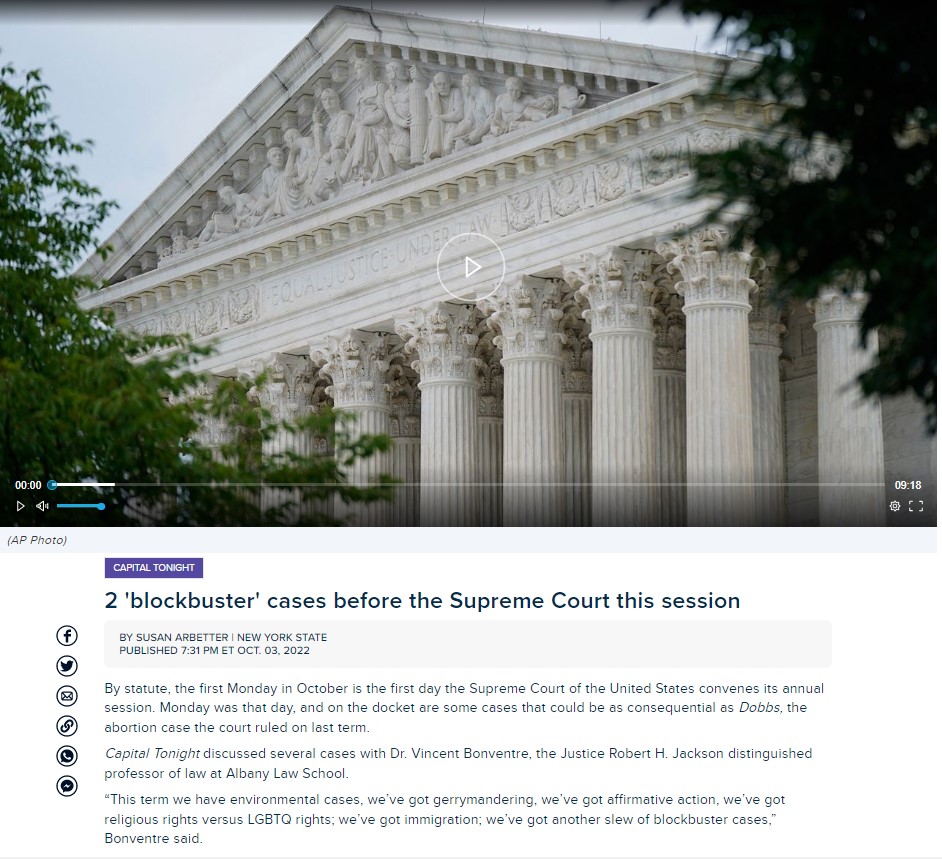
A Supremely Blockbuster New Term?

For much of the last two terms, the United States Supreme Court was short one Justice. The vacancy created by the death of Justice Antonin Scalia in early 2016 remained unfilled until the appointment of Neil Gorsuch late last term. During that interim period, the eight sitting Justices came to a 4-4 draw in several cases; in other cases, the competing ideological sides obviously compromised in order to render some decision; and in still other cases, the Justices either declined to grant review or they did grant review in cases that would be heard when there would be a full complement of nine Justices.

For the 2017-18 term of Court that is to begin Monday, October 2--the iconic First Monday in October--the cases that are already on the Court's docket strongly suggest that this will be a year of blockbuster decisions. It is always possible, of course, that the Justices will bob and weave and avoid confronting some of the hot-button constitutional questions at the heart of these cases. But with four Justices who lean very politically conservative, and four very politically liberal--oftentimes leaving Justice Anthony Kennedy to cast the deciding vote-- the Court can be expected to resolve some very ideologically-contentious issues with some very ideologically-charged rulings.

Here are several of the most significant issues the Court will tackle this term:

Partisan Gerrymandering
As in extreme gerrymandering. As in extreme mathematical efficiency to virtually guarantee that the political party in power remains in power. As in making it extremely difficult for that party to lose elections.
So, for example, in the case to be heard by the Court this week, Gill v. Whitford, the Republican party in power in Wisconsin has carved up voting districts in the state in ways that severely dilute the effect of Democratic votes. This gerrymandering has, in fact, produced a near certainty that the Republicans retain control of the legislature. Indeed, even when the Democratic party has won a substantial majority of the statewide vote in recent years, the Republicans have still won a substantial majority of the voting districts.
[Yes, Democrats have done the same thing when they can.]
Racial gerrymandering is unconstitutional. But what about partisan gerrymandering? Is it just another "political question" which the majority of the Court believes should be resolved in the political process? Or is partisan gerrymandering, at least in extreme cases, a fundamental violation of our democratic voting process that calls for a judicial redress?

Gay Rights/Religious Liberty
What happens when equal rights for gays and lesbians competes with religious objections to supporting their life choices? In Masterpiece Cakeshop v. Colorado, a baker refused on religious grounds to make a cake for a same-sex wedding. Colorado ruled that this refusal was a violation of the state's public accommodation law which, among other things, prohibits sexual-orientation discrimination.
There are many legal and constitutional ingredients relevant to this case. Nevertheless, it is a pretty sure bet that predetermined positions on LGBT rights will be reflected in the voting of most, if not all, of the Justices. For example, it is very very difficult to conceive of Justices Ginsburg and Sotomayor siding with the religiously objecting baker against the same-sex couple. It is at least as difficult to imagine Justices Thomas and Alito and Gorsuch siding with the same-sex couple against the baker. On the other hand, it is not difficult to see Justice Kennedy--or even Chief Justice Roberts--actually balancing the competing interests and determining the outcome of the case.
There are a few wrinkles that may affect the Court's decision. One has to do with the requested design of the cake in question--would the baker be required to include a message on the cake that expresses support for same-sex marriage, perhaps infringing on the baker's free speech?
Another wrinkle involves the current state of 1st Amendment religious liberty under which any "otherwise vaild law" defeats religious objections--thanks to the 1990 Scalia-authored decision, in Oregon v. Smith, derogating the religious freedom of Native Americans. [See Justice Scalia's Record (Part 1), New York Court Watcher, Feb. 18, 2016; The Fall of Free Exercise, 70 Alb. L. Rev. 1399 (2007).]
One last wrinkle to mention is that Colorado apparently does allow exemptions from its public accommodations law--e.g., an African-American baker need not include a white supremacy message. That raises the question of whether the state is discriminating against religious requests for exemptions.

Technology-Enabled Searches
When seeking a cell phone company's location records on a cell phone user, must law enforcement first obtain a warrant? Or as the Court has often styled the issue in other cases, when the government seeks to obtain and examine such records, is that a "search" within the meaning of the 4th Amendment? If it is, then a warrant supported by probable cause is required. If it's not a "search," then no warrant is required. This is the question presented in Carpenter v. U.S.
Whether or not the Court will view obtaining and examining cell phone location records as a "search"--thus triggering the warrant requirement--depends upon whether or not a majority of the Justices adhere to some search and seizure doctrines it has applied in the past. Some of these doctrines were, until recently, thought to have been permanently rejected by the Court. Others have never been explicitly rejected, but seem to have been weakened in Court decisions involving technology.
One of these doctrines is that a search is not a "search" unless there is a "trespass"--some illegal entry or contact--by the government on one of the things mentioned in the 4th Amendment. Sooooo, since the location records kept by a cell company do not belong to the cell phone user, there is no "trespass" upon something he owns and, thus, there is no "search." Additionally, cell phone location records are obviously not mentioned or even implicated by any of the items listed in the 4th Amendment which was ratified in 1792 (or its state government application via the 14th Amendment of 1868). 
Then there's the 3rd party doctrine. Since the cell phone company--the 3rd party--has access to the cell user's location, there is no "reasonable expectation of privacy" in such records and, thus, the government's examining of those records is not a "search" under the 4th Amendment.
[Hey, those aren't my doctrines. Like others--other courts, other judges and justices, other rulings--I disagree with those doctrines and, indeed, believe they are preposterous and were developed to approve very questionable, warrantless searches. See Is a Search a Search.]
We might see whether the Court abandons or at least further undermines those doctrines--or sticks to them.

Union Dues
May a state require non-members of a public employees union to pay some reduced dues (aka "agency fees") to help defray the expenses of collective bargaining and other services that the union provides for all the covered public employees, whether members or not?
The Court approved such dues in its 1977 decision in Abood v. Detroit Bd of Ed. But since then, some of the Justices have made clear their disagreement with Abood. Then, in 2016, following Scalia's death, the Court split 4-4 on that issue in Friedrichs v. California Teachers Assn.
Now, in Janus v. American Federation of St, Cnty, and Munic Employees (AFSCME), which the Justices just granted review last week, that question is back before the Court.
The issue pits the need of public employee unions in representing the rights of the workers against the counter claims of free speech and association of non-members who do not wish to support the positions of the unions--bargaining or otherwise.
Gorsuch would seem to be the tipping vote, ending the 4-4 tie, and that should not give comfort to the unions. But will both Roberts and Kennedy agree to actually overturn Abood? Stay tuned.

Anti-Gay Employment Discrimination (possible case)
Is discrimination against gays and lesbians a violation of the civil rights laws? The 11th Circuit Court of Appeals--the federal appellate court that sits in Atlanta, GA--recently ruled, in Evans v. Georgia Regional Hospital, that discrimination against a worker because she is a lesbian does not violate Title VII of the Civil Rights Law. That 1964 law prohibits sex discrimination, but it does not explicitly prohibit sexual-orientation discrimination.
The Obama administration took the position that sexual orientation discrimination is a form of sexual discrimination. Among other things, it is based on discriminatory sexual stereotyping--e.g., a man may partner with a woman, but a woman may not; a woman may partner with a man, but a man may not. By contrast, the Trump administration has argued that sex discrimination covers no such thing.
The 7th Circuit, the federal appeals court that sits in Chicago, recently took the position in Hively v. Ivy Tech that prohibited sex discrimination does include discrimination based on sexual-orientation. Notably, that court's position was supported by several of the federal judiciary's well-recognized heavyweights, including Judges Diane Wood, Frank Easterbrook, and Richard Posner--the latter authoring a separate concurring opinion arguing the irrational bigotry of discrimination against gays and lesbians, and even listing some gays throughout history who have contributed immensely to civilization. 
With this split among the circuits, and the challenge of Posner to any legitimate defense of sexual-orientation discrimination, it seems very likely that the Supreme Court will grant review to address the issue.

Gun Rights (possible case)
Does it violate the individual right to bear arms to require a license to carry a concealed weapon, based on some actual need for self-protection? The D.C. Circuit recently held that the D.C. law requiring such a license was invalid. That the law was contrary to the Supreme Court's 2008 decision, in D.C. v Heller, that the 2nd Amendment guarantees an individual right to bear arms.
This D.C. Circuit decision, in Wrenn v. D.C., seems to conflict with the 9th Circuit's 2016 decision in Peruta v. San Diego County, upholding a similar concealed-carry licensing requirement. Adding to the intrigue, the Supreme Court, just this past spring, declined to review that 9th Circuit's decision. Adding to that, Justices Thomas and Gorsuch dissented from the Court's decision not to review that case. Those dissenters argued that the Supreme Court was disparaging gun rights.
So it's pretty clear how Thomas and Gorsuch would vote if the Supreme Court now granted review in Wrenn in order to resolve the conflict among the circuits. But how the others would vote--especially after denying review in Peruta--is another question.

Trump's Travel Ban (moot?)
President Trump's original travel ban was replaced by a second. And last term, by a  6-3 majority in Trump v. Int'l Refugee Asst Project, the Court partially upheld the orders of the courts below that had temporarily barred enforcement of that executive order. The Court did, however, unanimously reverse the lower courts "with respect to foreign nationals who lack any bona fide relationship with a person or entity in the United States"--i.e., the Trump ban could be enforced against them. At the same time, the Court agreed to hear the case this term.
However, on the way to the hearing, which had been scheduled for this week, the Trump administration promulgated travel ban 3.0. That certainly seemed to make the case involving travel ban 2.0 moot--i.e., no longer an ongoing case or controversy in need of judicial resolution. So the Court cancelled oral arguments and asked for briefing on the question of mootness.
In short, the original case involving travel ban 2.0, which had been granted review, is no longer on the Court's schedule.

There are surely other significant cases which the Court has already accepted for review, and others which it will accept. But the foregoing six--which have been granted review or are very likely to be granted soon--are certainly among the most hot-button and ideologically-charged among the cases that promise to make this 2017-18 term a blockbuster one.

Wednesday, August 2, 2017

Gorsuch, Part 6: The Now-Justice Like the Then-Judge

We've seen how Neil Gorsuch's record as an appeals court judge was ultra-conservative. Reviewing those cases where he stuck his neck out to disagree publicly with his colleagues by writing a dissenting opinion--presumably because he felt strongly that his colleagues were wrong on an important issue--reveals a clear ideological pattern. (See Part 4 and Part 5.)

In civil cases, he repeatedly sided against the worker and for the employer; sided against consumer protection; sided against Planned Parenthood; sided against the separation of church and state. In criminal cases, he argued that correction and police officers should be immune from liability despite majority findings that the vindicated suspects' constitutional rights had been violated; and he argued that convictions should be upheld despite findings that the defendants' lawyers were ineffective, or that Miranda rights were violated, or that the incriminating evidence was unconstitutionally obtained.

Perhaps most notable (and in my view most worrisome), is that even when Gorsuch sided with the defendant, he set forth the very narrow, literalist view of the 4th Amendment that it does not prohibit unreasonable searches or seizures. Rather, it only prohibits unreasonable searches and seizures if they involve one of the few particular items mentioned in that amendment--i.e., "persons, houses, papers, and effects." But nothing else. This is a view, by the way, based on long-overruled decisions of the Supreme Court from an earlier era. This also just happens to be the same narrow, literalist view of search and seizure protections taken by Gorsuch's hero, the late Justice Antonin Scalia, to whose vacancy he was appointed. And it is the view condemned in recent years by, among others, conservative Justice Samuel Alito, whose separate concurring opinion in U.S. v. Jones, 565 US 400 [2012] exposed the dangers of that view which was embraced in Scalia's opinion in that case.

Sooooooo, has Gorsuch's record on the federal appeals court been reflected in his record to date at the Supreme Court? He has been a justice for only a short time. Confirmed by the Senate in April, he has only participated in those cases which the Court considered as it was wrapping up its term. And yet....

Let's take a look.

Death Penalty
McGehee v. Hutchinson: In Gorsuch's first public vote, he sided with execution. He broke the Court's 4-4 tie to allow Arkansas to proceed with several executions that the state wanted to complete before its supply of lethal drugs expired. Each of the death inmates had already been imprisoned for 10 years; a few for more than 20. Each of them had legal claims challenging their convictions or sentences or even insisting on innocence. State and federal courts at various stages of the litigations had found some merit in their claims. But the Supreme Court declined to review the claims and, with Gorsuch's vote making a bare majority, approved the executions.

Campaign Finance
Republican Party of Louisiana v. FEC: The Supreme Court majority summarily affirmed--in a four word entry--the decision of the court below to uphold a particular provision of the federal campaign finance law (the Bipartisan Campaign Finance Reform Act of 2002, aka “McCain-Feingold”). The provision in question prohibits the use of unregulated contributions made to political parties for federal election activities. Gorsuch, together with Justice Thomas, noted his disagreement with the majority's disposition of the case and would have proceeded with the full review process.

Indigent Criminal Defense
McWilliams v. Dunn: The Alabama courts had denied the death penalty defendant the assistance of a mental health expert. By a typical 5-4 ideological split, with Justice Kennedy casting his vote with the liberals, the Court held that indigent defendants who have raised serious mental health issues do have such a right, and it sent the case back to the lower courts to apply the law correctly. Gorsuch joined Justice Alito's dissenting opinion, taking the position that the decision of the state courts should have been affirmed, because the Supreme Court had not previously "clearly establish[ed] that a defendant is entitled to an expert."

Employee Grievance
Perry v. Merit Systems Protection Board: A 7-2 majority of the Court ruled that an employee could seek judicial review of his "mixed" grievance (i.e., discrimination underlying a civil service grievance) in federal district court; significantly, such a court is not required to defer to an administrative ruling which, in this case, was adverse to the employee. Gorsuch dissented. In an opinion joined by Thomas, Gorsuch argued that an employee seeking judicial review of an adverse administrative ruling on his civil service grievance can do so only in the Federal Circuit Court. And, again here's the significance: that court must affirm the employee-adverse administrative ruling unless it is utterly irrational.

Trump's Travel Ban
Trump v. Int'l Refugee Asst Project: The Court unanimously agreed to review the constitutionality of President Trump's executive order that suspended the entry of certain foreign nationals into the United States. At the same time, by a  6-3 majority, the Court mostly upheld the orders of the courts below that had temporarily barred enforcement of the executive order. The Court did, however, partially reverse the courts by allowing the executive order to be enforced "with respect to foreign nationals who lack any bona fide relationship with a person or entity in the United States." Gorsuch joined Thomas's dissenting opinion, arguing that the executive order should be allowed to be enforced in its entirety--i.e., including its enforcement against those with "a close familial relationship" with an American--because the "Government’s interest in preserving national security" outweighed the resulting hardships to affected individuals.

Church-State Separation
Trinity Lutheran Church v. Comer: By a 5-2-2 majority, the Court held that Missouri engaged in unconstitutional religious discrimination when it denied the church's request for funding for its playground--which funding was generally available to non-religious institutions. [Missouri is one of those state's with an strict (originally anti-Catholic immigrant) prohibition against aiding religious institutions.] Chief Justice Roberts' majority opinion, in a footnote, underscored that "This case involves express discrimination based on religious identity with respect to playground resurfacing. We do not address religious uses of funding or other forms of discrimination." Gorsuch, joined by Thomas, wrote a separate concurring opinion disassociating himself from that limiting footnote. Anticipating other applications of law to religious institutions, he wrote that "general [constitutional] principles here do not permit discrimination against religious exercise—whether on the playground or anywhere else." [Hmmm, such as laws requiring equal treatment of gays and lesbians and same-sex married couples, even in the face of religious objections? And see immediately below!]

Gay Rights
Pavan v. Smith: This case involved Arkansas's refusal to include the name of a biological mother's same-sex spouse as a parent on the child's birth certificate. By a 6-3 majority, the Court summarily granted review and reversed on the ground that, in accord with the Court's 2015 decision in Obergefell v. Hodges, same-sex married couples are equally entitled to “the constellation of benefits that the State has linked to marriage.” Gorsuch dissented. In his opinion joined by Thomas and Alito, Gorsuch insisted that "nothing in Obergefell indicates that a birth registration regime based on biology...offends the Constitution."

Gun Rights
Peruta v. California: The Court declined to review a decision of the 9th Circuit that “the Second Amendment does not preserve or protect a right of a member of the general public to carry concealed firearms in public.” The California law, which generally prohibits concealed guns in public places, was thus upheld. Gorsuch joined Thomas's dissent. The dissenters complained that the majority's decision not to take the case "reflects a distressing trend: the treatment of the Second Amendment as a disfavored right." They were also unequivocal about their position on the California law. As Thomas concluded for himself and Gorsuch: "the Framers made a clear choice: They reserved to all Americans the right to bear arms for self-defense. I do not think we should stand by idly while a State denies its citizens that right."

Well there it is. By his votes and separate opinions in these ideologically-laden cases, Neil Gorsuch has in short order left little doubt about his strong ideological leanings. And beyond ideology or political philosophy or jurisprudence, consider his partisan bent. How would a typical Republican politician vote on these issues? Not a judicially retrained judge or strict constructionist or believer in federalism (i.e., states' rights) or any other actual, coherent judicial or political philosophy. But a partisan Republican.

What's the common thread through his positions on issues as varied as gun rights and gay rights, Trump's travel ban and campaign finance, worker rights and rights of the accused? That's right, connect the dots. His record on the Supreme Court already screams "ultra-conservative partisan Republican."

Some--like the Federalist Society and the Heritage Foundation and other very conservative groups and individuals who recommended him to Trump--undoubtedly are pleased with Justice Gorsuch's record thus far. Others, more moderate or liberal, much less so. But whether pleased or not with Gorsuch's Supreme Court record to date, it is undeniably what it is: politically partisan, conservative Republican.

Friday, June 16, 2017

Gov. Cuomo Picks Justice Paul Feinman for the High Court

Yesterday, Thursday June 15, 2017, Governor Andrew Cuomo announced that he will nominate Paul G. Feinman to serve on New York's Highest Court. Feinman is currently a Justice on the state's intermediate court, the Appellate Division, and specifically the First Department which sits in Manhattan.
Feinman had been elevated to the Appellate Division by Cuomo in 2012. He was the first openly gay man to sit on that court and, if confirmed by the state senate, he will be the fist openly gay Judge on the Court of Appeals.
(At this time, the Senate Judiciary Committee has not yet scheduled a hearing. The Senate itself finishes its session and departs next Wednesday, June 21.)

Feinman was selected by Cuomo from the list of seven provided to the Governor two weeks ago by the Commission on Judicial Nomination. At the Governor's urging, the Commission completed its business in very short order. Beginning April 14, upon the official notification of the vacancy created by the sudden death of Judge Sheila Abdus-Salaam, the Commission began soliciting applicants, conducting interviews, and producing a list of possible nominees. Instead of the statutory allowance of 120 days, the Commission finished its work in just 1 1/2 months.

Justice Feinman is a graduate of Columbia University and the University of Minnesota Law School. He spent the fist several years of his with the Legal Aid Society of Nassau County and New York. He then served several years as a law clerk to a judge who sat on state Supreme Court (i.e., trial court) and then on the Appellate Division.

In 1996 he was elected to NYC Civil Court and was reelected in 2006. In 2004, he was selected by then-Chief Judge Jonathan Lippman to serve as an Acting Justice of  Supreme Court (highest trial court) Three years later, he was elected to that court and, in 2012, Governor Cuomo elevated him to be a Justice of the Appellate Division.

In short, Feinman has spent a career in government, all of it arguing or serving in and on courts. Beyond that, he has been very active in judicial and bar groups. He has, for example, served as the president and then chair of the supreme court justices association, and as the president of LGBT bar and judicial groups.

Feinman is 57 years old, born in January 1960. Under New York's (moronic) mandatory age-70 retirement for Court of Appeals Judges, he will be able to serve for 13 years of the full 14 year term, retiring at the end of 2030.

Notably, if and when Justice Feinman is confirmed, the composition of the Court of Appeals will include:
1 African-American Judge (Judge Rowan Wilson),
2 Hispanic Judges (Judges Jenny Rivera and Michael Garcia),
3 Women (Chief Judge Janet DiFiore and Judges Rivera and Leslie Stein),
1 Openly Gay Judge (Judge Feinman),
2 Upstaters (Judges Stein [the Capital Region] and Eugene Fahey [Buffalo]),
2 From New York City (Judges Rivera and Feinman [Also, Judge Garcia was born in the City and nominee Wilson works there.]),
2 Who live just north of the City in Westchester County (Chief Judge DiFiore and Judge Garcia),
1 Who lives on Long Island (nominee Wilson),
3 Who were appellate judges (Judges Stein, Fahey, and Feinman),
4 With experience as trial judges (Chief Judge DiFiore and Judges Stein, Fahey, and Feinman),
2 From private practice (Judge Garcia and Wilson),
2 Prosecutors who ran prosecutorial offices (Chief Judge DiFiore [Westchester County District Attorney] and Judge Garcia [U.S. Attorney for the Southern District of New York]),
1 Academic (Judge Rivera),
6 Different law schools (St. John's [DiFiore], Columbia [Abdus-Salaam], Albany [Stein and Garcia], SUNY Buffalo [Fahey], Harvard [Wilson]), and Minnesota [Feinman],
1 Italian-American (Chief Judge DiFiore), 1 Puerto Rican-American (Judge Rivera), 2 Jewish-Americans (Judges Stein  and Feinman), 1 Irish-American (Judge Fahey),
1 Republican (Judge Garcia),
6 Democrats (All the rest).

Monday, May 8, 2017

Gorsuch--Yes, Backward and Extreme (Part 2)

It's now Justice Neil Gorsuch, having been confirmed by the Senate following the Republicans' deployment of the nuclear option. I've been tied up with (over)commitments--not that I could have affected the outcome--but let's continue with this series because Gorsuch's record is at least as important now as it was when he was a nominee.

We saw how Judge, now Justice Gorsuch's avowed approach to judicial decision-making is "focusing backward, not forward." It's viewing constitutional rights in accordance with "what a reasonable reader at the time...would have understood the law to be." Judicial decision-making is "not a forward-looking but a backward-looking authority." Those are his words. That is his judicial creed. That is what he has reaffirmed repeatedly in speeches and writings, and applied in cases.

At first blush, Gorsuch's approach might sound perfectly reasonable. You know, it's a specie of the bromide that "judges should just apply the law and not make it." But any thoughtful consideration exposes Gorsuch's judicial creed as drastically reactionary. As a prescription for undoing our nation's cherished advances in fundamental constitutional protections.

That is no exaggeration. That is just plain fact and history. That might be his and others' preference. But that is what it is.

Gorsuch's judicial creed, which had been famously professed by his predecessor, Antonin Scalia, is part of a tradition that has opposed constitutional advances and has condemned those advances after they have been made. Yes, opposed them and condemned them--at least until those advances have become part of our culture, a cherished part of our culture, and to oppose them any longer is too embarrassing.

So, for  example, as mentioned previously [See Part 1.], the Gorsuch-Scalia creed would have precluded the landmark protections of equal rights for African-Americans, for women, for gays and lesbians, etc. Consider again the consequences if the Supreme Court had adopted the Gorsuch-Scalia approach to decision-making--i.e., looking "backward" to what the constitutional provisions meant "at the time":

  •  Racial segregation would have been upheld, not outlawed--the Supreme Court in Brown v. Board of Education (1954) deliberately re-construed the 14th Amendment to prohibit segregation, contrary to what had long been permitted and to what that amendment meant "at the time" it was ratified in 1868.
  • State laws preventing women from owning property or running a business or going to law school, etc., would have been upheld, not overruled--the Supreme Court in Reed v. Reed (1971) extended "equal protection" beyond what it meant "at the time" of ratification and invalidated laws that treated men better than women.
  • State laws that discriminated against and even criminally punished gays and lesbians would have been upheld, not declared unconstitutional--the Supreme Court in Lawrence v. Texas (2003) held that "equal protection" and "due process" protected gays and lesbians, even though those constitutional provisions certainly did not mean that "at the time."
  • And so many others, such as Loving v. Virginia (1967) [invalidating laws that prohibited inter-racial marriage]; Griswold v. Connecticut (1965) [invalidating laws that prohibited birth control]; Heart of Atlanta Motel v. U.S. and Katzenbach v. McClung (1964) [upholding civil rights laws that prohibit racial discrimination in privately owned lodging and restaurants]; West Virginia v. Barnette (1943) [upholding the right of religious-objecting Jehovah Witnesses not to salute the flag].
In every one of those landmark cases, and so many others, the Supreme Court rejected the Gorsuch-Scalia approach. Instead of confining constitutional provisions to what might have been their narrow, specific meanings "at the time" they were written and ratified, the Court gave life to the overriding, fundamental principles that those provisions reflected.

So the 14th Amendment's guarantee of "equal protection" in those cherished landmarks was not confined to "separate but equal" treatment for the newly freed black slaves. Instead, overruling Plessy v. Ferguson (1896) and breaking from the "backward-looking" "at the time" meaning of the 14th Amendment, the Court in Brown gave life to the overriding principle of equality under the law to put an end to legalized segregation of the races. Likewise, repudiating a long series of precedents that permitted disparate treatment of women, including some then-recent decisions, the Court in Reed expanded "equal protection" to invalidate gender as well as racial discrimination. And so forth.

Historically, the Gorsuch-Scalia brand of "backward-looking," "at the time," so-called "originalist-textualist" jurisprudence has always reared its head--yes, its ugly head--whenever the Supreme Court has advanced equal rights for minorities or women. Whether the Court was outlawing segregation, or protecting inter-racial marriages, or upholding the civil rights laws, or requiring that women have the same rights as men, or invalidating laws that discriminated on the basis of sexual orientation, the jurisprudence embraced by now-Justice Gorsuch has always been used to oppose those advances and to denounce them as illegitimate.

Yes, the repeated condemnation of all those cherished landmarks and so many others has been the same: "That's not what the constitutional provision meant at the time; that's not its original meaning." Fortunately for our country, that "originalist-textualist" approach has historically been rejected whenever the Court has understood that fundamental equality and fairness and decency were far more important constitutional principles than some avowed method of interpretation.

And it's not just the equal rights and privacy rights landmarks. The same is true for those landmarks that gave life to the rights of the accused. The Gorsuch-Scalia jurisprudence would have precluded those advances in criminal justice as well. We'll take a look at some of those in the next part of this series.

Tuesday, April 4, 2017

Gorsuch--Yes, Backward and Extreme (Part 1)

The Democrats in the Senate are right on this one. Judge Neil Gorsuch, President Trump's nominee for the Supreme Court, is indeed backward and extreme. Not necessarily him personally--I don't know him nor do I know others who do. But to be sure, his jurisprudence, as he himself has explained it and as he has applied it in deciding cases, is backward and extreme.

In fact, that is why he is supported so strongly by conservative Republicans, and other social conservatives. That is why he was placed on the list of recommended nominees from which Trump picked him. That list was produced by the Federalist Society and the Heritage Foundation, They are two very ideologically conservative organizations. They do their homework. They know his record.

Those strong supporters may not prefer the labels "backward" and "extreme." But no doubt, that is why they really like him.

Let's consider Gorsuch's own words.
Judges, he has said, should apply the law "focusing backward, not forward," in accordance with "what a reasonable reader at the time...would have understood the law to be."
And again, "judicial power" is "not a forward-looking but a backward-looking authority." In short, apply what the words originally meant.

Ah, no wonder social conservatives like him so much. Looking "backward," applying what constitutional provisions meant "at the time," as Gorsuch urges, just happens to produce decisional results that social conservatives would prefer. It's also no wonder why some of the most socially and politically conservative judges--and politicians and commentators who support them--embrace this so-called "originalism" and "textualism."

So, for example, consider the Constitution's "equal protection of the laws" guarantee. That provision has long been a major battleground between conservatives and liberals. It became part of the Constitution after the Civil War, with the ratification of the 14th Amendment in 1868.

Looking "backward," to what it meant "at the time," would certainly exclude equal rights for gays and lesbians. Certainly, in 1868, the ratification of the 14th Amendment was not meant to protect gays and lesbians. Applying the equal protection guarantee in a "backward""at the time" manner, as Gorsuch urges, would still permit laws that criminally punish private, consensual, same-sex intimacy between adults--let alone same-sex marriage. It would also permit laws that intentionally discriminate against gays and lesbians in employment, housing, restaurants, hotels, etc., etc.

That's right. The Constitution's equal protection guarantee says nothing about gays or lesbians or transgenders. And those persons were absolutely not--looking "backward"--what equal protection was about "at the time" in 1868.

Indeed, Judge Gorsuch's hero, the late Antonin Scalia--the foremost proponent of this so-called "originalist-textualist" approach that Gorsuch has ardently embraced--took exactly that position. The Supreme Court modern era decisions that have extended equal protection to gays and lesbians and same-sex couples were among the most hated and denounced by Scalia. What was Scalia's claimed reason? That the equal protection guarantee did not mean that in 1868. [Scalia on gay rights.]

But this looking "backward" and "at the time" approach goes well beyond allowing discriminatory treatment of gays and lesbians. How about women?

The equal protection guarantee was certainly not intended, in 1868, to insure equal rights for women. It would never have been ratified in 1868 if its purpose was to require that women be treated equally with men. That laws treating women differently and unequally were no longer valid. Looking "backward," equal protection of the laws for women was not what was meant "at the time." In fact, it was not until 100 years later that the Supreme Court finally did give equal protection that meaning and outlaw gender discrimination.

Again, Gorsuch's hero, the "originalist-textualist" Scalia, openly insisted that constitutional equal protection did not apply to women. And why? Because that's not what it meant when it was ratified. [Scalia on women's rights.]

Then there's racial segregation.

Equal protection was certainly not intended to end racial segregation when added to the Constitution in 1868. It would never have been ratified if its purpose was to require that African-Americans be allowed to share the same schools, restaurants, hotels, spaces on the bus and railroads, etc., with white persons. At most, "separate but equal" was as far as equal protection was intended to go "at the time." Indeed, it was not until 1954 that the Supreme Court expanded the meaning of equal protection to abandon "separate but equal' and to outlaw segregation.

So, should the Supreme Court really have looked "backward" and applied the law according to what it meant "at the time"--really? And allowed racial segregation to continue? And should judges today look "backward" and restore the racial segregation that was allowed "at the time" the 14th Amendment was ratified in 1868?

Well, of course, almost all self-avowed "originalist-textualist" judges, politicians and commentators are far too embarrassed to endorse a return to racial segregation. They will attempt to rationalize how their approach would not necessarily support that result. But it does do just that. Just as that "originalist-textualist" approach would deny equal protection of the laws to women. And--as most "originalist-textualist" devotees still do acknowledge--would undo all the gay rights and same-sex rights decisions of the Supreme Court in recent years. That "originalist-textualist" approach, looking "backward," supports a return to allowing racial segregation because it was allowed "at the time."

Of course, the same could be said for so many other constitutional guarantees--e.g., the right to the assistance of counsel, search and seizure protections, free "speech," the right to private sexual choice (even between married couples), etc., etc. Looking "backward" to what they meant "at the time," these were not the rights we enjoy and cherish today as Americans. They were much narrower, much more limited, and didn't mean then what they mean now.

We'll look at some of them in the next post.

But for now, even without looking further, it should be clear that Judge Gorsuch's approach to the law is backward--the term he himself uses--and extreme.