Tuesday, June 28, 2022

The Incredible Shrinking Docket: The Court of Appeals' Reduced Caseload (The Graph)

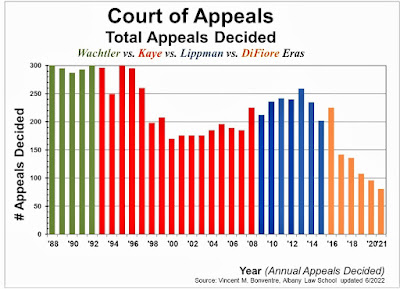
In The Incredible Shrinking Docket: The Court of Appeals' Reduced Caseload, we looked at the total appeals decided by New York's highest court each year from 1988 through 2021, the last full year for which figures are available. The data are all derived from the Court's own Annual Reports.

The visualization of the reduction in caseload over the years makes clear just how dramatic it has been, especially recently. Here it is:
(click to enlarge for a better view)
As discussed previously and now depicted in the graph above, the total of appeals decided annually by the Court has, indeed, fallen dramatically from what it had been. During the last several years of Sol Wachtler's tenure as Chief Judge through the early years of Judith Kaye's, New York's highest court typically decided almost 300 appeals annually. There was a significant drop in the later years of Kaye's tenure and then an increase while Jonathan Lippman was Chief Judge. Most recently, during Chief Judge Janet DiFiore's tenure, the total appeals decided annually dropped significantly to levels not previously seen.

Again, it may well be argued whether this development is a good thing or a bad one. But there can be no argument that the Court today is deciding fewer cases--much, much fewer.

Next post on the Court's caseload, we'll look at criminal appeals, including which Judges are granting and which Judges aren't.

Friday, June 24, 2022

The No-Longer-Just-Leaked Opinion--Constitutional Nonsense Revisited (Part 4)

The now-official opinion by Justice Samuel Alito for the Supreme Court in Dobbs v. Jackson Women's Health Organization, overturning Roe v. Wade and eliminating any right to choose an abortion, repeats what we've seen previously when the draft was leaked:
As we have explained, procuring an abortion is not a fundamental constitutional right because such a right has no basis in the Constitution’s text or in our Nation’s history.

As discussed in previous posts on New York Court Watcher, this argument is utter nonsense and dangerous. (See The Leaked Opinion--Constitutional Nonsense Revisited [Part 1], in which we looked at "it's-not-in-the-text" of the Constitution; [Part 2], in which we considered "deeply rooted in this Nation's history and tradition;" and [Part 3], in which we examined Alito's assurance that his opinion applies only to abortion and that there's no reason to be concerned about any other rights.)

To recap very briefly, as explained in Part 1, most fundamental rights are nowhere mentioned in the text of the Constitution. The document is absolutely not a catalog of rights. It nowhere mentions, for example, the right to marry, the right to be intimate with one's partner, the right to have children, the right to have a friend, etc., etc., etc. Indeed, Alito's argument--now the argument of the Court--was prominently feared by the Framers of the Constitution and nearly defeated adding a Bill of Rights: the fear that mentioning any rights might be the basis for denying others not mentioned. That fear has now been realized and forms the primary basis in the Court's decision today to reject the right to choose an abortion.

As explained in Part 2, the secondary argument, relying on the country's history, could be used to support racial segregation and discrimination against women, as well as the criminalization of interracial marriage, the use of birth control, and gay and lesbian intimacy. All of those were an entrenched part of this Nation's history and tradition from the time of its founding until overruled by the Court in more recent times.

And in Part 3, the notion that this opinion applies only to the right to an abortion and to no other right was shown to be as much nonsense as the text and history arguments. Those were the same arguments made to the Supreme Court against any right to use birth control and to equal protection for women. The same arguments to uphold criminal laws against gays and lesbians, including against same-sex marriage. Indeed, these were the same arguments to uphold racial segregation and criminal laws against interracial marriage. Are these arguments now being revived, but only to be applied against rights the current conservative majority of the Court dislikes?

Well, Justice Thomas for one has made clear where the arguments embraced by the Court necessarily take it:
in future cases, we should reconsider all of this Court’s substantive due process precedents, including Griswold [the right to use contraceptives], Lawrence [the right to engage in same-sex intimacy], and Obergefell [the right to marry for same-sex couples]. Because any substantive due process decision is “demonstrably erroneous,” we have a duty to “correct the error” established in those precedents.

Of course, Justice Thomas didn't mention Brown v. Board of Education [outlawing racial segregation], Loving v. Virginia [invalidating laws against interracial marriage], or Reed v. Reed [recognizing equal protection for women]. But all of those decisions, and many others, similarly rejected arguments that the Court majority applied today to uphold restrictions on abortion and to reject any right to choose. 

Justice Alito's introductory and concluding assertion is indisputably correct: Abortion presents a profound moral issue on which Americans hold sharply conflicting views. Yes. But the very same was said--and in some cases can still be said--about racial integration, interracial marriage, women's rights, gay rights, consensual adult sex, contraceptives, etc. But also about gun rights, campaign finance, affirmative action, etc. Does the existence of sharply conflicting views really mean that the Supreme Court should leave those matters to the states?

Regardless of one's views about abortion--and, as I believe is undeniable: there are profound interests on both sides--the arguments applied by Alito, and now by the Court majority, to justify denying any right to choose are nonsense. And beyond that, if they are to be taken seriously, they place other rights recognized in Supreme Court landmarks in jeopardy.

Thursday, June 16, 2022

The Incredible Shrinking Docket: The Court of Appeals' Reduced Caseload

New York's high court has been deciding fewer cases. Much fewer. That may be a good development or a bad one. Wise or foolish. There are arguments pro and con. But there is no arguing that the reduction has been dramatic.
Oral Arguments 2021

In the past year, the 2021 term, the Court of Appeals decided 81 appeals. That contrasts with the decisional record several years earlier which exceeded 200 appeals annually. Indeed, over the past several decades, the Court has always decided, at a minimum, more than twice as many appeals as the Court did last year. Not too long ago, it was three of four times as many.

With Recent Appointee,
Justice Scalia, 1986 Term
A similarly significant reduction has occurred at the nation's high court. The Supreme Court's decisional record has shrunk to less than one-half of what it had been. In 1986, shortly after Antonin Scalia was appointed to the Court, the new Justice told me that the Court's caseload did not permit adequate time and effort for each appeal. According to him, the caseload had to be cut.

Apparently, Scalia's colleagues agreed with him. Depending on how cases are counted, the Court had decided over 160 appeals on the merits the year before Scalia was appointed; last year the number was less than 60.

Chief Judge DiFiore
The significant drop in the caseload at the Court of Appeals in recent years certainly suggests that an assessment, similar to that of Scalia's, has been made by the Judges on New York's high court. Let's look at the Court's own data from its Annual Reports.

Here's from the latest report covering calendar year 2021:
(click to enlarge for a better view)

As the Court's Appeals Analysis indicates, the annual combined civil and criminal total of appeals decided by the Court fell from 142 to 81 in five years. Each year, from 2017 to 2021, the total number of decided appeals declined from the previous year.

To place this recently declining caseload in perspective, consider the total appeals decided annually by the Court in the immediately preceding years. These are the years shortly before and after the transition from the previous Chief Judge, Jonathan Lippman, to the current one, Janet DiFiore. Lippman's term ended at the close of 2015, the year in which he reached New York's (utterly moronic) mandatory retirement age of 70. DiFiore was appointed to fill the center seat early the next year.

Here are the caseload figures for the surrounding years:
(click to enlarge for a better view)
As noted in its 2017 Annual Report, the Court decided more than 200 appeals in the last few years of Lippman's tenure, 2013 -2015, and even the next year, 2016, when DiFiore was appointed. Of course, the 225 total decisions that year necessarily includes many appeals, both civil and criminal, that had been accepted for review the previous year while Lippman was still Chief Judge.

Chief Judge Lippman
Notably, the following year, 2017, when the total decisions reflected the cases accepted for appeal after DiFiore became Chief Judge, the number dropped precipitously--from 225 to 142. And as previously shown, that number would continue to drop, falling to 81 total appeals decided in 2021.

It should be made clear that those last few years of Lippman's tenure were not an aberration. Throughout his years as Chief Judge, the Court decided in excess of 200 appeals annually.

Here's the data from the Court's 2014 Annual Report:
(click to enlarge for a better view)
In each of the years displayed, 2010-2014, the Court under Chief Judge Lippman decided well over 200 appeals annually. As previously seen, that caseload began to decline--and the decline accelerated through 2021--following Lippman's retirement. 

Chief Judge Kaye
It might be asked whether the caseloads during the Lippman years were unusually high and perhaps the currently much lower caseloads are closer to the norm. There is no doubt that the Court's docket was somewhat higher while Lippman was Chief Judge than what it had been in the preceding years under Chief Judge Kaye.

The difference in criminal appeals was most notable. [This was covered quite a bit on New York Court Watcher; see e.g., NYCOA: Criminal Appeals (Part 2)--Annual Totals Through the Years.] But the difference in total appeals decided was nothing like the recent dramatic drop.

Take a look:
(click to enlarge for a better view)
In the last several years of Chief Judge Kaye's tenure on the Court, the caseload hovered just under or above 200 appeals. The transition to Chief Judge Lippman in 2009 saw little immediate change. Years later, as just seen, the Court's decisional record under Lippman would increase to an annual average of around 240 appeals. But even considering the somewhat lower average previously during the Kaye years, the total appeals decided at that time far exceeded the current figures--a little more or less than twice the decisional record of the last two years.

Finally, to provide a bit more history to Court of Appeals caseloads, let's look at the total appeals decided immediately prior to the Kaye era. Here are the figures from the Annual Report for 1992, the last year of the Court under Kaye's predecessor, Chief Judge Sol Wachtler. 
(click to enlarge for a better view)

Chief Judge Wachtler
As seen from that Annual Report, the Court's caseload during the Wachtler era was even greater than it was under Lippman--and substantially so. Higher than 300 or just below, the Court's caseload for the last several years under Wachtler averaged more than 100 appeals what it became under Kaye. The caseload then increased under Lippman--although not to the Wachtler levels--and then it dropped significantly under DiFiore.

Indeed, the Court's current caseload is far lower than it ever was under Chief Judges Wachtler, Kaye, and Lippman. The total appeals decided by the Court of Appeals in the last two years has not been even half of what the figures usually were under Wachtler, Kaye, and Lippman. In fact, they are about half the very lowest figures in any of those eras. And last year's figure--81 total appeals decided--was lower than that.

Again, there are pros and cons to a reduced caseload, even a drastically reduced one. The current Court of Appeals, like the Supreme Court, is apparently persuaded by the pros. And to be fair, the Court of Appeals' caseload, with 7 Judges and 3 law clerks each (with the Chief having 4), is still considerably higher--half again as high--than that of the Supreme Court, with 9 Justices and 4 clerks each (with the Chief having 5).

That is not an apologia for the Court of Appeals. To be frank, I think the Court should accept more appeals. And to be blunt, I think the Supreme Court's caseload is pathetic. [I did tell Justice Scalia I disagreed with his assessment.] But regardless of the Court of Appeals' assessment or Scalia's--and certainly regardless of mine--the fact is that New York's high court is hearing far (as in far, far) fewer appeals than it has in the past.

In a forthcoming post, we'll look at the number of criminal appeals being accepted for review, by the Court and by each of the Judges. 

Wednesday, June 8, 2022

The Leaked Opinion--Constitutional Nonsense Revisited (Part 3)

Here's the final installment in this series. Preparing an article on overturning precedent and grading final exams and papers are the culprits for the delay.

Justice Samuel Alito
Al Drago/Bloomberg via Getty Images
We've previously looked at Justice Alito's two main arguments against a woman's right to choose an abortion. In Part 1, we looked at "it's-not-in-the-text" of the Constitution; in Part 2, we considered "deeply rooted in this Nation's history and tradition." We now turn to his assurance that his opinion applies only to abortion and that there's no reason to be concerned about any other rights.

As Alito put it:
to ensure that our decision is not mis­understood or mischaracterized, we emphasize that our de­cision concerns the constitutional right to abortion and no other right. Nothing in this opinion should be understood to cast doubt on precedents that do not concern abortion.

Really? Even though the entire thrust of his opinion parallels the legal arguments that have been urged against other rights? Legal arguments ultimately rejected in landmark decisions protecting those rights? Legal arguments still raised against those rights?

Consider the essence of Alito's arguments. He doesn't conceal it. He says the same things repeatedly. And for him, what he repeats is proof beyond any doubt that the Constitution does not support a woman's right to choose. But it's more than that. For him, the Constitution's text and tradition affirmatively repudiate the notion of any such right.

As he must, Alito addresses the Constitution's explicit protection of "liberty." It's there in the 5th Amendment against federal violations, and in the post-Civil War 14th Amendment against violations by the states. So what to make of "liberty?"

Here's the essence of Alito's arguments--his proof positive that there can be no constitutional right for a woman to choose: the meaning of "liberty" is strictly limited to the legal understandings and decisions of the past; and it is illegitimate for the  Court to disrupt this past.

So, a cramped view of a fundamental constitutional concept, based on a legal past that binds the Court.

For Alito, that is axiomatic. Those who sought to preserve racial segregation and anti-miscegenation laws urged the same thing. More recently, it has been--and still is--relied upon by those who have denounced any private right to use contraceptives and equal rights for LGBTQ persons, and have even disputed the application of equal protection to women.

Let's first listen to Alito. Then we'll look at the arguments of those who contested landmark civil rights and liberties landmarks. Here's Alito:
The term "liberty" alone provides little guidance.
We must exercise the utmost care whenever we are asked to break new ground in this field. 
We must ask what the Fourteenth Amendment means by the term "liberty."
The abortion right is also critically different from any other right...within the Fourteenth Amendment's protection of "liberty."
It is certainly not "ordered lib­erty."
The clear answer is that the Fourteenth Amendment does not protect the right to an abortion. 
And, for Alito, the limited understanding of "liberty" is certainly fixed by the past:
An unbroken tradition of prohibiting abortion on pain of criminal punishment persisted from the earliest days of the common law. 
For the first 185 years after the adoption of the Constitu­tion, each State was permitted to address this issue in ac­cordance with the views of its citizens. 
When the Four­teenth Amendment was adopted, three-quarters of the States made abortion a crime. [And again...]
By the time of the adoption of the Fourteenth Amendment, three-quarters of the States had made abortion a crime. [And again...]
By 1868, when the Fourteenth Amendment was ratified, three-quarters of the States, 28 out of 37, had enacted statutes making abortion a crime.
Accordingly, for Alito:
Our Nation's historical understanding of ordered liberty does not prevent the people's elected representatives from deciding how abortion should be regulated. 
It follows that the States may regulate abortion. 
Courts cannot substitute their so­cial and economic beliefs for the judgment of legislative bod­ies. [To do so is...]
The exercise of raw judicial power. 
Anyone who studies the Supreme Court's landmarks will find Alito's line of reasoning and insistence to be quite familiar. Certainly not because it's what the Court embraced to advance civil rights and liberties. But because it is precisely what was argued by the opponents of those constitutional protections. It's the same line of reasoning and insistence argued by those who have resisted progress on civil rights and liberties at every turn, and still do.

Think that's an exaggeration? Ok. Let's see what the state of Kansas argued to the Supreme Court in Brown v. Board of Education (1954). This is straight from the state's brief defending racial segregation:
The laws of a majority of the states authorized segregation at the time the Fourteenth Amendment was ratified. 
Of the 37 states that comprised the Union at the time of adoption of the Fourteenth Amendment, 24 of them maintained legal segregation.
It is a late day to say that such segregation is violative of fundamental constitutional rights.
This court would be going far beyond the limits of the judicial power if, on the basis of such a record, it should reverse the trend of nearly ninety years.
Alito could have written that brief himself. No?

What about the effort in Loving v. Virginia (1967) to save anti-miscegenation laws? This is from the state of Virginia's brief to the Supreme Court supporting its criminal law against interracial marriage:
The Fourteenth Amendment had no application whatever to the anti-miscegenation statutes of the various States.
A majority of the States which ratified the Fourteenth Amendment still maintained and enforced their anti-miscegenation laws as late as 1950.
Federal courts and State courts clearly indicated that anti-miscegenation statutes of the various States are not violative of the Fourteenth Amendment.
It is the exclusive province of the legislature of each State to make the determination for its citizens.
Judicial inquiry into the wisdom, propriety or desirability of preventing interracial alliances is completely inappropriate.
Alito could have written that too.

It might well be argued that there's little likelihood that the Court--even the majority of Justices in Alito's leaked opinion--is going to overrule the Brown or Loving decisions. Even though the very same arguments apply. So let's look at some other landmarks that are more likely candidates for the chopping block. Unlike Brown and Loving, the Court's decisions in these other cases are still denounced by culturally conservative jurists, politicians, and others.

Let's take Griswold v. Connecticut (1965), where the Supreme Court recognized a constitutional right to privacy protecting the freedom to use contraceptives. That decision is a regular punching bag for the "it's-not-mentioned-in-the-Constitution" crowd. Here are arguments from Connecticut's brief supporting its criminal anti-contraceptives law:
 
The Connecticut statute stems from the [federal] Comstock Act of 1873...which prohibited the possession, sale, or mailing of contraceptives.
As of December 31, 1964 thirty states of the Union still have some statute specifically applicable to the prevention of conception.
Jurisdictions that have ruled on the constitutionality of contraceptive statutes all seem to be in agreement that the regulation of contraceptives is a legitimate exercise of the state's police power to regulate public morals.
[Citing, e.g., Commonwealth v. Allison, Mass. 1917 (emphasizing that the "means adopted are sanctioned by long continued usage"); People v. Byrne, N.Y., 1917 (relying of the fact that "convictions had under [an anti-contraceptives law] have never been held unconstitutional"); Lanteen Laboratories v. Clark, Ill., 1938 (noting that "after the federal [Comstock Act of 1873] was enacted, majority of the states passed statutes designed to prevent the sale of contraceptives").] 
This Court dismissed [challenges to contraceptive laws in 1919 and 1938] for want of a substantial federal question.
The Supreme Court may not decide the desirability of legislation in determining its constitutionality. 

Agreeing with those arguments were the dissenting Justices who voted, in Griswold, to uphold the law criminalizing contraceptive use. This is from one of the dissents:

The Court [majority] talks about a constitutional ‘right of privacy’ as though there is some constitutional provision...But there is not.
Every state criminal statute must inevitably curtail ‘liberty’ to some extent.

Here's from the other dissenting opinion:

As to the First, Third, Fourth, and Fifth Amendments, I can find nothing in any of them to invalidate this Connecticut law.
What provision of the Constitution, then, does make this state law invalid? 

 You might as well add that there's no provision in the Constitution mentioning "contraceptives" or "birth control" or "sex." Just what Alito says about "abortion."

Now, speaking of sex, what about the Supreme Court's landmark decision in Lawrence v. Texas, 2003,  ruling that laws criminalizing gay sex are unconstitutional? To be sure, "gay sex" is nowhere mentioned in the Constitution. But neither is straight sex or sex of any sort for that matter. Nevertheless, Justices Byron White and Antonin Scalia--who, not coincidentally, are quoted frequently in Alito's leaked opinion--argued vehemently that there was no right to "homosexual sodomy," as they insisted on calling it, because it is not mentioned or implied in the Constitution. (Does anyone honestly believe that White and Scalia opposed gay rights for that reason?)

Like the decision in Griswold, to protect a privacy right to use contraceptives, the decision in Lawrence, to protect the right of same-sex couples to engage in sexual intimacy, remains extremely controversial--again, at least in culturally conservative circles. So just consider the similarities between Alito's leaked opinion and the arguments favoring criminal laws against "homosexual sodomy." This is from Texas's brief to the Supreme Court in Lawrence:

In light of pervasive State criminalization of such conduct throughout the nation's history, it could not seriously be asserted that a right to engage in homosexual sodomy was “deeply rooted in this Nation's history and tradition.”
Sodomy was a serious criminal offense at common law.
It was forbidden by the laws of the original thirteen states at the time of the ratification of the Bill of Rights.
It was punishable as a crime in all but five of the thirty-seven states in existence at the time of the ratification of the Fourteenth Amendment.
Courts cannot concern themselves “with cultural trends and political movements” without “usurping the role of the Legislature.”
The State of Texas has a legitimate state interest in legislatively expressing the long-standing moral traditions of the State against homosexual conduct.

Then there's this from Justice Scalia's dissenting opinion in support of the Texas law:

Quoting approvingly from Justice White's majority opinion in Bowers v. Hardwick, 1986, where the Court had previously upheld criminal laws against "homosexual sodomy"--as, again, Scalia and White were fond of calling it:
“Proscriptions against that conduct have ancient roots.” 
“Sodomy was a criminal offense at common law and was forbidden by the laws of the original 13 States when they ratified the Bill of Rights.”
A right to engage in homosexual sodomy was not “‘deeply rooted in this Nation's history and tradition,’"
Scalia continued...
There are 203 prosecutions for consensual, adult homosexual sodomy reported from the years 1880–1995.
There are also records of 20 sodomy prosecutions and 4 executions during the colonial period.
Texas's hand should not be stayed through the invention of a brand-new “constitutional right.”
Those judgments are to be made by the people.

A lot like Alito's leaked opinion?

As might be expected, those same arguments against "homosexual sodomy" were urged again 12 years later against same-sex marriage. When the Court, in Obergefell v Hodges, 2015, recognized the right of same-sex couples to marry, Justice Scalia, again in dissent, made those now all-too-familiar arguments to defend laws restricting marriage to opposite-sex couples:

The [majority] opinion is the furthest extension in fact of the Court's claimed power to create “liberties” that the Constitution and its Amendments neglect to mention.
When the Fourteenth Amendment was ratified in 1868, every State limited marriage to one man and one woman, and no one doubted the constitutionality of doing so. That resolves these cases.
We have no basis for striking down [this marriage restriction] that is not expressly prohibited by the Fourteenth Amendment's text, and that bears the endorsement of a long tradition of open, widespread, and unchallenged use dating back to the Amendment's ratification.
 
Let me refer to just one more landmark to help understand how utterly dangerous and threatening Alito's arguments are to our fundamental notions of civil rights and liberties today. Consider Reed v Reed, 1971. This was the very first decision of the Supreme Court to hold that women are entitled to equal protection under the Constitution. That's right, it was not until 1971! But still, you might think, the Court would never go back and start upholding discrimination against women again. (Although Justice Scalia, the hero of several Justices who have joined Alito's leaked opinion, insisted that the Constitution's Equal Protection guarantee did not apply to women.)

Let's look at the arguments in Reed v. Reed to uphold such discrimination. The state law at issue in that case prioritized the appointment of men over women in probating estates. Here's what the brief to the Supreme Court argued in support of that law:

Statutes specifically preferring males to females have been applied whenever they have come before the courts. [Citing numerous cases from several states dating back to 1845.] 
Their constitutionality has never before been questioned.
The 14th Amendment [Equal Protection Clause] was not enacted to prohibit the enactment of laws making a distinction on the basis of sex.
There is no present legal authority for [a contrary] contention.
Nothing new can be put into the Constitution except by the amendatory process.
The remedy or remedies should be with the electorate, by state legislatures, where local conditions and needs are better known and responded to than nationally.
There is nothing in the vague generalities of the Equal Protection and Due Process Clauses which empower this Court to nullify the deliberate choices of the elected representatives of the people.

Yep, these arguments to deny equal protection to women are those we've seen repeatedly and the same ones in Alito's leaked opinion. Whether the arguments were made in the past to support racial segregation, or anti-miscegenation laws, or laws prohibiting contraceptives, or laws criminalizing same-sex intimacy, or laws limiting marriage to opposite-sex couples, or laws denying equal protection of the laws to women, they are of one cloth with the arguments now being made to uphold laws against a woman's right to choose an abortion.

To rephrase how I characterized these arguments at the outset, they boil down to this:
Constitutional guarantees have only narrow, specific meanings; that's the way they've been viewed in the past; and the Supreme Court has no legitimate authority to give those rights and liberties any fuller effect.

Alito may insist that "Nothing in this opinion should be understood to cast doubt on precedents that do not concern abortion." But that can't be so if he is serious about his arguments. Because those are the same arguments as those that were made--and in some circles are still made--against other precedents. They are the same arguments that were made, but the Supreme Court rejected, in Brown, and Loving, and Griswold, and Lawrence, and Obergefell, and Reed--and, in fact, in most landmark decisions. Alito's leaked opinion reverses the course taken in those landmarks and he now embraces those arguments as dispositive.

Unless Alito's arguments are retracted, or distinguished away, or in some incoherent, unprincipled way made applicable to some constitutional issues but inapplicable to others, they do actually undermine other precedents. They revive the previously rejected positions urged--and still urged--against many landmark decisions.

One last thing. Many readers have surely been doing this all along. Just exchange laws against abortion for laws against racial integration, or against interracial marriages, or against contraceptives, or against "homosexual sodomy," or against same-sex marriage, or against equal rights for women. Make the substitutions in Alito's leaked opinion or in the arguments made against the landmarks. The rights in question may be different, but the arguments against those rights are the same.

Whatever one thinks about a woman's right to choose--and there are profound interests on both sides of the issue--Alito's leaked opinion is dreadfully reasoned and dangerous to civil rights and liberties.